skip to Main Content
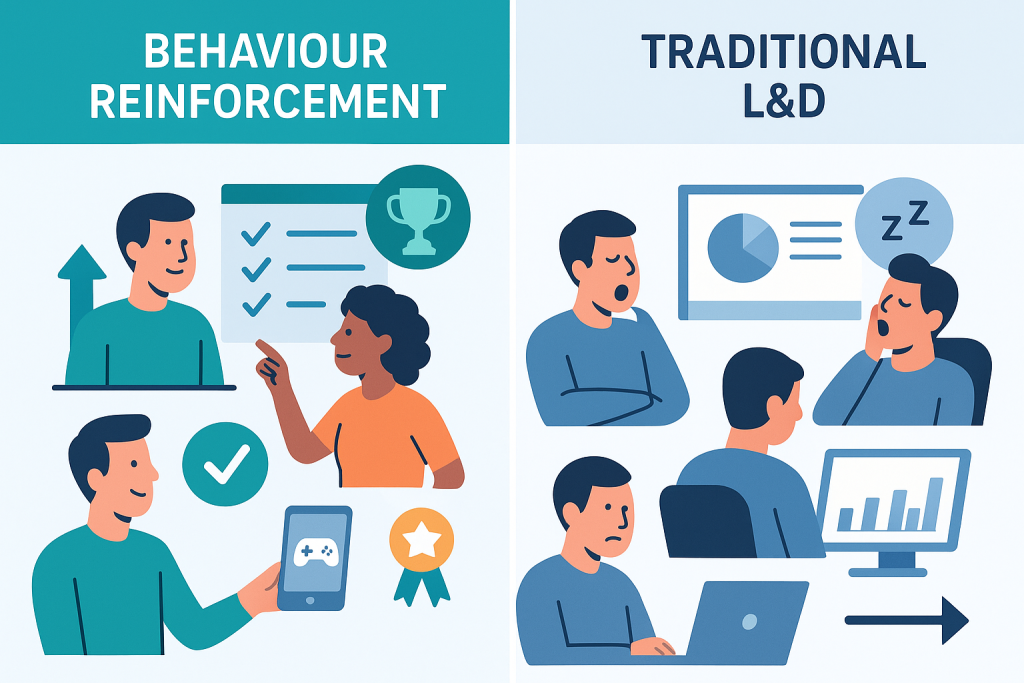

The behaviour reinforcement vs traditional training has emerged as the major strategic divide that defines the way of contemporary capability building. Organisations are still spending big on workshops, courses and training programs, yet the day to day behaviour on the ground can hardly change permanently.
This gap is bridged by reinforcement systems that implement continuous cues, micro-actions, and accountability loops into the normal work process. This change enables CHROs, L&D leaders, and COOs to have better culture adoption, higher training ROI, and more predictable operations.
The path to this transition is provided by Gwork, which offers a system level implementation of the process of behaviour reinforcement, shifting people between knowing to doing.
Why Training Alone No Longer Drives Real Behaviour Change?
Behaviour reinforcement vs traditional training is a significant shift in the capability formation and learning of new working styles by organisations. The conventional training has been based on workshops, courses, and formal classroom experiences that are meant to convey information.
In spite of the fact that training is still useful in terms of awareness building, the decades of learning science and real-life outcomes proved the assumption that only knowledge will lead to behaviour change false. In spite of this, organisations are still spending millions on training initiatives that do not achieve long term behavioural adoption.
The current organisations encounter dynamic problems that require beyond the theoretical knowledge. Remote work, accelerated digital change, greater complexity in operations, and greater cultural demands expect some capabilities to be manifested in exhibited and observable behaviours.
The repetition, context and reinforcement in traditional training events is insufficient to develop habits that are sustained. This gap is bridged by behaviour reinforcement which deals with the actual processes by which individuals learn, store and utilise behaviours with time.
CHROs must have sound access to culture adoption. Leaders in L&D must have quantifiable learning transfer. COOs should have behavioural consistency in operations. These results require reinforcement systems to offer the missing infrastructure to change the emphasis of knowledge acquisition to behaviour execution.
What’s the Difference Between Reinforcement and Training?
Behaviour reinforcement vs traditional training introduces two fundamentally different approaches to capability building. The conventional training is based on formal learning programs, typically being presented in the form of workshops or online courses. These incidents give awareness in the short run but hardly any long term behaviour change since the individual soon gets back into the old habits once the training is over.
The reinforcement systems work based on repetition, timely encouragement, minor actions, and responsibility cycles incorporated in the work. Rather than teaching big blocks, reinforcement breaks down behaviours into observable repeatable micro-actions that create habits with time. Reinforcement is not to be considered in lieu of training, but to complement it and make it even more powerful, providing the circumstances in which the latter may be performed in reality.
Traditional Training
Conventional training emphasizes on content delivery. Information, frameworks, and best practices are shared at a workshop, course, or webinar. Participants can walk away feeling refreshed, but due to the lack of continuous reinforcement, new behaviours are not repeated often enough to qualify as habits.
Trained conceptualization stays as a concept without habitual reminders, practice, or social responsibility.
The typical features of traditional training are:
- Event-based delivery
- High cognitive load
- Minimal practice in practice
- Fast knowledge decay
- No habit formation
This strategy assists in the creation of awareness but has a small effect on behaviour in day-to-day activities. After they resume normal routines, old habits easily crush new ideas among the employees.
Behaviour Reinforcement
The mechanism of behaviour reinforcement works on the basis of continuous and systematic cycles and assists the individuals in inculcating certain behaviour in day-to-day work. Rather than big events, reinforcement is based on small and repetitive behaviors with the assistance of a timely cue and feedback.
The behaviour reinforcement programs allow making regular habits, which remain stable in the face of pressure, competing priorities and changing circumstances.
The main characteristics of behaviour reinforcement are:
- Continuous micro-actions
- Environmental cues
- Workflow embedded practice
- Immediate feedback
- Data-driven iteration
Reinforcement changes behaviour, which is an occasional effort, into habit. This transition generates much higher retention and practical implementation in comparison with traditional training.
Comparison Table
Behaviour Reinforcement vs Traditional Training
| Dimension | Traditional Training | Behaviour Reinforcement |
| Structure | One-off events | Continuous cycles |
| Focus | Knowledge transfer | Habit formation |
| Delivery | Workshops and courses | Cues, nudges, micro-actions |
| Retention | Low due to forgetting curve | High through repetition |
| Application | Delayed and inconsistent | Immediate and contextual |
| Measurement | Rare and subjective | Frequent and behavioural |
Traditional training increases awareness. Reinforcement increases execution. The distinction creates a new category within organisational learning, and Gwork sits at the centre of that shift by providing systematic reinforcement loops that move concepts into sustained behaviours.
What is behaviour reinforcement in the workplace?
Behaviour reinforcement in the workplace is a continuous process, which entails instilling the preferred behaviours via repetition of cues, organized micro-actions, reinforcement loops and data-driven variations.
It associates daily tasks with organisational expectations by instilling habits as opposed to education based on knowledge. Reinforcement makes the abstract competencies an everyday activity, such that people often practise what they have been doing it becomes automatic.
Why doesn’t training lead to real change?
The traditional forms of training seldom bring about real behavioural change since they do not provide the environment of creating a habit. Knowledge is not behaviour. Employees might know what good looks like but still tend to go back to familiar patterns through environmental stimuli, time constraints or cognitive load. New behaviour dies away in days or weeks unless it is reinforced on a regular basis.
The forgetting curve speeds up the deterioration of the remembered information. The brain prioritises theoretical knowledge without repetition or context. Reinforcement breaks this decay by reoccurring the important behaviours and associating them with real life situations.
Executives need behavioural results and not memorization. CHROs need cultural consistency in behaviours. Learning transfer is needed in L&D teams. COOs need reliability in their operations. The effects of reinforcement are manifested by the fact that it maintains the behaviour even after the trainee has been trained.
What is continuous behaviour reinforcement?
Continuous reinforcement of behaviour also offers a continuous loop of cues, prompts, actions and feedback that reinforce behavioural adoption. This method correlates with behaviour science in that it recognizes human habits as a result of repetitive micro-actions as opposed to theoretical knowledge.
The process of continuous reinforcement is based on environmental stimulus, stacking of the habits and use of timely nudges to maintain the behaviours. The cycles being in the flow of work means that the employees develop habits without the pushs that come with traditional training.
Gwork helps maintain behaviour continuity, with automated prompts and structured recipes and data-driven monitoring to offer organisations a viable way of achieving long-term behaviour change.
Reinforcement vs Training Retention
Reinforcement is an important factor in training retention since it provides the conditions in which long-term memory and habit formation takes place. Repetition, contextual clues and little wins create neural avenues which transform behaviours that are consciously learnt to unconscious habits. The case of traditional training provides information and leaves the adoption to chance. Reinforcement makes sure that the behaviours that are being trained are practised to ensure that they become stable.
Executives view retention as a strategic asset. CHROs depend on it to embed cultural values. L&D leaders rely on it to increase ROI. COOs depend on it to reduce variability across teams. Reinforcement provides the operational infrastructure for retention, supporting consistent behaviour across the organisation.
Why Traditional Training Fails to Create Behaviour Change
Traditional training fails to create behaviour change due to several systemic limitations. Workshops frontload too much information at once, overwhelming participants and reducing long-term recall. Learning events occur too infrequently to build or sustain habits. There is no consistent reinforcement to counteract competing priorities and environmental pressures. Without ongoing practice, behaviours deteriorate rapidly.
The absence of measurement further limits impact. Training measures attendance, satisfaction, and abstract knowledge, not real behaviour. Organisations struggle to track whether people execute behaviours correctly, consistently, and at scale. Reinforcement resolves this gap by generating behavioural data and supporting continuous improvement.
For organisations building capability through habits rather than one-off learning events, the Gwork Behaviour Blueprint provides a clear, structured model for defining behaviours, mapping reinforcement loops, and guiding teams toward consistent execution.
How Reinforcement Systems Outperform Training
Reinforcement systems outperform training by focusing on daily execution rather than theoretical understanding. Training introduces new ideas; reinforcement ensures they are practised. Reinforcement shifts the centre of gravity from knowledge to habit, distributing learning across time instead of condensing it into isolated events. This approach mimics how people naturally build habits, leading to reliable behaviour adoption.
Reinforcement systems deliver several advantages:
- Persistent behavioural activation
- Reduced cognitive load
- Higher completion of micro-actions
- Consistent practice in real conditions
- Increased organisational alignment
- Stronger behavioural culture
Also read:- Behavioral Triggers That Improve Employee Consistency
A Simple Reinforcement Framework
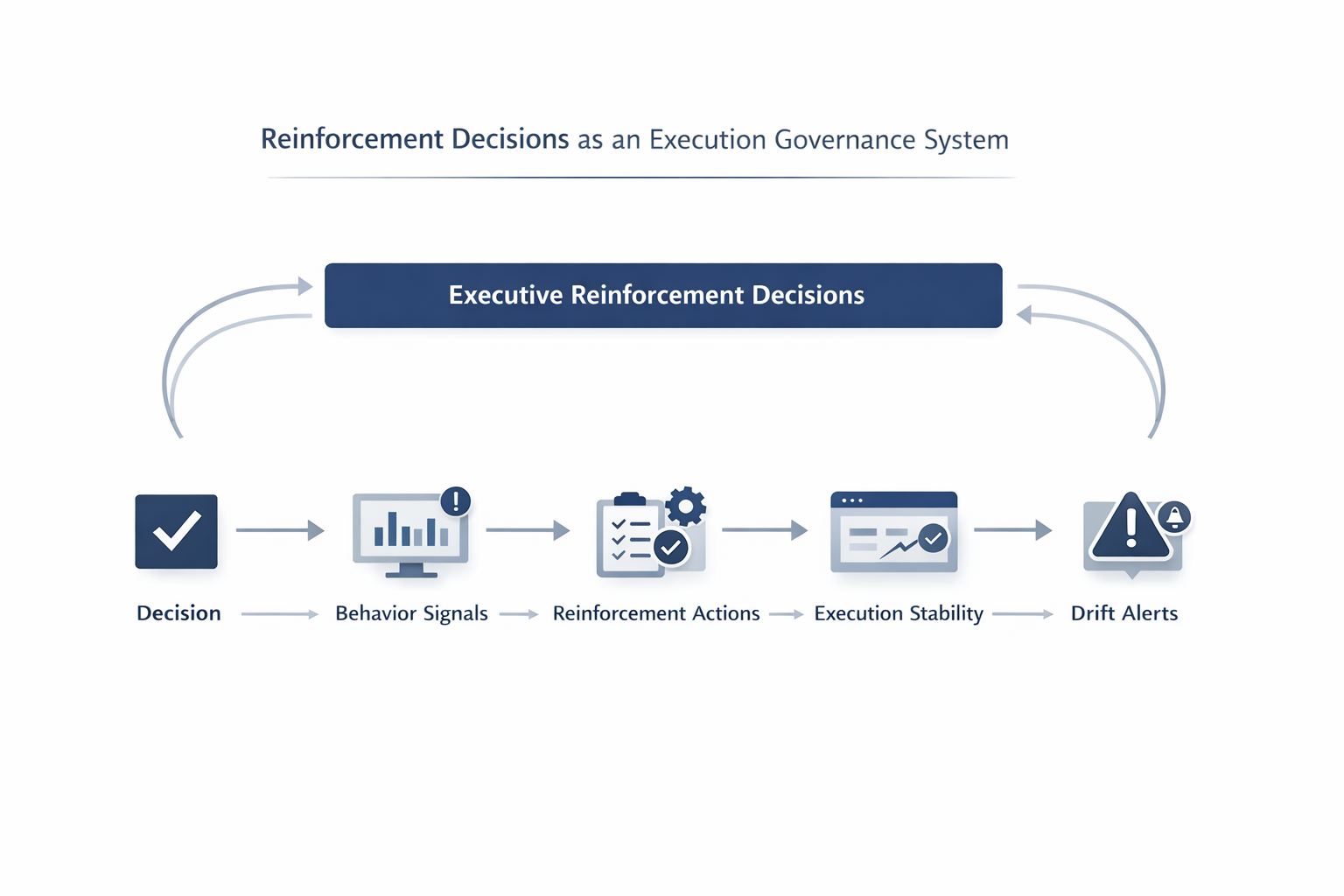
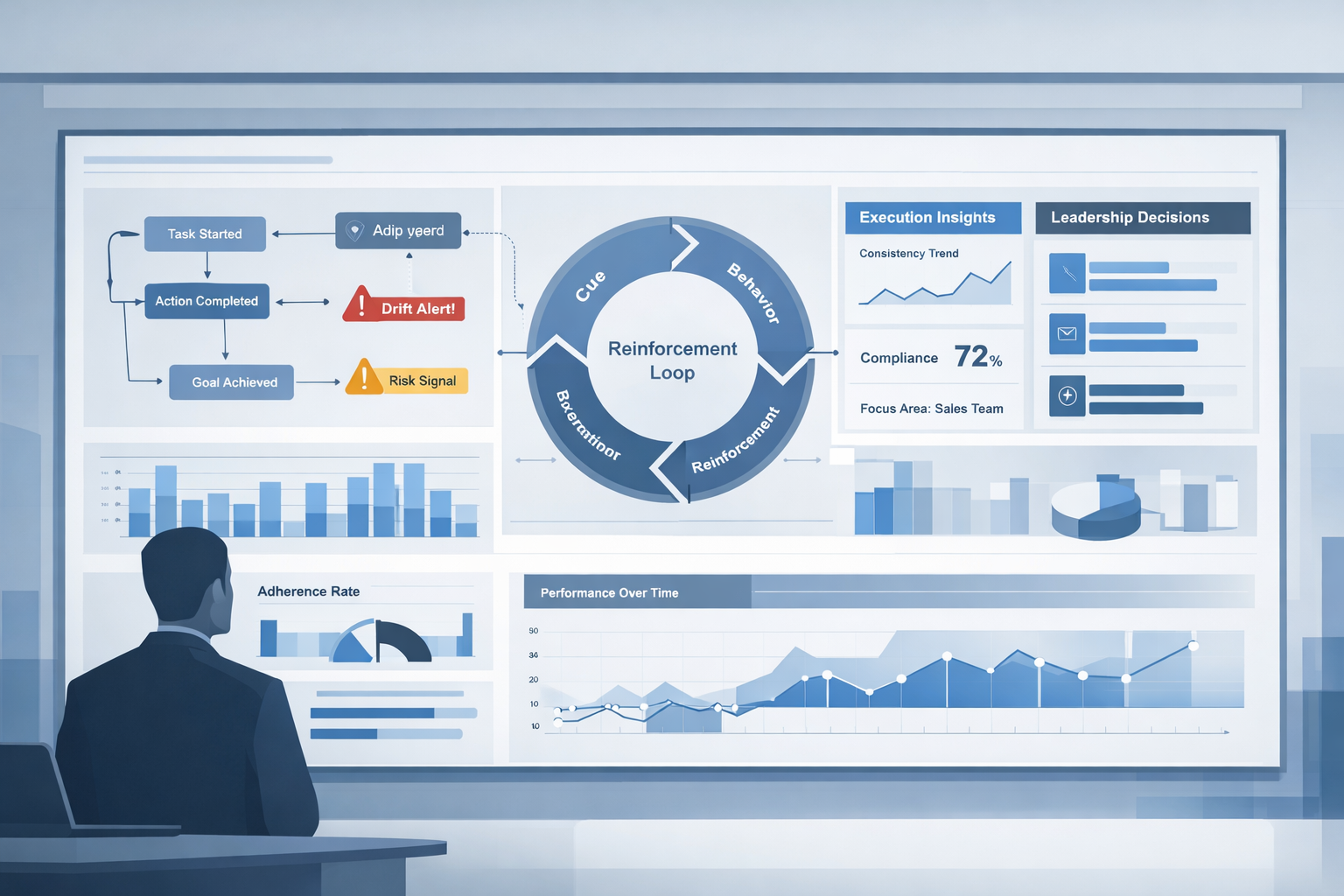
Cue → Behaviour → Reinforcement → Data → Adjustment
This simple behavioural model structures how organisations build and sustain new habits.
Cue
A trigger that prompts the desired behaviour at the right moment. Cues reduce reliance on memory.
Behaviour
A small, observable action that can be repeated within a few minutes. Micro-actions reduce friction.
Reinforcement
Recognition, feedback, or nudges that strengthen the behaviour, increasing the likelihood of repetition.
Data
Tracking of behavioural execution, enabling measurement of consistency and impact.
Adjustment
Iteration based on behavioural data, improving outcomes and providing new cues.
Habit stacking for organisational learning emerges from this loop. Gwork operationalises these cycles across teams, enabling behaviour reinforcement at scale.
Teams looking to turn abstract competencies into simple, repeatable actions can draw on the Gwork Habit Recipes, which break behaviours into practical micro-steps that are easy to reinforce and track across the organisation.
Nudge-Tech Alone vs Nudge-Tech Within a Reinforcement System
Nudge-tech solutions provide reminders, prompts, or notifications that encourage a desired action. While nudges can influence short-term behaviour, they rarely lead to sustained habit formation. Nudges operate as suggestions rather than structured systems. They deliver hints without providing the reinforcement loops required for long-term behavioural adoption.
Reinforcement systems operate differently. Instead of relying on simple notifications, they embed cues within structured behavioural cycles that include micro-actions, reinforcement, measurement, and adjustment. Reinforcement systems provide the architecture for habit formation and behavioural consistency, offering a level of reliability far beyond nudge-based tools.
Gwork positions itself within this second category, offering a comprehensive reinforcement system rather than a reminder engine. This distinction forms a core differentiator within the behaviour change space.
Reinforcement in Corporate Learning: Examples
Reinforcement appears in many high-performing organisations through structured daily practices that encourage behavioural consistency. Leadership development programs often reinforce behaviours such as active listening, coaching conversations, or decision-making clarity through small weekly actions and peer accountability cycles. Sales teams reinforce behaviours like pipeline hygiene, daily outreach habits, and discovery questioning techniques through repeated micro-actions.
Operational teams reinforce safety behaviours, quality checks, and customer service routines through consistent cues embedded in workflows. Culture transformation programs rely on reinforcement to anchor values such as respect, accountability, and transparency into everyday actions. Each example highlights the importance of repetition and context, demonstrating how reinforcement systems outperform training in real-world conditions.
Culture Change That Sticks – Powered by Gwork
Leadership teams accelerate culture adoption through behaviour reinforcement systems powered by Gwork.
Behaviour Reinforcement Programs: What They Look Like
Behaviour reinforcement programs operate through structured cycles that support long-term behavioural adoption. Key components include clearly defined behaviours, contextual cues, timely nudges, small actions, reinforcement loops, and behavioural data. Reinforcement programs break down large competencies into practical actions that employees can perform repeatedly without excessive cognitive load.
Gwork provides the infrastructure for these programs, offering automated cue delivery, behavioural tracking, and habit recipes. Reinforcement programs scale across teams because they rely on simple, repeatable actions supported by technology rather than resource-intensive workshops.
12. Continuous Learning vs Workshops: What the Data Shows
Continuous learning provides sustained exposure to behaviours through frequent repetition, leading to greater retention and behavioural reliability. This approach aligns directly with how neural pathways develop through repeated stimulation. Workshops introduce concepts but do not provide sufficient practice for long-term retention.
Continuous learning distributes practice across weeks or months, allowing behaviours to form naturally and with lower cognitive burden.
Continuous reinforcement counters the forgetting curve by resurfacing behaviours at the right moment. It integrates learning into the flow of work, eliminating the gap between training and real-world application. Behaviour reinforcement programs use micro-actions to maintain steady progress, ensuring that learning remains active.
Persona-Specific Value Section
For CHROs
CHROs require consistent cultural behaviours across the organisation. Reinforcement supports the adoption of values, leadership behaviours, and inclusion commitments by embedding them into everyday actions. Behaviour reinforcement systems strengthen culture and drive organisational alignment through habit-based adoption cycles.
For L&D Leaders
L&D leaders require measurable learning transfer. Reinforcement systems provide a mechanism for tracking actual behaviour, demonstrating ROI through behavioural consistency rather than theoretical knowledge. Reinforcement increases engagement with learning content and ensures that training investments translate into meaningful action.
Value for COOs
COOs require predictable operations and reliable frontline execution. Behaviour reinforcement systems ensure consistency in safety routines, customer interactions, quality checks, and task execution. Reinforcement reduces operational variability by moving behaviours from awareness to habit.
Key Takeaways
- Behaviour reinforcement vs traditional training reflects a major shift toward habit-based behaviour change.
- Traditional training creates awareness but not sustained behavioural execution.
- Reinforcement cycles provide the repetition, cues, and accountability required for long-term habits.
- Continuous reinforcement consistently outperforms workshops in retention and real-world application.
- Gwork provides the system-level reinforcement needed to move organisations from knowledge to behaviour.
FAQs: Behaviour Reinforcement vs Traditional Training
1. What behaviour reinforcement means in the workplace?
Behaviour reinforcement at the workplace is the continuous process of enhancing the desired behaviour by means of constant cues, micro behaviour, timely feedbacks and repetitions. It instils certain behaviours into the routine work process such that it makes them routine habits and not rare attempts. Reinforcement is based on small and regular efforts that help build long-term capability and organisational alignment.
2. How behaviour reinforcement improves training outcomes?
Reinforcement of behaviour enhances better training results as it brings about repetition and context, which lacks in the workshop based learning. Its concepts are introduced through training and retained through reinforcement to make sure that they are practised to the extent that they become sticky. Reinforcement avoids the steep drop in retention rates that usually results when training is conducted at once by integrating cues and micro-actions into daily work.
3. Why traditional training often fails to create lasting behaviour change?
Traditional training is flawed as it offers awareness and not by repetition. Workshops overwhelm individuals with facts and even leave them to practice behaviours independently, without guidelines and without being monitored. Lack of reinforcement enables the old habits to take hold again and the behavioural effect of training disappears in a few days or weeks.
4. How reinforcement systems outperform one-off training events?
The reinforcement systems are better than the traditional training because it allows a steady practice in the long run. Reinforcement gives structured prompts, micro-actions and feedback loops as opposed to memory or motivation. It is a long lasting system of habits and is a stronger real life application method than event based learning.
5. How continuous behaviour reinforcement supports organisational learning?
Constant reinforcement of behaviour makes learning dynamic as it reappears around the time when the behaviour is most needed. It spreads the learning process down to daily and weekly cycles, making the learning process less cognitive and more likely to be retained. This continuous reinforcement develops neural pathways that are linked with the formation of long-term habits and keeps the teams in line with organisational expectations.
6. What habit-based behaviour change means for workplace capability building?
Habit-based behaviour change focuses on small, repetitive behaviours which accumulate in the long run. It does not depend on conceptual knowledge but dwells on the micro-behaviours that generate visible changes in leadership, culture, customer experience, and operational execution. The habit-based approaches make learning a theoretical activity into a day-to-day behavioural activity.
7. How reinforcement applies to leadership, culture, and operational execution?
Reinforcement facilitates leadership by inculcating leadership practices like coaching, communication habits and decision making clarity in the daily activities. It empowers culture by transforming organisational values into practised behaviours. It increases operational performance through strengthening of regular frontline practices and quality levels. Reinforcement produces consistent behaviour patterns in any situation.
8. How Gwork enables behaviour reinforcement at scale?
Gwork is a behaviour reinforcer structured in such a way that it operationalises behavioural data, habits recipes, cues and micro-actions. The reinforcement loops it can result in assist organisations in entrenching leadership behaviours, organisational culture and operation routines to a far greater extent than a mere training programme. Gwork provides the infrastructure required to transfer knowledge to execution.