
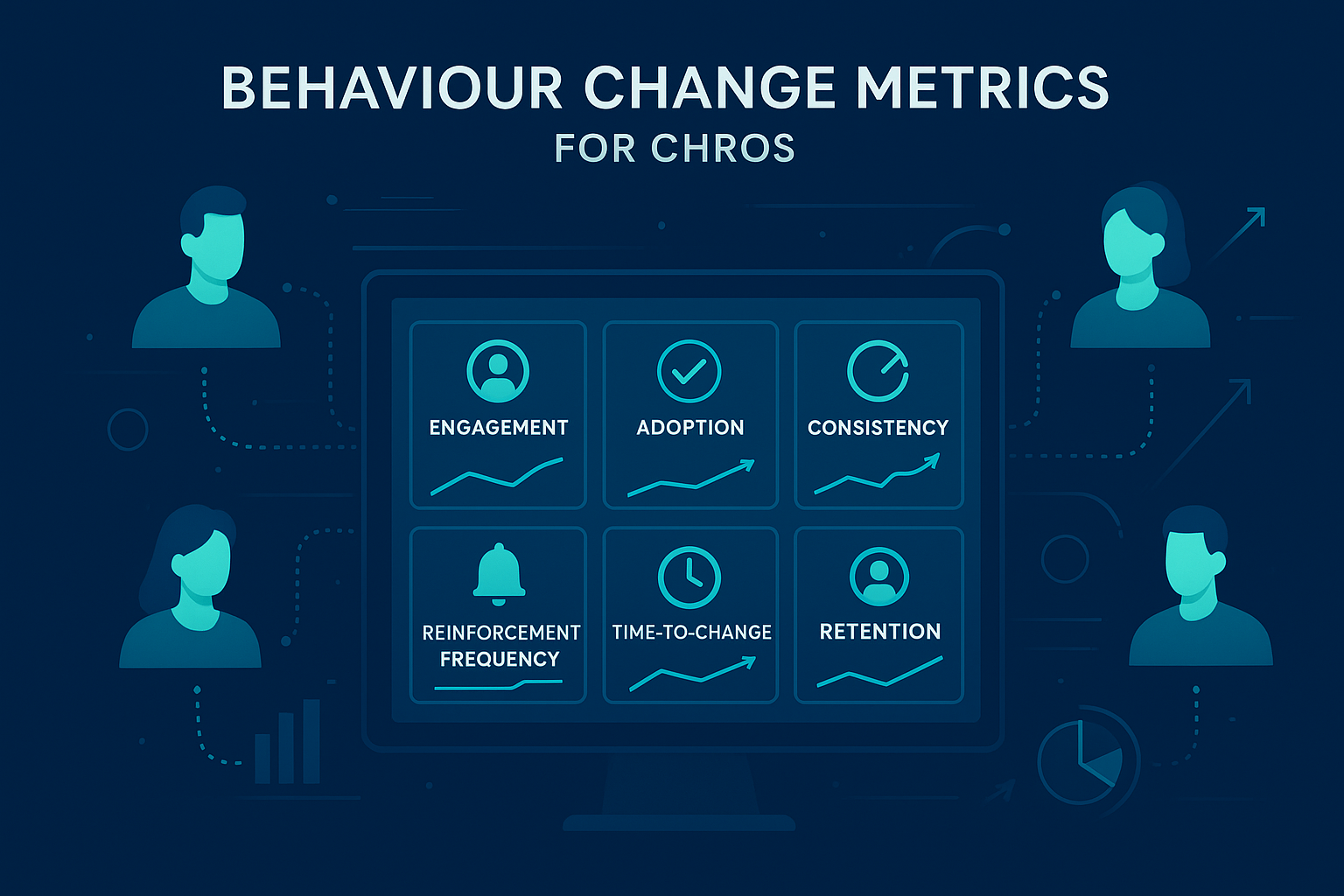

Over the years, organizations have spent a lot of money on training, leadership programs and culture programs. However, the same query by the CEO and board is persistent to many CHROs.
Last updated: April 2026
Are the people really changing the manner in which they work?
Here behavior change metrics come into play. The employee rates of completion, scores on engagement or survey feeling might give you an idea of what the employees think or know. They fail to inform you about what employees do. And culture, performance, and execution is what is ultimately driven by behavior and not intention.
CHROs are being pressurised more as organizations move into 2026 to demonstrate that people strategy delivers business results. The first evidence begins by monitoring the correct employee behavior KPIs.
This article is a breakdown of the seven behavior change measures that any CHRO must follow to gauge actual adoption, habit formation and cultural impact by scale.
Executive Summary: Why Behavior Change Metrics Matter Now
- Training metrics do not prove behavior change or execution readiness.
- Culture change only happens when daily behaviors shift and stick.
- Behavior change metrics give CHROs leading indicators, not lagging engagement data.
- Organizations that track behavior adoption metrics outperform those that rely on surveys and completion rates alone.
Why Behavior Change Metrics Matter More Than Ever for CHROs
The CHRO position has been altered.
The CHRO nowadays is not only in charge of talent and engagement. They must be responsible in workforce preparedness, culture realization, and success in change. That is the ability to answer one important question quite confidently.
Is the behavior of our people changing due to our strategy?
Here behavior change metrics will prove important. In their absence, organizations use assumptions. Leaders believe that training will bring behavior change. They presuppose cascading nature of culture initiatives. They believe that managers are strengthening the correct course of action.
As a matter of fact, the vast majority of organizations do not see through the daily behavior at work.
This is the reason why most organizations are moving beyond the traditional HR metrics and are now putting their focus on attaining behavior change success through actions that are observable and measurable.
This is why leading organizations are shifting from traditional HR metrics to measuring behavior change success through observable, trackable actions.
Training Metrics vs Behavior Change Metrics
Why Traditional Learning Metrics Fail to Prove Behavior Change
Most organizations still rely on a familiar set of learning and people metrics:
- Course completion rates
- Time spent in training
- Post-training satisfaction scores
- Knowledge assessments
These are metrics that can be collected easily and reported. They are also terribly deceptive.
Graduation is not equivalent to practice. Knowledge does not imply action. Satisfaction is not that there are habits formed.
These metrics provide the wrong question in terms of CHRO. They give information on whether employees spent in training. They do not inform you of the employees that altered their behavior in the work place.
This disconnect is particularly dangerous when operating on a massive scale, when rolling out a leadership program, or even to change the workplace culture where consistency is more important than the intent to oversee the execution.
What Behavior Change Metrics Measure Instead
Behavior change metrics focus on what happens after training ends.
They measure:
- Whether employees adopt target behaviors
- How consistently those behaviors are repeated
- Whether behaviors persist over time
- How behaviors impact business outcomes
These are employee behavior KPIs that reflect real-world performance, not theoretical understanding.
| Training Metrics | Behavior Change Metrics |
| Completion rates | Behavior adoption rate |
| Knowledge checks | Habit consistency |
| Engagement scores | Reinforcement frequency |
| Post-course surveys | Behavior impact on KPIs |
For CHROs, this shift moves people analytics closer to business analytics. For COOs, it creates a direct link between behavior and execution. For L&D, it replaces activity metrics with outcome metrics.
The Behavior Measurement Framework CHROs Should Use
Tracking behavior change requires more than isolated data points. It requires a system that reflects how behavior actually changes at work.
This is where a behavior measurement framework becomes essential.
The Behavior Reinforcement Loop
Effective behavior change follows a repeatable loop:
Cue → Behavior → Reinforcement → Data → Adjustment
- Cue: A prompt, context, or trigger that signals the desired behavior.
- Behavior: The observable action taken by the employee.
- Reinforcement: Feedback, recognition, or consequence that strengthens the behavior.
- Data: Measurement of frequency, consistency, and impact.
- Adjustment: Refining cues or reinforcement based on what the data shows.
This loop turns behavior change from a one-time intervention into an ongoing system.
For CHROs, the loop creates visibility into culture execution. For COOs, it provides leading indicators of operational reliability. For L&D leaders, it closes the gap between learning and performance.
Platforms like GWork are designed around this loop, enabling organizations to move from intention-based change to data-driven reinforcement.
The 7 Behavior Change Metrics Every CHRO Should Track
Not all metrics are created equal. The following seven metrics represent the most reliable leading indicators for culture change and execution success.
They focus on daily behavior, habit formation, and reinforcement, not lagging sentiment.
1. Behavior Adoption Rate
Behavior adoption metrics measure the percentage of employees who are performing a defined target behavior.
This is the starting point for any behavior change initiative. If adoption is low, nothing else matters.
Adoption rates answer questions like:
- How many employees are actually using the new safety checklist?
- How many managers are conducting weekly feedback conversations?
- How many teams are applying the new decision-making framework?
For CHROs, adoption rates provide immediate clarity on whether strategy is translating into action. For COOs, they indicate execution readiness. For L&D leaders, they reveal whether learning is transferring to the job.
2. Habit Formation Consistency
Adoption alone is not enough. Sustainable change requires repetition.
Habit formation metrics track how consistently a behavior is performed over time. This moves measurement beyond one-time compliance toward automatic execution.
Consistency metrics answer questions like:
- Are behaviors happening daily, weekly, or only once?
- Are behaviors becoming part of normal workflows?
- Where do behaviors drop off after initial rollout?
For L&D leaders, this metric replaces post-training surveys as a measure of success. For CHROs, it reveals whether culture change is sticking or fading.
3. Daily Behavior Tracking Completion
Daily behavior tracking focuses on small, observable actions that employees can complete regularly.
This metric captures whether employees are engaging in micro-behaviors that compound into larger outcomes. Examples include safety checks, feedback moments, or reflection habits.
Tracking daily actions creates real behavioral data instead of relying on quarterly surveys or annual engagement scores.
For COOs, daily behavior tracking offers early warnings before performance issues emerge. For CHROs, it creates a live view of culture in action.
4. Time to Behavior Proficiency
Time to proficiency measures how long it takes for employees to perform a behavior independently and correctly.
This metric answers a critical question: how quickly does behavior change after intervention?
Shorter timeframes indicate effective reinforcement and clarity. Longer timeframes signal friction, confusion, or insufficient support.
For CHROs, this metric highlights where transformation initiatives are stalling. For L&D leaders, it identifies where learning design or reinforcement needs adjustment.
5. Behavior Drop-Off Rate
Behavior drop-off rate measures how quickly behaviors decline after initial adoption.
This is one of the most important leading indicators for culture change because it shows where initiatives lose momentum.
Drop-off often occurs when:
- Reinforcement stops
- Managers are not involved
- Behaviors are not tied to real outcomes
For CHROs, tracking drop-off prevents silent failure. For COOs, it reduces execution risk. For L&D leaders, it reveals where ongoing reinforcement is missing.
6. Manager Reinforcement Frequency
Managers play a critical role in sustaining behavior change.
This metric tracks how often managers reinforce target behaviors through feedback, recognition, or coaching.
Research consistently shows that behavior change fails without manager reinforcement. Measuring this frequency makes reinforcement visible and actionable.
For CHROs, this metric supports leadership accountability. For COOs, it improves consistency across teams. For L&D leaders, it shifts learning ownership closer to the line.
7. Behavior Impact on Business Outcomes
The final and most powerful metric connects behavior change to performance.
This includes linking behaviors to:
- Safety incidents
- Productivity metrics
- Quality scores
- Customer outcomes
- Retention or absenteeism
These employee behavior KPIs move behavior change from an HR conversation to a business conversation.
For CHROs, this metric builds credibility at the executive table. For COOs, it ties people strategy directly to execution. For the organization, it proves ROI.
See how leading CHROs use GWork to track behavior adoption, habit formation, and reinforcement in real time.
Explore the GWork Behavior Blueprint to see how behavior change metrics work in practice.
Why Nudge-Tech Alone Does Not Measure Behavior Change
Nudge technology has gained popularity as a way to prompt better behavior. While nudges can be useful, they are often misunderstood.
What Nudge-Tech Measures Well
Nudge tools are effective at measuring:
- Engagement with prompts
- Click-through rates
- Reminder interactions
These signals show attention, not execution.
What Nudge-Tech Misses Without a Reinforcement System
Without a reinforcement system, nudge-tech cannot measure:
- Whether behaviors actually occur
- Whether habits form over time
- Whether behaviors impact performance
This is the key distinction.
Nudge-tech alone influences awareness. Behavior reinforcement systems like GWork measure and strengthen execution through continuous feedback, data, and adjustment.
For CHROs, this difference defines the category.
People Also Ask
What are the key metrics for behavior change?
The most important metrics include behavior adoption rate, habit consistency, reinforcement frequency, behavior drop-off, and impact on business outcomes.
How do organizations measure new habits?
Organizations measure new habits through daily behavior tracking, repetition data, and reinforcement loops that show consistency over time.
What is a behavior measurement framework?
A behavior measurement framework links cues, behaviors, reinforcement, and data to create a continuous improvement loop for behavior change.
How CHROs Can Start Measuring Behavior Change This Quarter
Getting started does not require a massive transformation.
CHROs can begin by:
- Selecting three to five critical behaviors tied to strategy
- Defining observable actions
- Tracking behaviors daily or weekly
- Involving managers in reinforcement
- Adjusting based on data, not assumptions
This approach makes culture measurable and execution visible.
For CHROs:
Explore how GWork gives CHROs real-time visibility into behavior change metrics and culture execution.
For L&D Leaders:
See how GWork replaces completion metrics with behavior adoption and habit formation data.
For COOs:
Learn how behavior KPIs reduce execution risk and improve operational consistency across teams.
Key Takeaways
- Behavior change metrics outperform traditional training metrics.
- Habit formation and consistency matter more than one-time adoption.
- Daily behavior tracking creates actionable culture data.
- Manager reinforcement is a leading indicator of success.
- Platforms like GWork make behavior change measurable at scale.
Frequently Asked Questions About Behavior Change Metrics
1. What are behavior change metrics?
Behavior change metrics measure whether employees are actually adopting and sustaining desired behaviors at work. Unlike training or engagement metrics, they focus on observable actions, habit consistency, and real-world execution.
2. What are the most important behavior change metrics for CHROs?
The most important behavior change metrics include behavior adoption rate, habit formation consistency, daily behavior tracking, behavior drop-off rate, manager reinforcement frequency, and the impact of behaviors on business outcomes.
3. How do CHROs measure behavior adoption in the workplace?
CHROs measure behavior adoption by defining clear, observable behaviors and tracking how many employees consistently perform those actions over time. Behavior adoption metrics provide early indicators of culture and execution readiness.
4. How do organizations measure new habits at work?
Organizations measure new habits by tracking the frequency and consistency of daily or weekly behaviors. Habit formation metrics show whether behaviors are becoming automatic rather than one-time actions after training.
5. Why does training not lead to sustained behavior change?
Training often fails to create sustained behavior change because it focuses on knowledge, not reinforcement. Without ongoing feedback, manager involvement, and measurement, behaviors fade quickly after training ends.
6. What is a behavior measurement framework?
A behavior measurement framework is a structured system that links cues, behaviors, reinforcement, and data. It allows organizations to continuously measure, reinforce, and adjust behaviors to drive lasting change and business impact.
Ready to close the strategy-execution gap?




![6 Best 15Five Alternatives for Teams That Want More Than Check-Ins [2026] - engagement, surveys, behavior, leadership, teams](https://gwork.io/wp-content/uploads/2026/04/15five-alternatives-featured.jpg)
![The Complete Guide to Behavioral Change Platforms [2026] - engagement, surveys, behavior, leadership, teams](https://gwork.io/wp-content/uploads/2026/04/behavioral-change-platforms-guide-featured.jpg)
![GWork vs Humu: Behavioral Change Platforms Compared [2026] - engagement, surveys, behavior, leadership, teams](https://gwork.io/wp-content/uploads/2026/04/gwork-vs-humu-featured-3.jpg)
![GWork vs BetterUp: Behavioral Change Platform vs. Coaching Platform [2026] - engagement, surveys, behavior, leadership, teams](https://gwork.io/wp-content/uploads/2026/04/gwork-vs-betterup-featured.jpg)
![6 Best BetterUp Alternatives for Scalable Employee Development [2026] - engagement, surveys, behavior, leadership, teams](https://gwork.io/wp-content/uploads/2026/04/betterup-alternatives-featured.jpg)
![7 Best Lattice Alternatives for Performance That Actually Changes [2026] - engagement, surveys, behavior, leadership, teams](https://gwork.io/wp-content/uploads/2026/04/lattice-alternatives-featured.jpg)