
The programme ends.
The practice
shouldn’t.
Connect your learning programme to workplace commitments, manager support and a useful review of what people try.
Start with the free kit. Discuss your programme when you need help with the follow-through.

“At Tuesday’s review, I’ll give one specific observation.”
One skill.
Watch it become an action.
A fictional feedback-training example. Choose a step to see what changes.
FROM THE TRAINING ROOM
“Give better feedback.”
A useful intention needs a moment to happen.
IN THE WORK
Tuesday. Project review.
The manager helps rehearse the opening. The learner tries the action.
AT THE FOLLOW-UP
Make the next attempt better.
Record the attempt and the evidence. Agree the next support action.
Illustrative example. An attempt does not establish lasting behaviour change.
Start manually. Learn what needs support.
Make the commitment specific.
Illustrative feedback-training example from the kit.
“I’ll communicate better.”
“At the next project review, I’ll discuss one specific observation and ask for the colleague’s perspective.”
Ask for support someone can give.
A short briefing helps the manager understand the action and their role.
Help the participant rehearse the opening of the conversation.
Ask what they tried, what happened and what they need next.
Includes a manager briefing and four adaptable follow-up messages.
See the gaps before drawing conclusions.
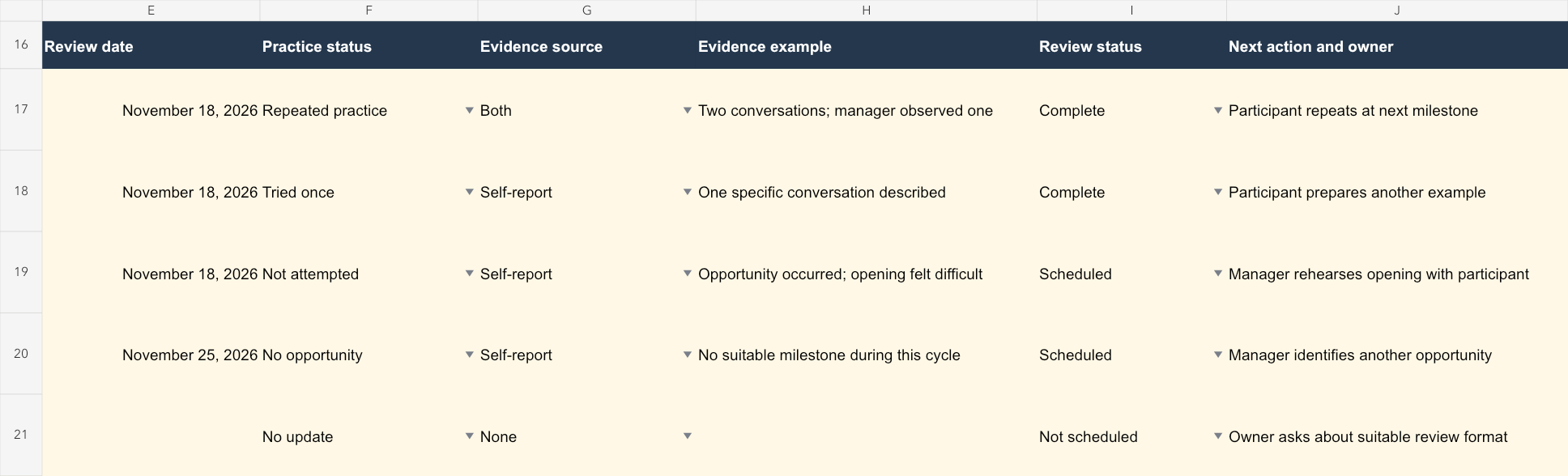
Keep the cohort’s practice status and evidence source separate.
No update · No opportunity · Not attempted · Tried once · Repeated practice
Self-report · Observation · Both · None
Repeated practice is not proof of a lasting habit. The guide explains how to report the limits.
A clear view of
what happened.
The Excel tracker separates practice status from evidence. Missing updates stay visible.
Choose what you need next.
A few practical answers.
What’s included in the download?
A session-to-action planner, behaviour examples, facilitator closing script, participant worksheet, manager briefing, four follow-up messages, an Excel cohort tracker and a review/report template.
Do we need a GWork account?
No. Use the editable resources manually with your existing documents, spreadsheets and messaging tools. The kit does not send automated reminders.
What does the tracker actually measure?
Reported practice, evidence sources and completed review conversations. It distinguishes missing updates and lack of opportunity from reported attempts. It does not establish that training caused a business outcome or that a lasting habit formed.
Must we follow the 30-day schedule?
No. Choose review dates around real opportunities to practise. If a session has already happened, start with the next opportunity and label recalled starting points as retrospective.
Bring one programme. Leave with a next step.
Discuss your cohort, the action learners need to practise and where follow-through gets difficult.