Skip to content


Executive Summary
Leaders cannot wait for revenue, delivery, or performance numbers to reveal that execution has already slipped. By the time outcomes decline, behavior has already drifted – often silently.
Behavior Analytics for Execution gives leaders early visibility into whether critical execution behaviors are happening consistently, drifting, or breaking altogether – long before dashboards change.
Reinforcement systems, embedded inside behavior analytics, stabilize follow-through across teams and prevent silent execution drift.
Platforms like Gwork help leaders see behavior patterns in real time, intervene precisely where execution is at risk, and maintain reliable performance under real-world conditions.
Why Execution Breaks Before Results Decline – And What Leaders Must Govern Next
Most leadership teams believe execution is working – until results prove otherwise.
Revenue declines, delivery slips, customer complaints rise. Only then does execution become a priority. By that point, intervention is already late.
The problem is not poor strategy, weak talent, or lack of communication.
The problem is invisible execution drift.
Execution rarely fails suddenly. It degrades quietly as critical behaviors lose reinforcement, workflows bend under pressure, and follow-through becomes inconsistent after leadership attention moves on.
Traditional dashboards cannot surface this early. KPIs are lagging indicators. They report outcomes after execution has already broken.
Behavior is the leading execution system.
Behavior Analytics for Execution gives leaders visibility into whether agreed execution behaviors are:
- holding steady,
- drifting under real conditions, or
- breaking entirely – long before results change.
When embedded with reinforcement systems, behavior analytics allows leaders to govern execution stability, not react to failure. It shifts leadership from post-hoc problem solving to preemptive execution control.
Execution reliability is not accidental.
It is designed, monitored, and reinforced – or it erodes.
Why Leaders Should Care
CHROs
Engagement, culture programs, and learning metrics may look strong – while daily execution quietly drifts.
COOs
Operational KPIs can remain green – even when handoffs, follow-through, and process reliability are degrading underneath.
L&D Leaders
Course completion does not equal execution. Without reinforcement loops, knowledge rarely becomes sustained behavior.
Understanding where behavior is drifting allows leaders to intervene early – before outcomes shift, customers feel the impact, or execution reliability erodes.
Behavior Analytics for Execution: The Anchor Leaders Need
Execution reliability is not primarily a people problem.
It is a system problem:
- behaviors
- cues
- reinforcement
- leadership follow-through
- drift visibility
Behavior Analytics for Execution becomes the leadership anchor because it connects behavior to governance – not compliance.
What it gives leaders
1. Visibility beyond dashboards
Leaders see whether the right behaviors are consistently happening – not just whether numbers look good.
Insight → Where execution is holding, drifting, or silently breaking.
2. Identification of drift points
Behavior analytics reveals where loops are incomplete, handoffs stall, or reinforcement is missing.
So leaders can decide where to intervene before results change.
3. Guidance for leadership intervention
Leaders don’t guess. The data shows where to reinforce behaviors, adjust processes, or realign priorities.
Insight supports decision – not reporting.
4. Integration with Gwork
Gwork turns behavioral insight into action:
- track execution loops in real time
- detect drift earlier
- reinforce at the right points
- stabilize follow-through across teams
Leaders move from reactive problem-solving to proactive execution governance.
Traditional Metrics vs. Behavior Signals
Most organizations rely almost entirely on performance dashboards.
But:
Traditional metrics tell you what already happened.
Behavior signals tell leaders what is happening now.
Leaders who wait for metrics are always reacting too late.
Behavior analytics allows leaders to decide earlier:
- where to reinforce
- where to intervene
- where execution is drifting
- where reliability is at risk
This is the strategic distinction between managing outcomes and governing execution.
👉 Execution problems usually appear in lagging metrics first – but the real signal sits in Leading vs Lagging Indicators that show drift earlier.
Where Execution Breaks Before Anyone Notices
Execution failure rarely starts with big mistakes.
It starts with subtle breakdowns leaders can’t see.
Common drift points:
Process Drift
Teams quietly deviate from the intended workflow because “this is faster.”
Skipped Reinforcement Loops
Cues, feedback, and follow-through are ignored – behavior loses stability.
Interrupted Handoffs
Critical actions pass between teams with delay, ambiguity, or partial completion.
Assumed Alignment
Leaders assume alignment exists simply because issues are not reported.
Normalization of Workarounds
Temporary solutions become standard practice – and reliability erodes.
These cannot be spotted on a performance dashboard.
They require execution visibility – not just KPI monitoring.
Reinforcement vs Training: Why Knowledge Alone Fails
Training explains what should happen.
Reinforcement ensures it actually happens – repeatedly.
| Aspect | Training | Reinforcement System |
| Purpose | Awareness + skill building | Stabilize execution behavior |
| Duration | Short-term | Continuous |
| Outcome | Knowledge acquired | Reliable follow-through |
| Feedback | Delayed | Immediate + looped |
| Leadership Role | Minimal | Central to governance |
Interpretation:
Training increases understanding.
Reinforcement stabilizes behavior loops so execution doesn’t drift.
👉 Leaders who want to see which behavior signals actually stabilize execution should read Behavioral KPIs That Stabilize Execution.
A Simple Reinforcement Model Leaders Can Govern
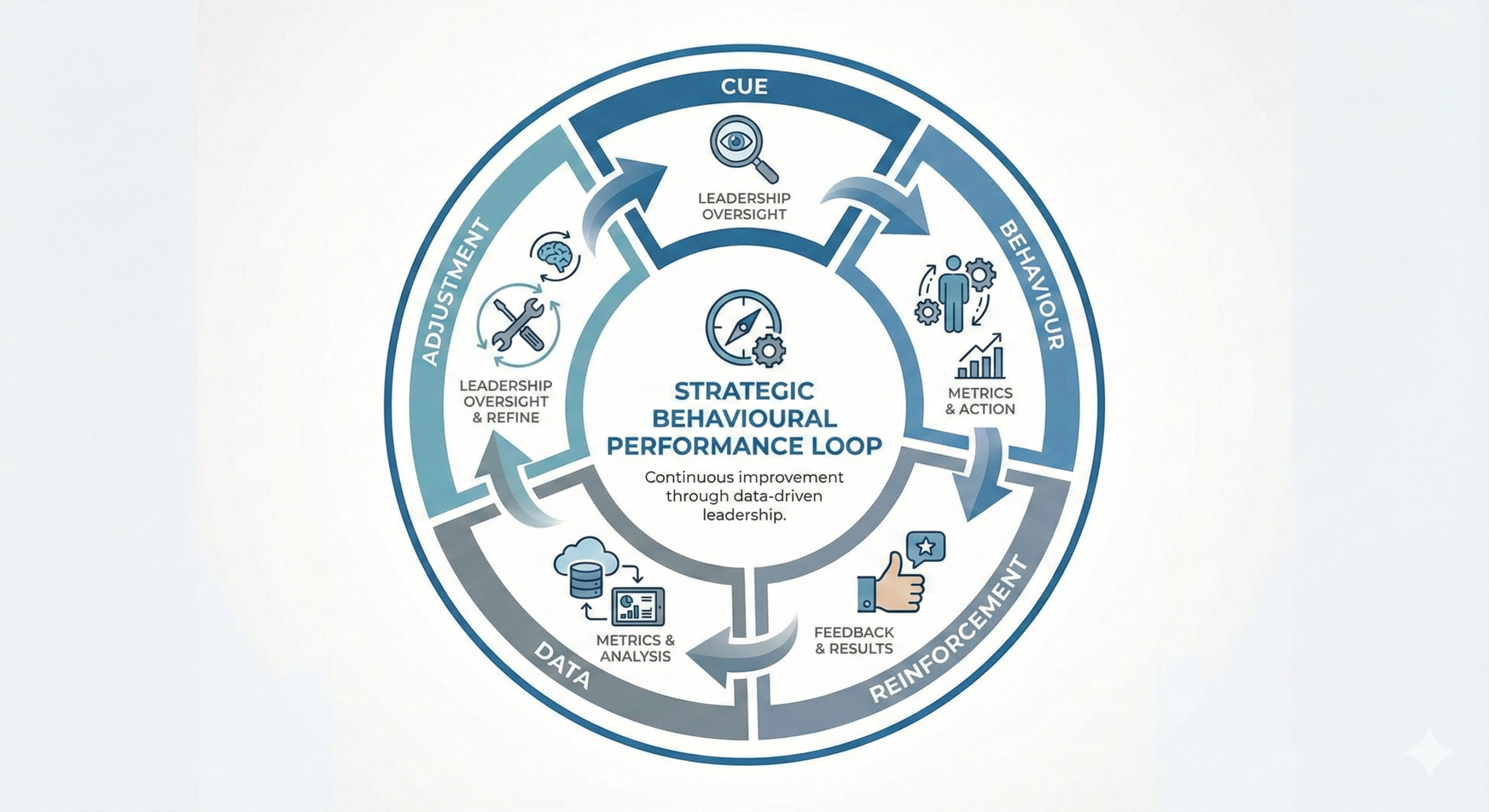
Cue → Behavior → Reinforcement → Data → Adjustment
Step 1: Cue
Signals that trigger execution.
Leaders ensure cues are visible, timely, and unambiguous.
Step 2: Behavior
Teams execute the action.
Leaders verify whether execution matches intent – not assumption.
Step 3: Reinforcement
Feedback and recognition stabilize repetition.
Step 4: Data
Behavior data reveals patterns, drift, and loop completion.
Step 5: Adjustment
Leaders intervene where drift appears – before outcomes shift.
Reinforcement systems inside behavior analytics keep execution stable under pressure.
Nudge-Tech Alone vs Nudge-Tech Inside Reinforcement
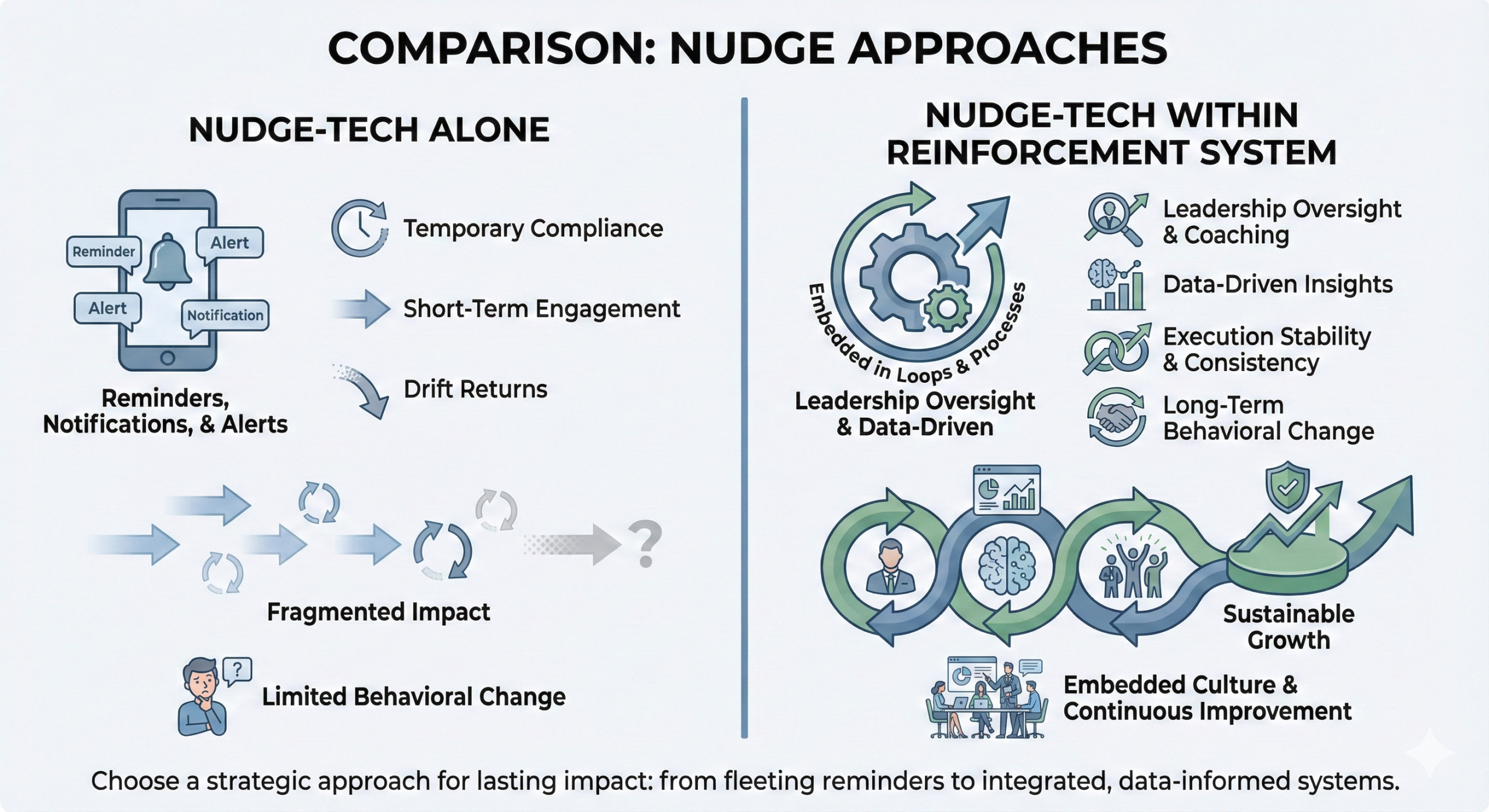
Nudge-Tech Alone
- reminders only
- temporary compliance
- drift returns quickly
Nudge-Tech Inside Reinforcement
- governed by leadership
- measured using behavior analytics
- creates stable execution patterns
Nudges don’t fix drift.
Governed reinforcement systems do.
Measurement Only Matters When It Enables Decision
Measurement is not the objective.
Leadership decision quality is.
Behavior analytics exists to:
- reveal failure points
- guide intervention
- prevent drift
- stabilize execution loops
For leaders:
CHROs
See behavior drift across programs – not just employee sentiment.
COOs
Spot weak operational handoffs before they slow delivery.
L&D
Measure reinforcement and application – not just training completion.
Executive Scenario: Early Signals vs Late Reactions
A leadership team noticed that one critical behavior – daily follow-through checks – fell below its normal pattern for two weeks.
KPIs were still flat.
Nothing “looked wrong.”
Behavior analytics surfaced the drift early.
Instead of launching a large restructuring review, leadership reinforced the single behavior loop and reset expectations.
Within six weeks:
- execution stabilized
- handoffs improved
- outcomes strengthened – without radical change
This is the difference:
Leaders reacting to outcomes vs. leaders governing execution.
Key Takeaways
- Execution breaks before results decline.
- Behavior Analytics for Execution reveals drift early.
- Reinforcement systems – not training alone – stabilize execution.
- Nudge-tech only works when embedded in governance.
- Measurement exists to support leadership decisions – not reporting.
👉 If you’re new to the concept, start with What Is Behavior Analytics – it sets the foundation for everything that follows.
Leadership Actions: What to Do Next
Leaders should:
- Shift from dashboard-driven reporting to execution visibility.
- Look for drift in processes, handoffs, and reinforcement – not just results.
- Decide where to reinforce behavior before outcomes change.
- Govern loops, not events.
- Use platforms like Gwork to see execution patterns in real time.
Execution reliability is not accidental.
It is governed.
Take Control of Execution Before Results Decline
Don’t wait for KPIs to expose problems.
With Gwork, leaders gain visibility into:
- behavior loops
- reinforcement gaps
- execution drift
– and can intervene early to maintain reliability.
👉 Book a Gwork walkthrough and see where execution breaks before results decline.
Ready to close the strategy-execution gap?