
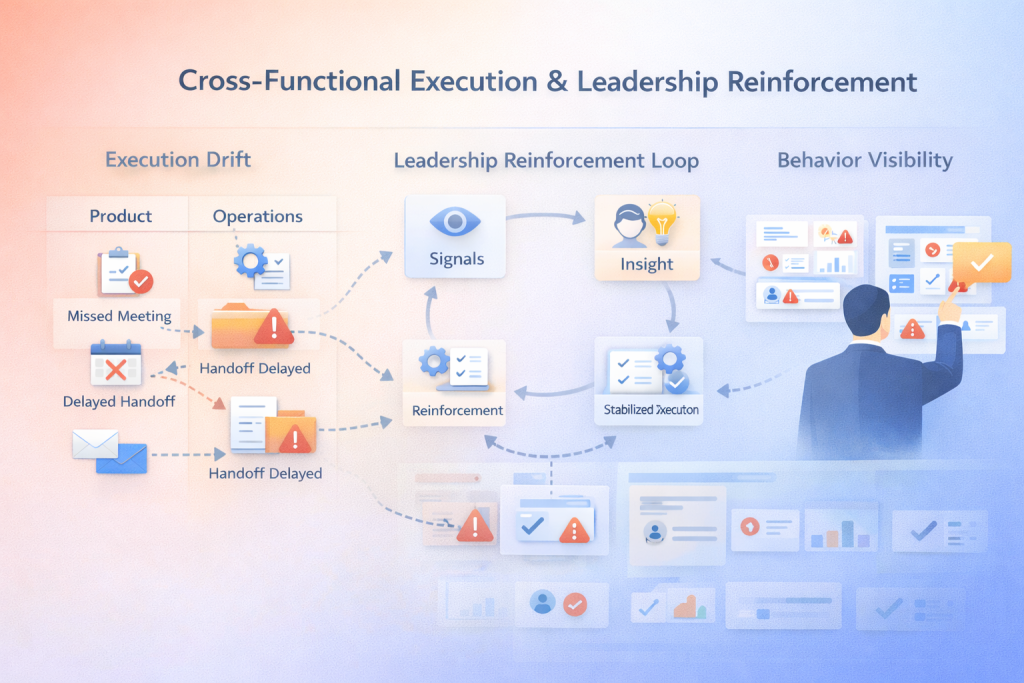

Most cross-functional initiatives don’t fail because the strategy was wrong.
They fail on an ordinary Tuesday morning.
The plan is approved. Roles are clear. Everyone aligns.
Then daily work takes over.
Sales chases targets. Operations clears backlogs. Product fights fires.
The cross-team commitments that felt critical last week slowly become optional.
No one cancels them.
They simply fade.
A review is skipped.
A handoff is late.
An escalation waits.
Weeks later, results slip – and leaders wonder what changed.
Nothing dramatic happened.
Follow-through weakened.
That quiet erosion is what breaks most cross-functional execution.
Not capability.
Not motivation.
Not effort.
But a lack of visibility into whether the few actions that hold teams together are actually happening.
1. Execution Drift Starts Inside Ordinary Work
Execution rarely collapses all at once.
It erodes in small, forgettable moments.
Consider a simple example.
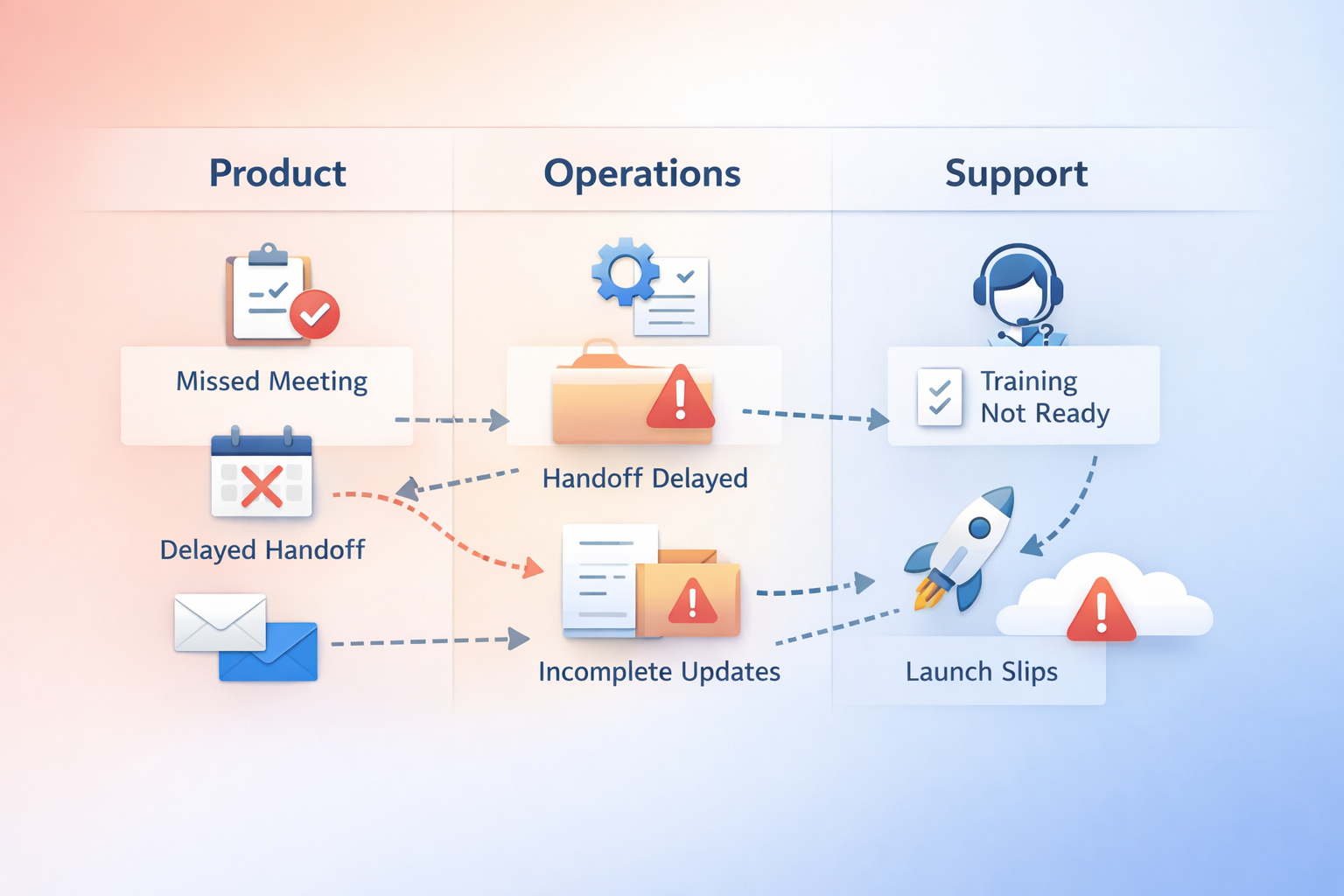
A product launch depends on three teams:
- Product finalizes scope
- Operations prepares readiness
- Support trains agents
Leadership sets one rule: a weekly cross-team readiness review every Friday.
At first, it works.
Then one week gets busy. The meeting moves.
The next week only two teams join.
Notes aren’t shared.
Risks surface late.
Days before launch, Operations discovers missing documentation.
Support isn’t trained.
The release slips.
Nothing failed dramatically.
But the one behavior that kept teams aligned – the weekly review – weakened.
That’s how most problems start.
Not with bad strategy.
With skipped follow-through.
And by the time results show it, recovery is expensive.
Managing outcomes alone is always too late.
👉 Read also: – Leadership Insight: Identifying Execution Drift Before Results Decline
2. Leadership’s Job Is to Stabilize the System, Not Push People Harder
When cross-team efforts stall, organizations usually react with more pressure.
More meetings. More reports. More reminders.
But pressure doesn’t create reliability.
Design does.
Execution isn’t a motivation problem. It’s a system problem.
If critical steps are easy to skip, they will be skipped.
If key moments aren’t visible, leaders can’t reinforce them.
So the job isn’t to push harder.
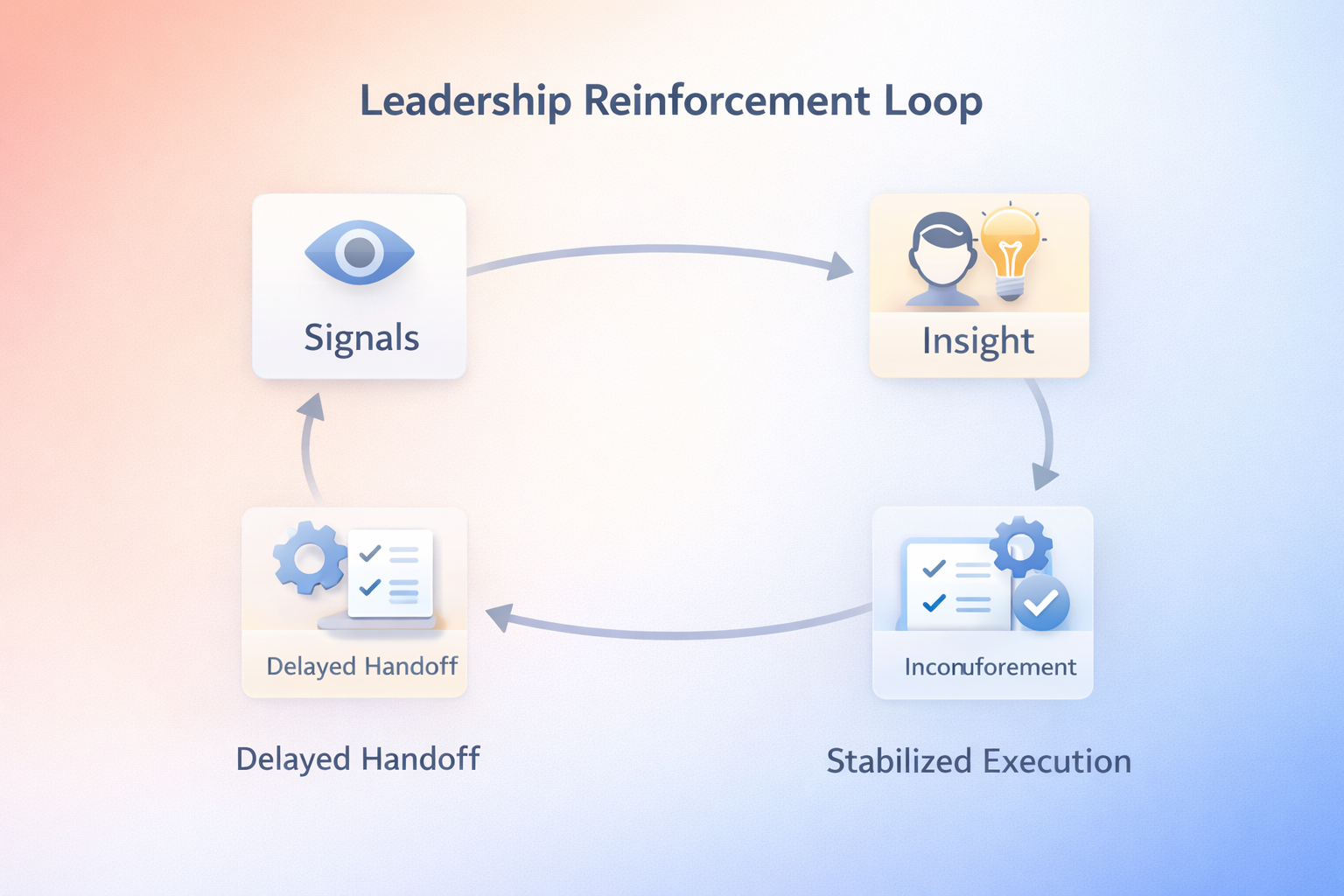
It’s to make follow-through visible, simple, and consistently reinforced.
Effective leaders don’t ask,
“Why aren’t teams aligned?”
They ask,
“Which step is breaking first?”
That question leads to fixes.
3. Behavior Visibility Lets Leaders Act Early
Results are lagging indicators.
By the time a KPI moves, the damage already happened.
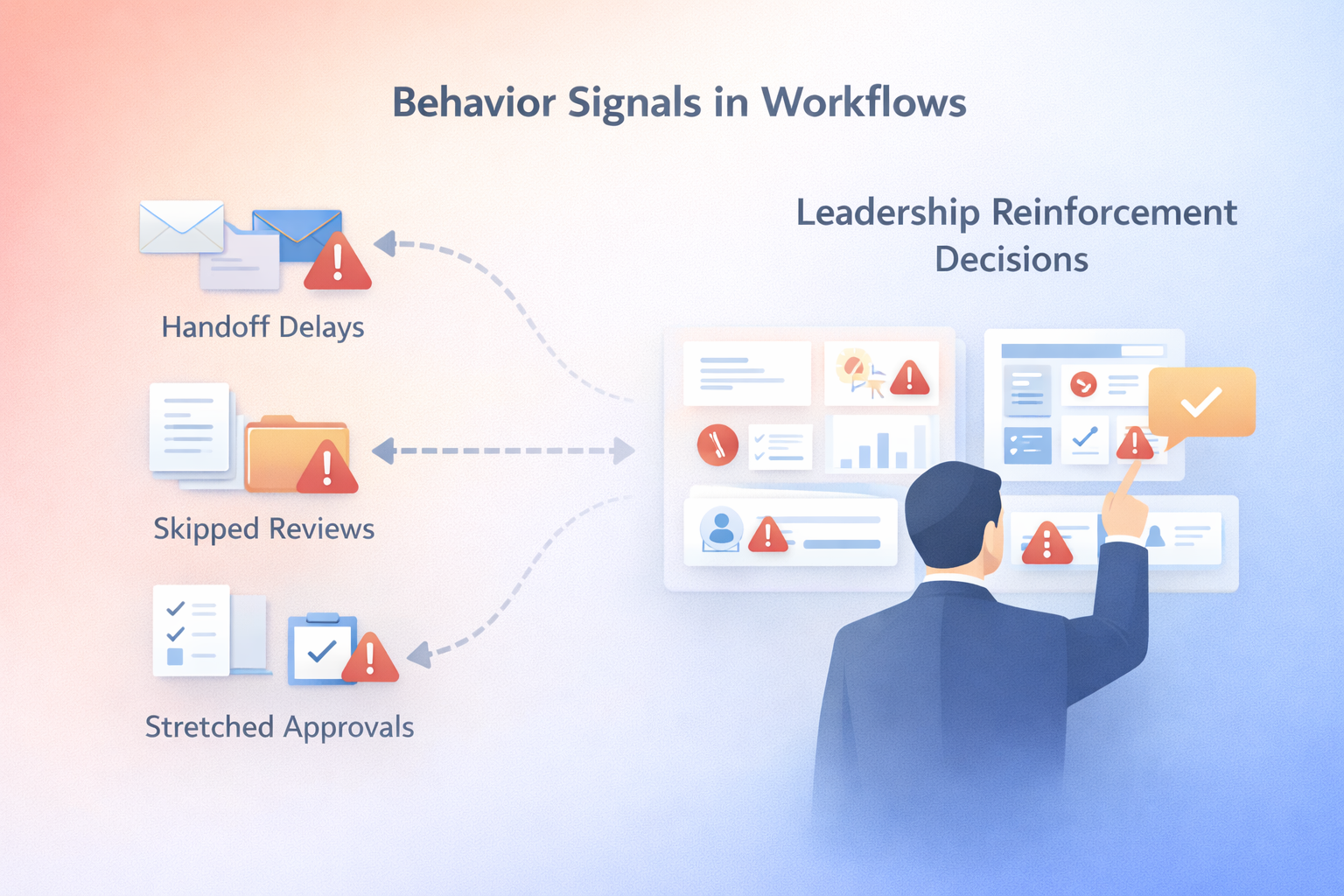
Behavior data shows what’s happening earlier.
Not opinions.
Not surveys.
Observable actions inside workflows.
For example:
Before delivery delays:
-
handoffs slow
-
approvals stretch
-
checkpoints get skipped
Before quality issues:
-
reviews shorten
-
testing steps reduce
-
escalations happen later
Before costs rise:
-
rework increases
-
cross-team decisions stall
These are not performance judgments.
They’re execution signals.
When leaders can see them weekly, decisions become obvious:
-
reinforce this review
-
add visibility to this handoff
-
simplify this approval
-
remove this unnecessary step
Small corrections early prevent large failures later.
This is what Behavior Analytics for Execution provides.
Not surveillance.
Not productivity tracking.
But objective visibility into whether critical follow-through is happening.
Once leaders see that clearly, Cross-Functional Execution becomes predictable.
Not heroic.
Not dependent on constant attention.
Just stable.
Because the few actions that matter are consistently reinforced.
Closing Thought
Strategy sets direction.
Follow-through determines results.
Execution rarely breaks loudly.
It drifts – one missed step at a time – until outcomes finally expose it.
Leaders who wait for results react too late.
Leaders who watch behavior keep strategy alive.
Execution doesn’t fail from lack of effort.
It fails from lack of visibility.
Cross-functional execution doesn’t fail from bad plans. It fails when leaders stop seeing what actually happens.
Ready to close the strategy-execution gap?
