

Most strategies don’t fail dramatically. They fade quietly.
Last updated: April 2026
On Monday morning, operations take over:
Sales pushes deals. Support handles tickets. Finance closes the month. Product fixes issues.
The strategic priorities everyone aligned on last week begin to slip.
A weekly review is skipped.
A safety check happens “later.”
A cross-team handoff loses clarity.
An escalation takes two days instead of two hours.
Nothing appears broken.
Yet execution begins to drift.
By the time results drop, it’s already too late.
This is not a motivation problem.
It’s not a training problem.
It’s a timing problem.
Leaders notice failure only after it shows up in outcomes.
Early Intervention Strategies exist to act before failure, not after.
Execution Drift Happens Long Before KPIs Move
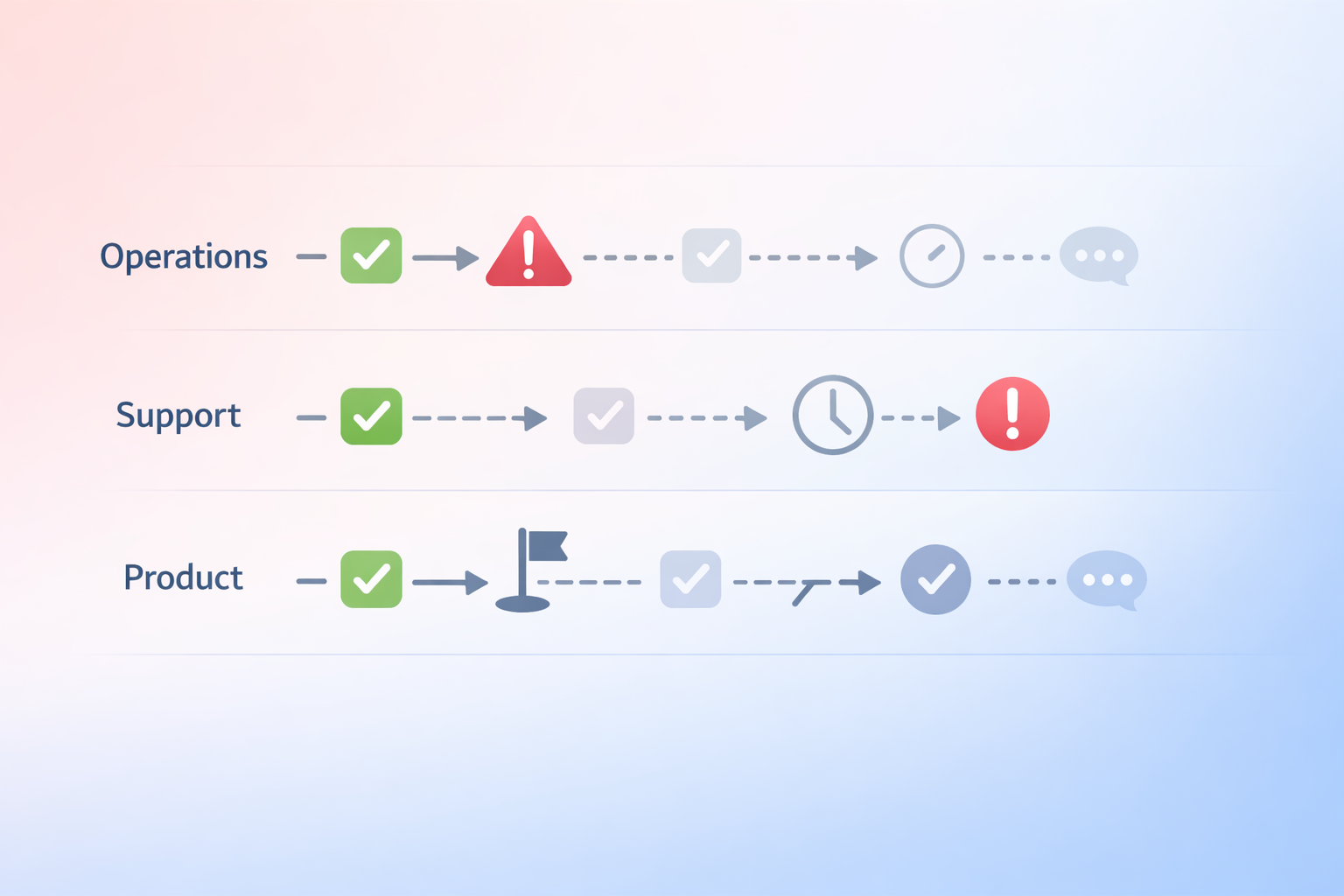
Execution rarely collapses suddenly. It weakens gradually.
Small misses compound:
- a missed checkpoint
- a delayed approval
- a skipped follow-up
- a review that becomes “optional”
Each looks harmless alone. Together, they alter outcomes.
A COO doesn’t wake up to broken operations. They wake up to results that suddenly decline – with no clear explanation. The causes began weeks earlier.
Real Example:
A logistics team commits to same-day dispatch.
- Week 1: all good
- Week 2: one late handoff
- Week 3: two missed reviews
- Week 4: dispatch accuracy drops
- Week 6: customer complaints spike
The KPI dropped in week six. The drift began in week two. Leadership only saw the last step. That gap is where most execution failures live.
Why traditional approaches miss this:
Organizations often rely on:
- quarterly reviews
- engagement surveys
- performance summaries
- outcome dashboards
These are late signals. They tell you what happened, not what is starting to weaken.
The result? Large, reactive interventions:
- new initiatives
- new training
- new messaging
But the problem wasn’t knowledge. It was fading follow-through.
Reliable execution requires seeing drift early, while it’s still small. That is the foundation of effective Early Intervention Strategies.
The Leadership Role: Governing Follow-Through, Not Managing People
Many companies confuse execution with HR, motivation, or engagement issues.
It isn’t. Execution reliability is a leadership governance issue.
The job is not:
“Get people to try harder.”
The job is:
“Make critical actions happen consistently under real conditions.”
Motivated people will still fail in unstable systems. Handoffs may be unclear, reviews unscheduled, priorities shifting – follow-through breaks despite effort.
What leaders actually control:
- Which actions matter most
- Where attention goes
- Which checkpoints are non-negotiable
- What gets reinforced weekly
These decisions shape reliability.
The Early Intervention Mindset:
Reactive leadership asks:
“We missed the target. What went wrong?”
Early intervention leadership asks:
“Where is follow-through starting to loosen?”
This question changes timing. Leaders protect stability before failure shows up.
Example in practice:
A Head of Operations notices weekly safety reviews dropping from 95% to 82%. No incident yet.
- Traditional response: ignore until something breaks
- Early intervention response: reintroduce review cadence, clarify ownership, make completion visible, reinforce expectations
Small actions, early timing, problem contained. No fire drill needed.
For executives, this approach delivers:
- Less firefighting
- Fewer escalations
- Fewer surprises
- More predictability
Predictability, not heroics, is what operations leaders truly want.
Visibility and Reinforcement Systems Enable Early Action
You cannot intervene early if you cannot see early.
Many organizations fail here:
- They collect too much abstract data
- Or rely on gut feeling
Neither supports timely decisions. Leaders need simple, objective visibility into follow-through – not surveillance, not activity counting – just clarity on whether critical steps happen consistently.
What useful visibility looks like:
- Handoff completion rate
- Checkpoint adherence
- Review cadence stability
- Response time consistency
- Escalation closure time
These signals show whether execution is holding together.
Reinforcement turns insight into action:
Every signal must lead to a decision:
- If a checkpoint drops, what changes this week?
- If response time slows, what gets reinforced?
- If reviews fade, what becomes mandatory again?
This is reinforcement: structural support inside daily work, not reminders or motivational emails.
Practical examples:
- Fixed weekly reviews on calendars
- Automated workflow triggers
- Clearly assigned ownership
- Visible completion dashboards
- Standing follow-ups
When reinforcement is embedded in workflow, follow-through becomes natural. Without it, drift returns.
The simple model leaders use:
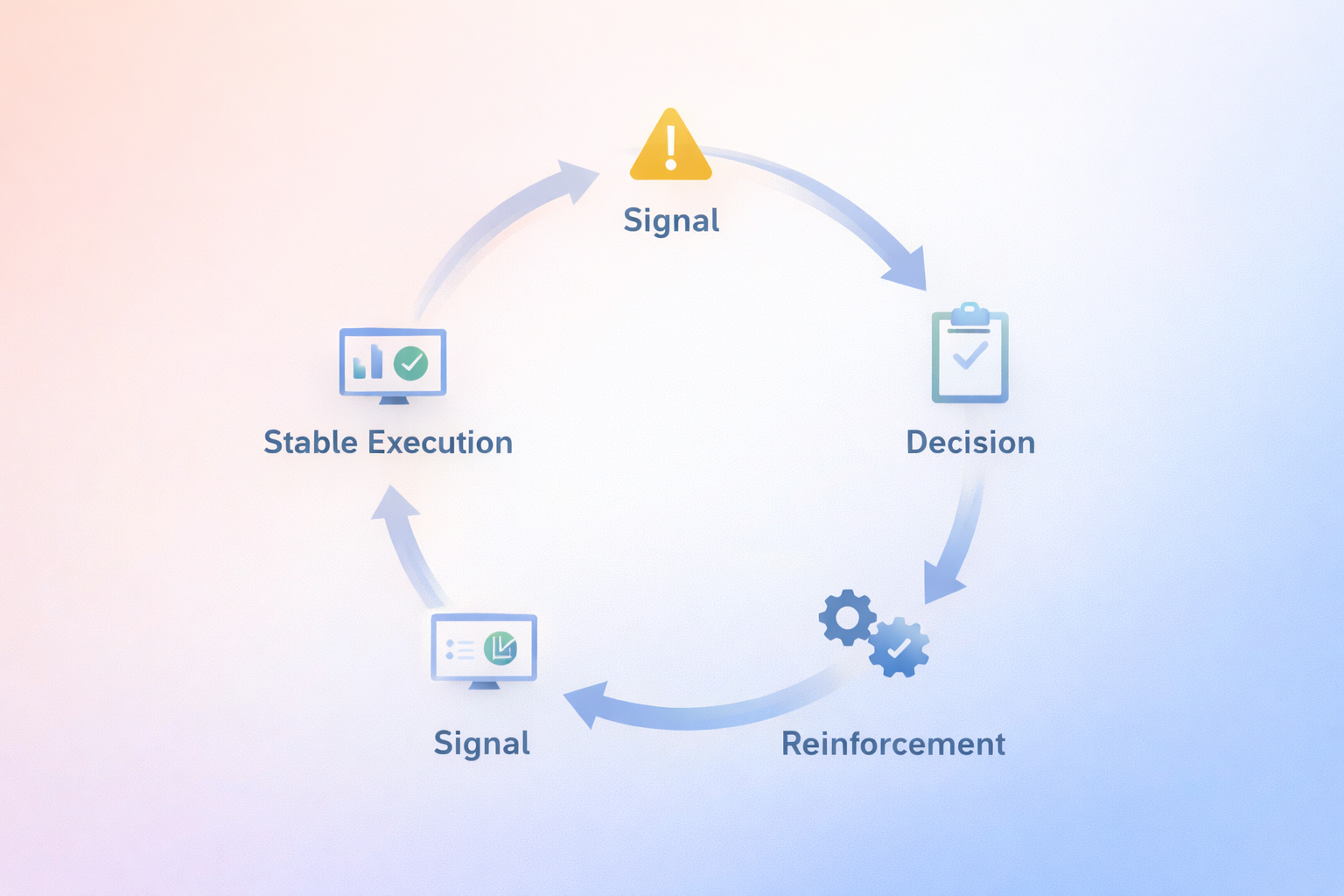
Signal → Leadership Decision → Reinforcement → Stable Execution → Next Signal
No complexity, no heavy frameworks. Just a rhythm: See early. Decide fast. Reinforce quickly. Repeat.
Why this differs from HR or engagement tools:
- Engagement asks: “How do people feel?”
- Performance asks: “How did they do?”
- Early Intervention asks: “Is execution holding together right now?”
Only the last one enables prevention. Prevention is always cheaper than recovery.
Key Takeaways
- Execution failure begins as small drift, not sudden collapse
- Leaders must govern conditions, not manage effort
- Early signals enable small, low-cost corrections
- Reinforcement inside workflows maintains stability
- Reliable follow-through beats heroic recovery
Final Thought
Most organizations fix execution after outcomes drop.
The best protect it before it weakens.
Execution doesn’t fail loudly. It drifts quietly. Leadership exists to catch it early.
Reliable execution isn’t rescued at the finish line – it’s preserved every day through Early Intervention.
Ready to close the strategy-execution gap?
