
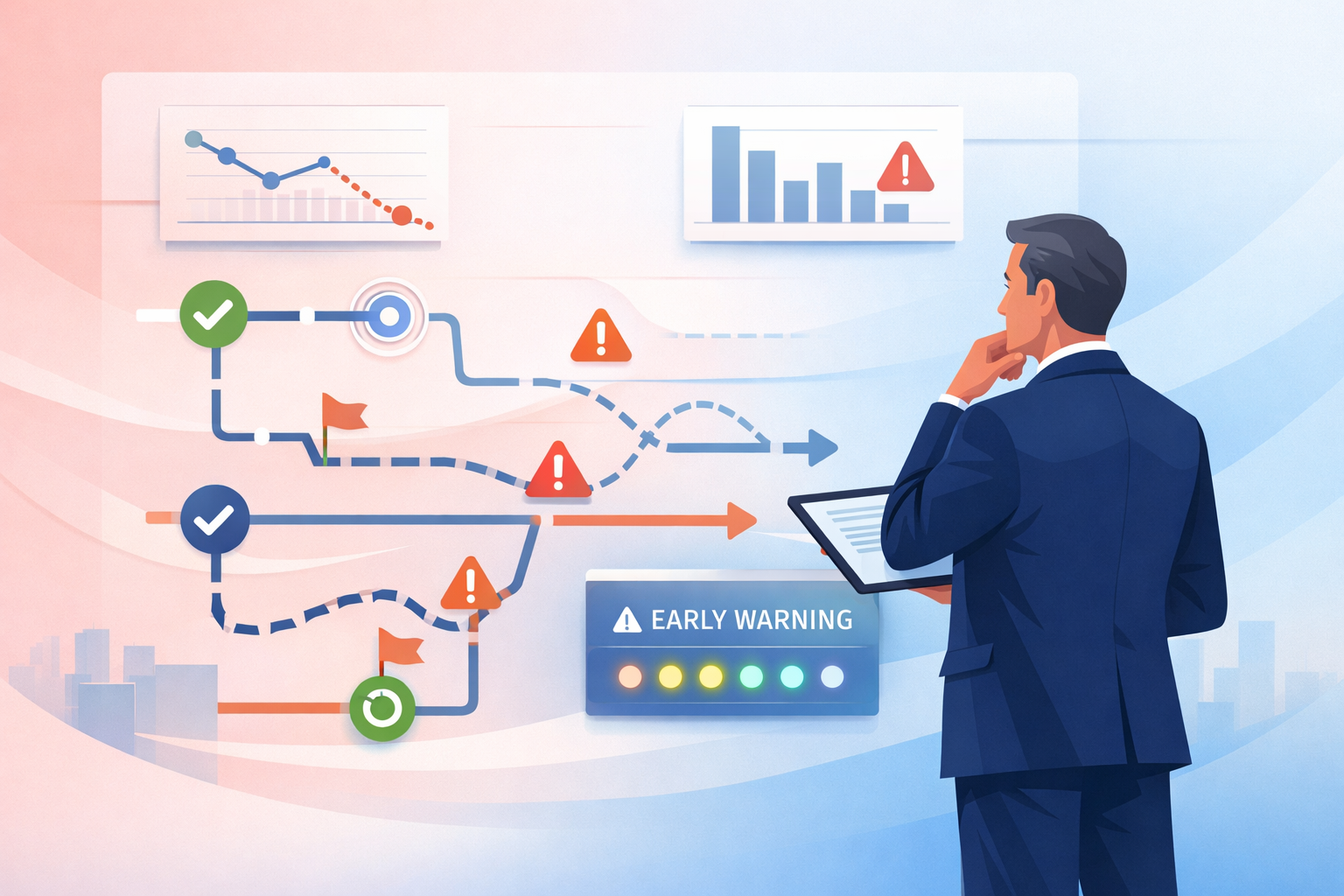

Most leaders believe they have a visibility problem when results decline.
In reality, they have a timing problem.
Last updated: April 2026
By the time KPIs start moving in the wrong direction, execution has already been weakening for weeks or months. Targets are missed not because strategy failed, but because the conditions required to sustain execution quietly eroded after decisions were made.
The real leadership challenge, then, is not interpreting metrics faster. It is predicting execution breakdowns before performance indicators confirm the damage.
Execution Doesn’t Collapse. It Drifts.
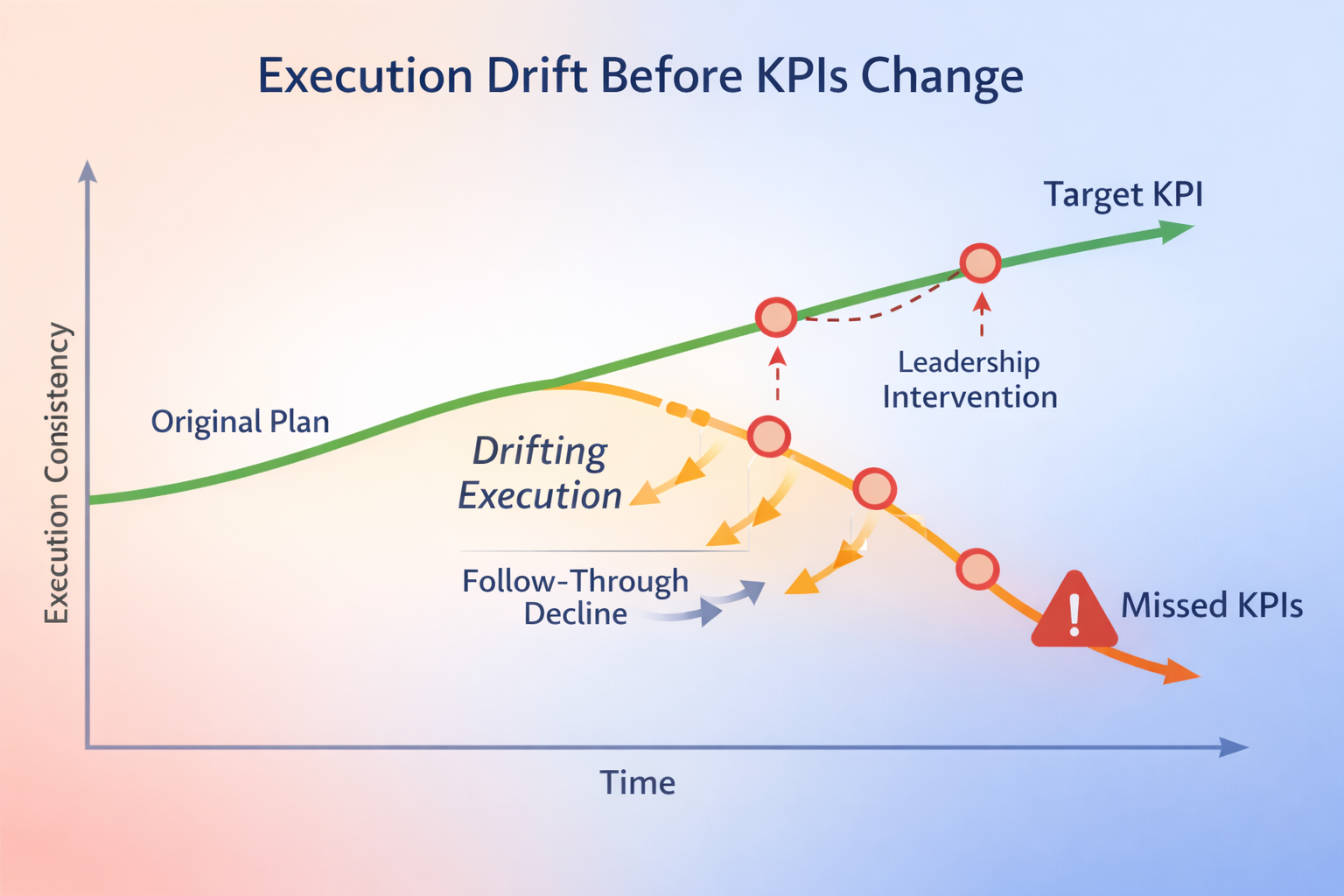
Execution rarely fails in dramatic ways. It weakens gradually, almost invisibly.
A process that once took one day starts taking two. Escalations still happen, but later than before. Checklists are completed, but not with the same rigor.
Hand-offs occur, yet accountability becomes less clear. None of this triggers alarms. Dashboards remain green.
This is execution drift – the slow degradation of follow-through after a decision has been formally approved.
What makes execution drift dangerous is its subtlety. Each individual deviation appears reasonable under pressure. Teams adapt. They compensate.
They work around constraints. And because outcomes are initially protected by effort and heroics, leadership receives no immediate signal that execution conditions are weakening.
KPIs, by design, are lagging indicators. They measure results, not behavior. By the time those numbers change, drift has already hardened into habit.
A Familiar Operational Pattern
Consider a common operational scenario.
A company introduces a new escalation protocol to reduce customer resolution time. Initially, response times improve. Leaders move on to other priorities.
Three months later, escalation requests are still logged – but managers are slower to respond. Teams hesitate to escalate unless the issue is severe. Informal judgment replaces formal thresholds. Resolution time begins creeping up, but average metrics remain within tolerance.
Only when customer complaints spike does leadership intervene.
Nothing “broke” suddenly. The breakdown was visible long before KPIs reflected it. What was missing was not data, but attention to execution behavior.
Most COOs recognize this pattern immediately. It happens in safety checks, quality controls, onboarding processes, and compliance routines. Execution weakens not because people forget the rules, but because reinforcement fades.
The Leadership Blind Spot
Many leaders assume that once a decision is communicated and accepted, execution will hold unless someone actively resists it. This assumption is flawed.
Execution decays under pressure, scale, and competing priorities. Teams respond rationally to local constraints. They optimize for speed, workload, or conflict avoidance. Over time, these adaptations accumulate.
The blind spot emerges when leaders rely primarily on outcome metrics to detect problems. When dashboards show stability, attention shifts elsewhere. “No signal” is interpreted as “no risk.”
Effective leadership, however, distinguishes between managing results and managing execution conditions.
Results tell you what has already happened. Execution conditions tell you what is likely to happen next.
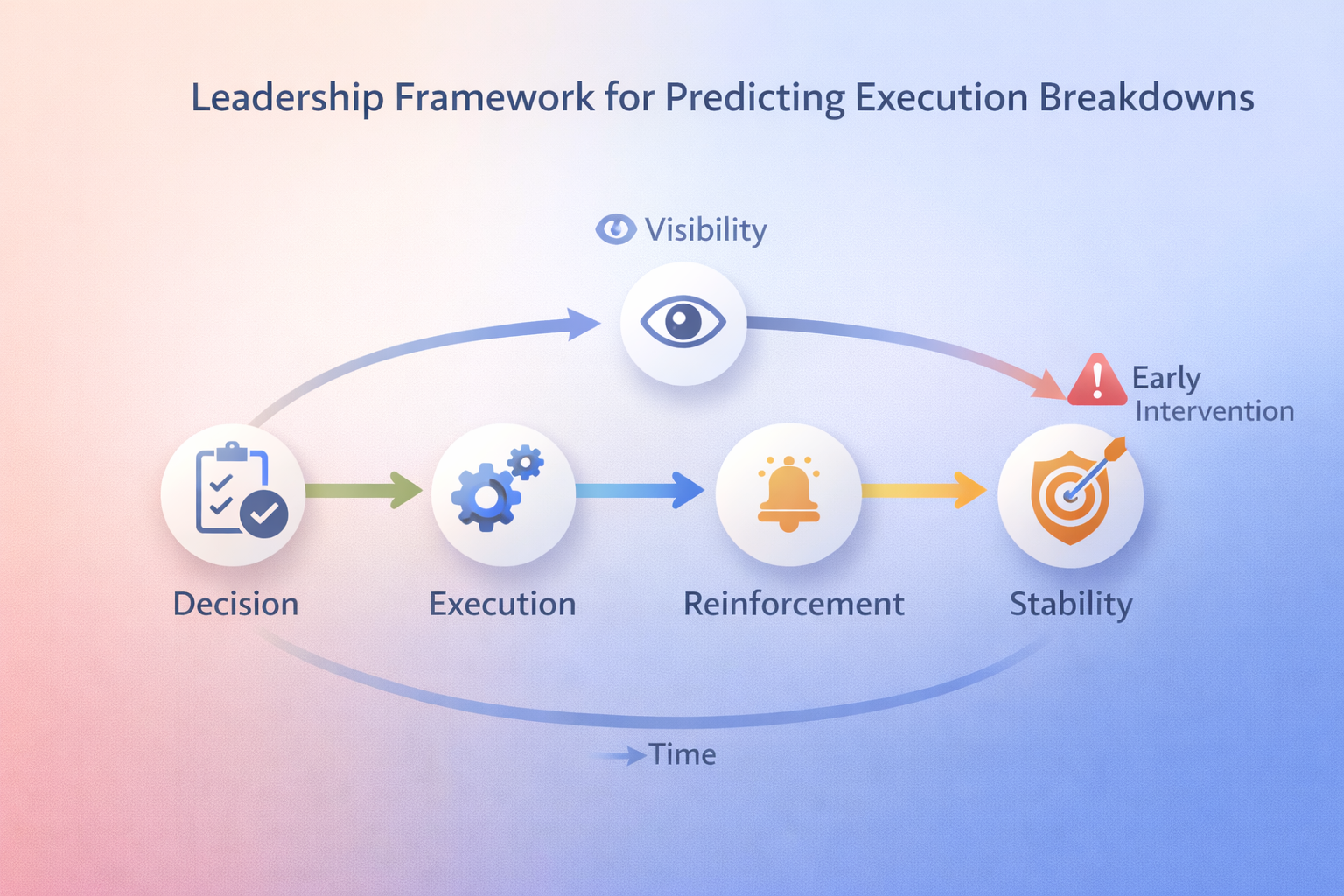
Predicting execution breakdowns requires leaders to watch the system itself – how work flows, how decisions are reinforced, and how consistently standards are applied after the spotlight moves on.
What Early Visibility Actually Looks Like
Visibility is often misunderstood as more reporting. In practice, additional dashboards rarely reveal early breakdowns because they measure the wrong thing.
Early visibility comes from observing behavior patterns:
- Are hand-offs becoming slower or more informal?
- Are exceptions becoming routine?
- Are leaders reinforcing the same priorities they emphasized at launch?
- Are frontline managers still treating certain steps as non-negotiable?
These signals are qualitative, but they are not subjective. They show up in meeting cadence, escalation timing, language used in reviews, and the questions leaders ask – or stop asking.
Organizations that excel at predicting execution breakdowns do not obsess over every deviation. They focus on a small set of execution-critical behaviors and monitor their stability over time.
Reinforcement Is the Missing System
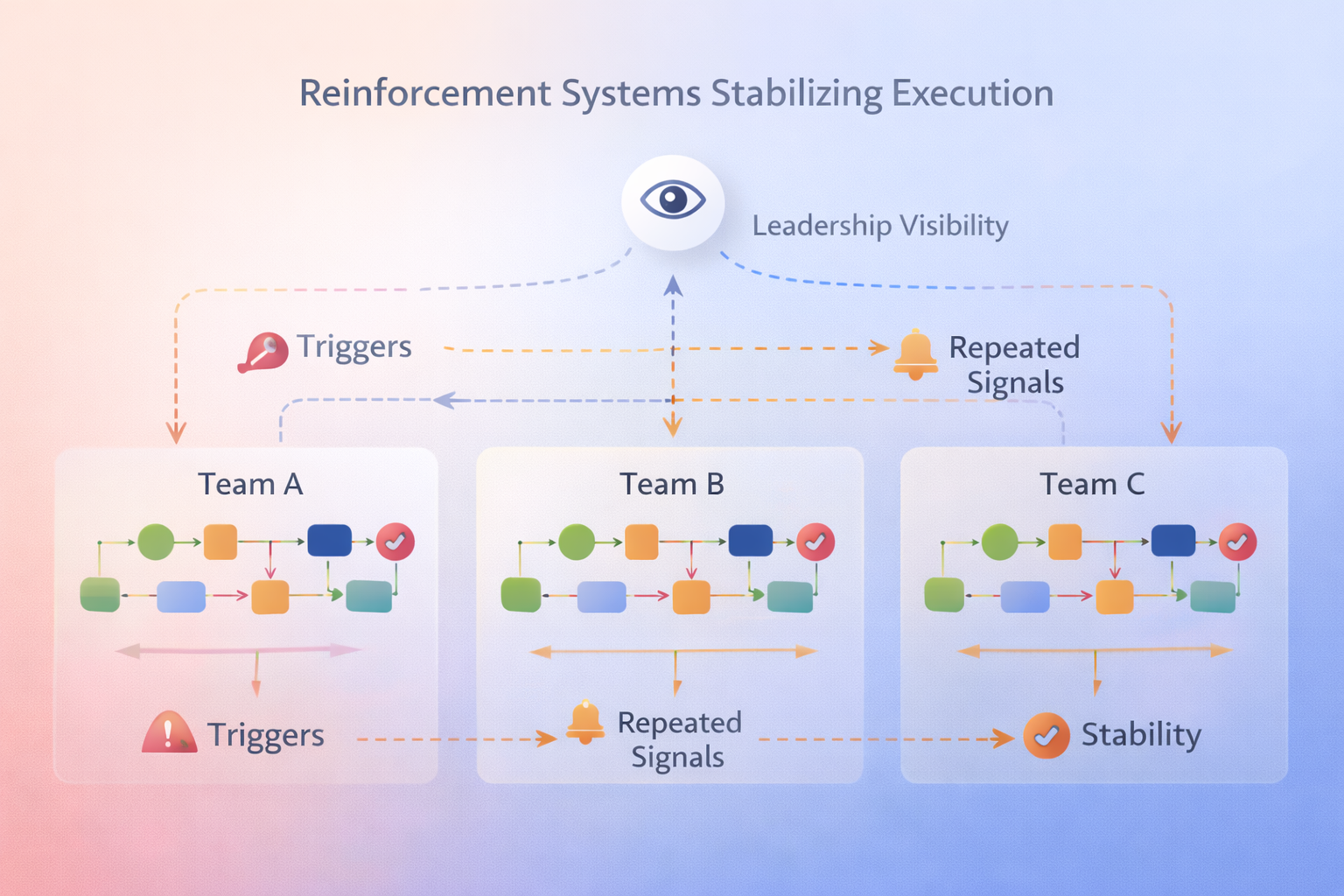
Execution does not sustain itself. It requires reinforcement.
Reinforcement is not micromanagement. It is the repeated signaling of what still matters after initial alignment fades. This includes:
- Clear ownership for execution standards
- Regular, brief check-ins focused on how work is being done, not just what was delivered
- Early, low-friction course correction when drift appears
- Leadership attention that returns predictably, not only during crises
When reinforcement is consistent, teams self-correct. When it weakens, drift accelerates.
Importantly, reinforcement systems allow leaders to intervene early – when corrections are small and inexpensive – rather than react later when outcomes force disruptive action.
The Strategic Advantage of Seeing Early
Organizations often pride themselves on fast reactions. But the real advantage lies in early recognition.
Predicting execution breakdowns is not about predicting failure. It is about noticing when execution conditions are no longer strong enough to support success.
Leaders who develop this capability are rarely surprised by missed KPIs. They intervene before performance declines, not after explanations are required.
The best organizations do not wait for numbers to change. They notice when execution quietly starts to slip – and act while it still can be corrected.
Behavioral KPI Examples That Predict Execution Problems
Traditional KPIs tell you what happened. Behavioral KPIs tell you what is about to happen. Here are concrete behavioral KPI examples that leading organizations track to predict execution breakdowns before they show in results.
Leading Behavioral Metrics (Track These Weekly)
- Follow-through rate: What percentage of committed actions are completed within the agreed timeframe? A drop from 85% to 70% predicts missed quarterly targets 6-8 weeks before they appear in revenue.
- Decision-to-action lag: How many days between a leadership decision and the first visible action by teams? When this stretches from 3 days to 10+, execution drift has already started.
- Reinforcement frequency: How often do managers acknowledge or redirect behavior aligned to strategic priorities? Below twice per week per direct report, drift accelerates.
- Meeting action completion: What percentage of meeting action items get done before the next meeting? Below 60% signals systemic follow-through failure.
- Cross-team handoff speed: How quickly do deliverables move between teams? Slowdowns here predict project delays 3-4 weeks before deadlines.
Behavioral Metrics vs Traditional KPIs
The difference is timing. Revenue, NPS, and retention are lagging indicators. By the time they move, you have lost months. Behavioral KPIs like follow-through rate and reinforcement frequency are leading indicators. They move first, giving you weeks to course-correct.
Organizations using behavioral KPIs alongside traditional metrics report catching execution problems 40-60% earlier than those relying on outcome metrics alone.
How to Build a Behavioral KPI Scorecard
- Pick 3-5 behavioral metrics tied to your top strategic priority (not 20, not 10, just the ones that matter this quarter)
- Set baseline measurements for 2 weeks before drawing conclusions
- Review weekly in existing leadership meetings (do not create a new meeting for this)
- Act on trends, not single data points – two consecutive weeks of decline warrants investigation
- Connect to outcomes – track whether behavioral metric changes actually predicted KPI changes over 90 days
Platforms like GWork automate behavioral KPI tracking, removing the manual overhead that causes most organizations to abandon measurement after the first month.
Key Takeaways: Predicting Execution Breakdowns
- Execution rarely fails suddenly; it drifts quietly after decisions are made.
- KPIs reflect outcomes, not the stability of execution- by the time metrics move, drift is already entrenched.
- Leaders must focus on execution conditions, not just results, to intervene early.
- Reinforcement systems preserve follow-through, maintain alignment, and reduce drift across teams.
- Early visibility into execution patterns enables proactive governance and lowers the cost of corrections.
- Organizations that predict execution breakdowns act before KPIs change, preserving reliability and operational consistency under pressure.
Ready to close the strategy-execution gap?




![6 Best 15Five Alternatives for Teams That Want More Than Check-Ins [2026] - engagement, surveys, behavior, leadership, teams](https://gwork.io/wp-content/uploads/2026/04/15five-alternatives-featured.jpg)
![The Complete Guide to Behavioral Change Platforms [2026] - engagement, surveys, behavior, leadership, teams](https://gwork.io/wp-content/uploads/2026/04/behavioral-change-platforms-guide-featured.jpg)
![GWork vs Humu: Behavioral Change Platforms Compared [2026] - engagement, surveys, behavior, leadership, teams](https://gwork.io/wp-content/uploads/2026/04/gwork-vs-humu-featured-3.jpg)
![GWork vs BetterUp: Behavioral Change Platform vs. Coaching Platform [2026] - engagement, surveys, behavior, leadership, teams](https://gwork.io/wp-content/uploads/2026/04/gwork-vs-betterup-featured.jpg)
![6 Best BetterUp Alternatives for Scalable Employee Development [2026] - engagement, surveys, behavior, leadership, teams](https://gwork.io/wp-content/uploads/2026/04/betterup-alternatives-featured.jpg)
![7 Best Lattice Alternatives for Performance That Actually Changes [2026] - engagement, surveys, behavior, leadership, teams](https://gwork.io/wp-content/uploads/2026/04/lattice-alternatives-featured.jpg)