


Executive Summary
Most organizations don’t fail because they lack strategy, talent, or technology.
Last updated: April 2026
They fail because leaders cannot see what actually happens after decisions are made – and by the time outcomes drift, it is often too late to intervene.
Behavior Analytics gives leaders visibility into execution behavior before results change – showing:
-
which critical behaviors actually happen,
-
where execution is drifting,
-
and where reinforcement can stabilize follow-through.
In this article you’ll learn:
-
why execution fails even when training and communication are “complete”
-
how behavior signals reveal drift and broken loops
-
how leaders move from measurement to governance
-
how reinforcement systems convert knowledge into consistent, repeatable action
For CHROs, COOs, and L&D leaders, this isn’t surveillance or control.
It’s about governing execution systems – so leaders can reinforce what matters most, at the right time, without micromanagement.
👉 Learn more about the concept in our article: What Is Behavior Analytics – and how it helps leaders see execution before outcomes drift.
Introduction: Strategy Isn’t the Problem – Visibility Is
Organizations invest heavily in strategy, communication, and training.
Yet leaders keep seeing the same pattern:
“We decided. We aligned. We communicated.
And still… execution drifts.”
Projects stall. Priorities fade. Processes that launch well slowly weaken.
Training reports may look successful – but behavior in daily operations does not change where it matters most.
The problem is not intention, culture, or motivation.
The problem is visibility.
Leaders can see dashboards and KPIs – but they cannot see:
-
where behavior loops break,
-
where intentions collapse under pressure,
-
where commitments dissolve in real workflows.
Without this layer, CHROs over-train, COOs firefight, and L&D teams ask:
“If people know what to do, why don’t they do it consistently?”
The answer sits inside behavior and reinforcement, not beliefs.
This is the core of Behavior Analytics for Execution – and platforms like Gwork operationalize it at scale.
What “Execution Visibility” Really Means (for Leaders)
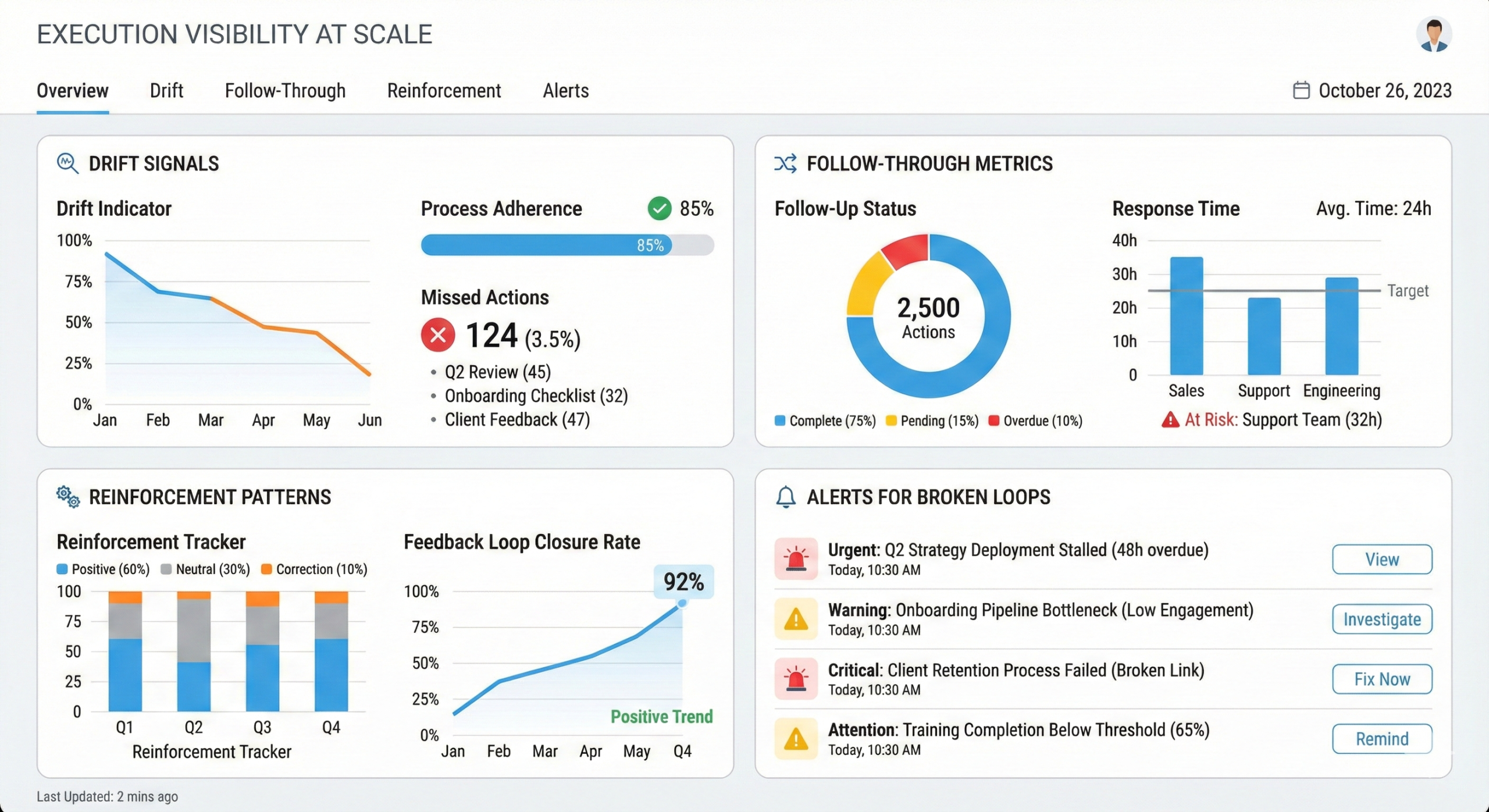
Execution visibility is not about monitoring people.
It is about seeing reality:
-
which behaviors actually happen,
-
where loops drift or break,
-
and how reinforcement affects follow-through.
Think of it as looking behind the wall – not at the paint.
Leaders gain actionable clarity into:
-
where processes repeatedly stall,
-
which steps are skipped under pressure,
-
where reinforcement is missing,
-
where teams improvise because systems don’t support execution.
And – most importantly:
so leaders can decide where to reinforce before outcomes drift.
👉 You can explore this idea further in Why Execution Breaks Before Results Decline.
Behavior Analytics for Execution: The Category Anchor
Behavior Analytics for Execution focuses on how work actually happens – not how it is described in playbooks or strategy decks.
It does three essential things:
1️⃣ Makes behavior loops visible
2️⃣ Reveals where execution is drifting
3️⃣ Supports leadership decisions about reinforcement
It is not:
-
HR analytics
-
engagement measurement
-
productivity surveillance
It is execution-first.
It connects:
-
behavior
-
reinforcement
-
drift
-
stability
-
leadership action
And the point is simple:
Insight → Leader decision → Reinforcement action
Anything else is just more data.
Why Outcomes Alone Mislead Leaders
Outcomes lag behind behavior.
By the time a KPI signals trouble:
-
drift has already spread,
-
habits have already stabilized,
-
people have already adapted locally.
Leaders end up reacting late instead of shaping execution early.
Traditional metrics vs behavior signals
Traditional metrics tell leaders what already happened.
Behavior signals show what is happening now – inside execution.
Leaders who wait for outcomes are always late.
Leaders who see behavior early can decide sooner where to intervene.
👉 To understand how behavior signals work alongside outcome metrics, read our guide on Leading vs Lagging Indicators.
Why Dashboards Without Reinforcement Fail
Dashboards describe performance.
Reinforcement stabilizes execution.
When leaders rely on dashboards alone:
-
problems appear late,
-
root causes remain invisible,
-
interventions arrive after drift becomes normalized.
Behavior Analytics gives leaders visibility before outcomes change, so they can decide:
-
what to reinforce,
-
where to support behaviors,
-
and where systems must adjust.
Measurement exists to support reinforcement, not to generate more reports.
Reinforcement vs Training: Why Knowledge Doesn’t Create Change
Training builds awareness.
Reinforcement builds reliability.
| Area | Training | Reinforcement Systems |
|---|---|---|
| Primary focus | Understanding | Consistent follow-through |
| Time horizon | Event-based | Ongoing |
| What leaders see | Completion reports | Repeatable behavior loops |
| Weakness | Fades under pressure | Only weakens when reinforcement disappears |
| Result | “People know.” | “People actually do – consistently.” |
Training prepares people.
Reinforcement stabilizes execution.
👉 We break this down in detail in Behavioral KPIs That Stabilize Execution, showing which behavior metrics help leaders reinforce the right actions.
The Behavior Reinforcement Loop: From Signals to Decisions
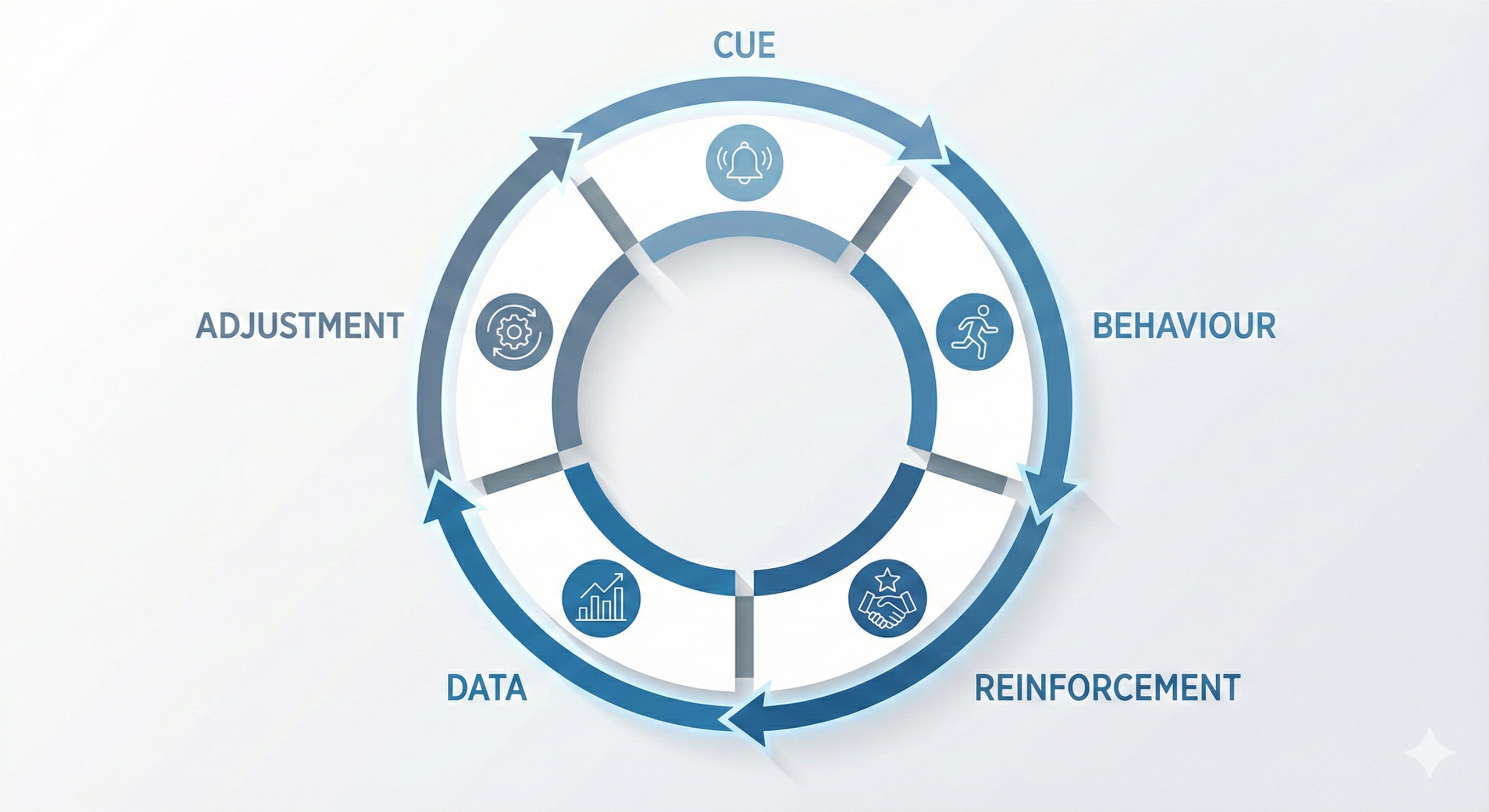
A practical way to think about execution stability:
Cue → Behavior → Reinforcement → Data → Adjustment
-
Cue – the context that triggers action
-
Behavior – what actually happens
-
Reinforcement – what is rewarded, simplified, supported
-
Data – what shows drift vs stability
-
Adjustment – the leadership decision
The key is the final step:
Leadership uses data to adjust reinforcement – not pressure people.
That shift is what separates Behavior Analytics from generic analytics.
Measurement: Decision-Led, Not Data-Led
Measurement doesn’t fix execution.
Its job is to help leaders:
-
see drift early,
-
detect broken loops,
-
understand reinforcement effects,
-
focus resources where they create stability.
Every signal should answer:
“What decision should leaders take next?”
If a metric doesn’t guide leadership action, it belongs on a report – not inside execution governance.
Leadership as Execution Governance – Not People Control
This is the leadership shift.
The question is not:
“Why aren’t people doing this?”
The real leadership question becomes:
“What in the system fails to reinforce this behavior?”
Leaders govern:
-
what gets reinforced
-
where to intervene
-
when to allow stabilization
-
how to maintain consistency under pressure
That moves leadership from:
❌ managing employees
to
✔ governing execution systems.
Nudge-Tech Alone vs Nudge-Tech Inside Reinforcement
Nudges alone create reminders and temporary behavior spikes.
But they fade.
Nudges inside reinforcement systems:
-
stabilize loops,
-
support leader decisions,
-
strengthen execution reliability.
Nudges change moments.
Reinforcement systems change execution.
Leadership implication:
Don’t buy nudges as strategy – integrate them into reinforcement.
Executive Scenario: Early Signals Prevent Late Damage
A leadership team noticed something subtle:
Completion of critical daily actions dropped below expected patterns for two weeks –
yet monthly KPIs still looked stable.
Behavior Analytics showed:
-
cues unclear,
-
reinforcement favoring the wrong outcomes,
-
friction slowing the right behaviors.
Instead of resetting strategy or launching new training, the executive team:
-
clarified cues,
-
aligned rewards with follow-through,
-
removed friction.
Within six weeks:
-
behaviors stabilized,
-
drift reversed,
-
outcomes improved – without escalation or blame.
This is the value of early signal governance.
A Simple Walkthrough: From Drift to Stability
Decision:
“Every customer follow-up within 24 hours.”
Training delivered.
Dashboards created.
Weeks later:
-
follow-ups slipped,
-
reminders ignored,
-
escalations increased.
Behavior Analytics revealed:
-
cues unclear,
-
systems rewarding closure – not timeliness,
-
friction making follow-ups harder than delays.
Leadership reinforced:
-
automatic cues,
-
faster workflows,
-
recognition tied to timeliness.
Execution stabilized – without micromanagement.
Key Takeaways
-
Execution fails due to drift, not intention.
-
Behavior Analytics reveals drift before outcomes change.
-
Leadership governance stabilizes execution systems.
-
Reinforcement converts knowledge into reliable follow-through.
-
Nudge-tech works only inside reinforcement loops.
-
Leaders finally see what to reinforce – and where.
Closing: Seeing What Really Happens After Decisions
Organizations don’t need more dashboards.
They need visibility into what happens after decisions leave the room.
Behavior Analytics helps leaders:
-
reduce drift,
-
stabilize execution,
-
create reliable follow-through – at scale.
Execution becomes governable.
Not by control – but by reinforcement.
Frequently Asked Questions (FAQs)
1. What does “execution visibility” actually mean?
Execution visibility means seeing what really happens after decisions are made – not just the outcomes. It shows where behaviors repeat, where loops break, and where execution drifts so leaders can reinforce the right actions.
2. How is Behavior Analytics different from HR analytics?
HR analytics focuses on people, engagement, and workforce metrics.
Behavior Analytics focuses on execution patterns, follow-through, and reinforcement – helping leaders understand how work actually happens across systems.
3. Why doesn’t training alone change behavior?
Training improves awareness, but behavior changes only when systems reinforce new actions. Without reinforcement, people revert to old habits under pressure, deadlines, and competing priorities.
4. What is a reinforcement system?
A reinforcement system is a structured way to make the right behavior easier, clearer, and consistently supported. It uses cues, feedback, recognition, and workflow design to stabilize follow-through over time.
5. Is Behavior Analytics about monitoring employees?
No. Behavior Analytics is not surveillance. It focuses on patterns, not people. The goal is to reduce execution drift and improve reliability – not to track or control individuals.
6. How can leaders use Behavior Analytics in decision-making?
Leaders use Behavior Analytics to see:
- where processes stall
- which loops drift
- what needs reinforcement
- where interventions matter most
This helps leadership govern execution – instead of reacting to problems after results appear.
7. Where does nudge-tech fit into reinforcement systems?
Nudge-tech works best when it supports reinforcement.
On its own, it creates reminders.
Inside reinforcement systems, it strengthens repeatable behavior loops and improves stability.
8. How quickly can reinforcement systems show results?
Early improvements usually appear within weeks as friction reduces and cues become clearer. Long-term stability develops as reinforcement becomes consistent across teams and workflows.
9. Does Behavior Analytics replace dashboards or KPIs?
No. Dashboards still matter – but they become more useful when leaders can see why execution drifts, not just what happened. Behavior Analytics adds the missing layer beneath KPIs.
Real-World Scenarios: Where Behavior Visibility Changes the Outcome
Execution visibility is not theoretical. These three scenarios show exactly how behavior visibility prevents the slow decay that traditional dashboards miss entirely.
Scenario 1: Strategy Rollout That Quietly Fades
A new strategy is announced. Town halls are held. Leaders communicate alignment. Three months later: rituals disappear, reviews become irregular, priorities compete silently, and execution fragments. Dashboards still look fine – but drift is already happening. Behavior visibility reveals missing reinforcement rituals, weak follow-through points, confusion about priorities, and early drift signals across teams. Leaders intervene before strategy loses credibility.
Scenario 2: Process Change That Never Stabilizes
A new process launches to improve speed and quality. But pressure rises. Teams defend old shortcuts. Leads say “we will do it properly later.” Months later, defects rise – then dashboards finally register the problem. Behavior visibility shows inconsistent process adherence, reinforcement gaps from leadership, and exactly where drift originated. Governance, not policing.
Scenario 3: Compliance Drift Without Bad Intent
Nobody is malicious. Nobody ignores policy on purpose. But deadlines compress, trade-offs happen, and “temporary exceptions” become permanent. Eventually risk surfaces publicly. Behavior visibility shows drift before it becomes risk – giving leaders the window to correct course while the cost of intervention is still low.
Ready to close the strategy-execution gap?




![6 Best 15Five Alternatives for Teams That Want More Than Check-Ins [2026] - engagement, surveys, behavior, leadership, teams](https://gwork.io/wp-content/uploads/2026/04/15five-alternatives-featured.jpg)
![The Complete Guide to Behavioral Change Platforms [2026] - engagement, surveys, behavior, leadership, teams](https://gwork.io/wp-content/uploads/2026/04/behavioral-change-platforms-guide-featured.jpg)
![GWork vs Humu: Behavioral Change Platforms Compared [2026] - engagement, surveys, behavior, leadership, teams](https://gwork.io/wp-content/uploads/2026/04/gwork-vs-humu-featured-3.jpg)
![GWork vs BetterUp: Behavioral Change Platform vs. Coaching Platform [2026] - engagement, surveys, behavior, leadership, teams](https://gwork.io/wp-content/uploads/2026/04/gwork-vs-betterup-featured.jpg)
![6 Best BetterUp Alternatives for Scalable Employee Development [2026] - engagement, surveys, behavior, leadership, teams](https://gwork.io/wp-content/uploads/2026/04/betterup-alternatives-featured.jpg)
![7 Best Lattice Alternatives for Performance That Actually Changes [2026] - engagement, surveys, behavior, leadership, teams](https://gwork.io/wp-content/uploads/2026/04/lattice-alternatives-featured.jpg)