Skip to content

High-performing teams have all the same factor, which is of high and well-maintained habits on a scientific basis. However, motivation is what initiates teams, but the habits supported by science can help them progress. Psychological and behavioral science studies indicate that when teams strategically build the appropriate behavior patterns, they would perform better, interact more and maintain a high level of performance in the work environment.
We will now discuss the seven most effective science-based habits that build team productivity, reinforce cooperation, and ensure behavior change through the years, and how Gwork can assist an organization in implementing these habits.
CTA: Are you willing to support your team to its highest ability? Make science-driven habits that lead to actual results and a change today by trying Gwork.
1. Start with Clear Goals and a Shared Vision
All performance-based teams are founded on clarity. The goal-setting theory explains that, a team that establishes clear and measurable goals is highly likely to attain its goals compared to one that work without focus. When all the team members get to know what success should be and why their input is important, motivation automatically increases.
A shared vision is not merely a guide to the day-to-day actions, but it creates purpose. Individuals desire to believe that their labor is related to something important. According to a study conducted by Harvard Business Review, high engagement and productivity in the team are reported by teams that have a strong sense of shared purpose.
To implement it, develop an open system of setting and monitoring of goals. Bring them to the view of all. Promote the discussion of the meaning of each milestone. This visibility makes decision-making less confusing, provides a higher level of coordination and the team is moving on the right direction.
2. Prioritize Deep Work and Focus Time
The contemporary work environment is full of distractions – messages, emails, notifications, and meetings. Studies of the neuroscience provide evidence indicating that continuous interruptions decrease concentration, deteriorate energy and reduce overall performance workplace. That is where the idea of deep work may come in.
Deep work is an idea introduced by Cal Newport and is defined as unbroken and concentrated time spent on cognitively challenging work. Research indicates that teams that plan to spend some time in deep work (on a regular basis) of lower quality are able to produce better results within a shorter period. The brain works optimally when it has the ability to maintain the flow state and not have to alternate between tasks.
To develop this science-backed habit, you should remind your team to:
- Dedicate specific focus work hours
- Switch off unnecessary notifications
- Meetings schedule during different working time
- Adhere to time limitations on respect in the team.
Such tiny changes enhance personal effectiveness, and also group cohesiveness. The better outcomes of the teams focused on a specific problem are gained with minimal stress and mistakes with time.
3. Encourage Open Communication and Feedback Loops
Psychological safety, which is the perception that all people can speak without the fear of being judged, is one of the most effective predictors of a successful team. Google research on the Project Aristotle identified psychological safety as the most important variable in team effectiveness. Solving problems is quicker in teams that communicate openly and learning more than they making mistakes.
Simple but consistent actions begin the creation of this science-based habit. The leaders are expected to be transparent. Make members of the team share opinions and ask questions. Keep the communication active and healthy by using structured feedback loops, including general one-on-ones or retrospective meetings.
Continuous improvement is fuelled by a feedback-driven culture. Positive feedback reinforces the relationship and frequent recognition would create trust and motivation. Simply put, open communication is not about speaking it is about listening, changing, and coming together to grow.
4. Practice Regular Reflection and Learning
Learning is not a one time affair but a process. Reflection – taking time to reflect on what went right and what did not – makes experience growth. Based on a study conducted by the Harvard business school, the employees who have a chance to reflect on their work enhance their performance by up to 23%.
The habit aids in teams processing experiences, making mistakes, and making their decisions stronger. Reflection also help adaptive thinking that is highly demanded in the modern workplaces that are changing at a rapid rate.
The following are ways through which teams can incorporate reflection in their practices:
- There should be short (weekly or monthly) retrospectives
- Open-ended questions such as What worked well? and What could we improve? should be asked
- Promote the recording of major lessons learnt by team members
- Be able to identify those who implement those insights in subsequent projects
The act of reflection becoming the norm in teams leads to a culture of continual learning and sustained behavior change to propel the long-term performance of the workplace.
5. Foster Well-being and Work-Life Balance
Productive team is healthy team. It is evident science-wise that burnout, lack of sleep, and chronic stress destroy the productivity of the team and the overall performance at the workplace. On the contrary, fostering employee welfare results in the increased concentration, enhanced creativity, and cooperation.
Well-being does not only mean taking time off to your mind, but it also means creating work systems which acknowledge human energy levels. A study by Stanford University concluded that productivity declined considerably in working more than 50 hours a week. Excessive work forces commit more errors and are not able to be creative.
to develop a well-being culture:
- Promote frequent rest periods and holidays
- Individual work hours where permitted
- Provide a good working atmosphere that embraces balance as opposed to being busy
- Normalize stress and workload management discussion
By leaders demonstrating well-being, they provide a very strong signal: it is important to perform, yet it is also important to be sustainable. Motivated, resilient and loyal teams are those that are supported.
6. Recognize and Reward Progress
It is the behavioral science that proves positive reinforcement to be one of the most effective techniques of influencing long-term habits. When human beings are rewarded because of their efforts, their brain stimulates dopamine, which is a chemical associated with motivation and satisfaction. The desire to repeat productive behavior is enhanced with the passage of time.
Teams flourish on the basis of the celebration of both large and small achievements. Recognition may be in various forms; it may be a company shout out, a team award, or just thanks. The key is consistency. Turn recognition into a beats in your team.
According to a research conducted by Gallup employees who feel valued are twice as likely to be engaged at work. The involvement is directly proportional to the team productivity and performance in the workplace. Perception does not only lift morale, it enhances the same actions that make success.
To establish this science-based habits, establish effective mechanisms of rewards and monitoring. Promote peer-to-peer appreciation to create a sense of community and support.
7. Embrace Technology for Smarter Collaboration
In contemporary teamwork, technology is an important aspect. The trick is in applying it strategically. Science-based habits: Science-based tools can improve coordination, automate repetitive tasks, and provide teams with scientifically-based information on team performance.
According to behavioral science studies, by having small reminders or tracking devices, new habits are easily kept. Those cues can be offered on a scale with the assistance of collaboration tools and digital platforms. They assist teams to visualize goals, track progress and modify real time behaviors.
Some of the examples of technology that improve the productivity of the team are:
- Transparency project management systems.
- Continuous improvement feedback platforms.
- Performance trend measurement analytics tools.
- Hybrid working virtual collaboration applications.
Technology is a potent facilitator of performance in the workplace when it is in line with the principles of behavior. It transforms the intentions into quantifiable outcomes.
8. How Gwork Supports Your Team
The right support system can help one build such habits. Gwork is also meant to assist the teams to embrace and maintain science-based habits that enhance performance, participation, and cooperation.
The way Gwork enables teams is as follows:
- Goal Alignment: Gwork enables teams to establish clear and measurable goals and monitor their progress on the fly. All people are kept on track and confusion is minimized and coordination is enhanced.
- Behavioral Insights: The platform applies data analytics to point out the trends in productivity, to show leaders what is driving the success or impeding it.
- Feedback and recognition software: Teams are able to communicate freely and have frequent celebrations because of the integrated feedback and recognition software.
- Well-being Support: Gwork promotes balance by tracking the workload trends and healthy work habits.
- Continuous Learning: Weekly reflection and performance analytics allow teams to review, make changes, and develop.
Gwork is a behavioral science powered by smart technology that turns ordinary teamwork into quantifiable development. It assists organizations to transform theory into action – one habit at a time.
9. Build Habits That Last
It is not successful by putting in a spurt in the modern workplace, but by developing sustainable habits that can be maintained. These evidence-based practices establish the basis of high teamwork efficiency, continuity of behavior change and sustained performance at the workplace.
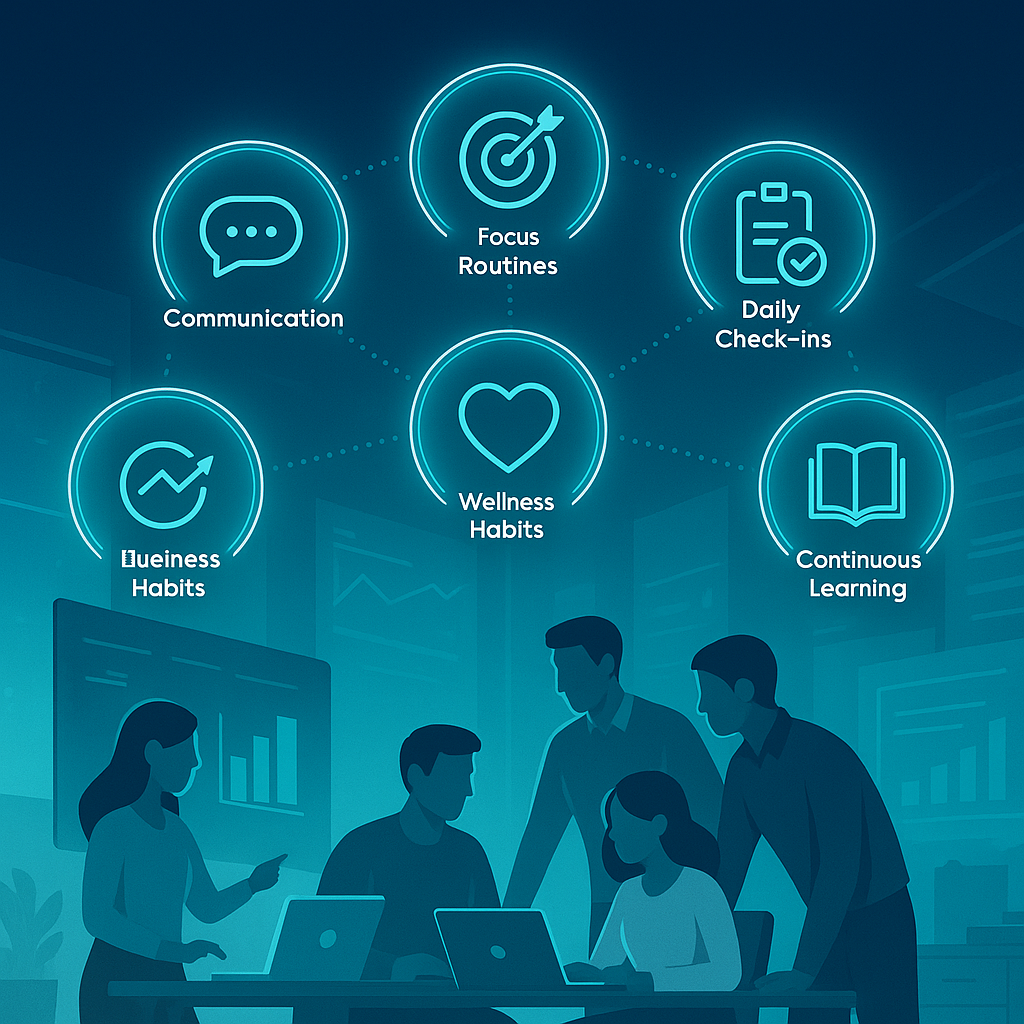
A team that has clear objectives, is highly focused, communicates regularly, reflects, has a strong emphasis on well-being, acknowledges progress, and adopts smart technology will unlock the potential of the team. The habits support each other and the cycle of improvement and growth gets created.
And the best part? You don’t have to do it alone.
Gwork brings it easy to bring these principles into your daily lives – helping your team in all their steps.
Final Thoughts
Teams perform well when they work smarter and not harder. It is science that provides blueprint. The habits described below such as being clear and focused to reflecting and recognizing are not mere theories. They are tested methods that are based on behavior studies and practical outcomes.
By focusing on these science-backed habits, leaders can create an environment where people thrive, perform, and feel connected to their purpose. These evidence-based practices are the highway whether you want to build on your collaboration, increase productivity, or reinforce your workplace culture.
The right attitude, and the right tools, such as Gwork, can make your team do more than you initially believed possible. Established habits that count, gauge improvements, and take pleasure in the process of achieving a more productive, high-perform working environment.
Frequently Asked Questions (FAQs)
1. What are science-backed habits in the workplace?
Science-based habits are research-based actions that have been found to be backed by scientific studies in neuroscience and psychology. The habits enhance concentration, communication and productivity of a team resulting in quantifiable workplace performance improvements.
2. How do science-backed habits improve team productivity?
They assist teams to develop structure, clarity and positive change of behavior. Evidence-based routines like setting goals, reflection, and feedback help teams to reduce confusion, enhance motivation, and provide faster results.
3. Can technology really support habit formation at work?
Yes. Behavioral insights are used to enhance consistency with digital tools such as Gwork. Such characteristics as progress tracking, reminders, and analytics enable teams to keep track and embrace new habits successfully.
4. What role does well-being play in team performance?
The concentration, decision making and collaboration are directly influenced by employee well-being. Groups that value rest, balance, and spatial safety are more engaged and maintain long-term performance at the workplace.
5. How can leaders encourage lasting behavior change?
Leaders are in a position to make expectations clear, give feedback and cheer small wins. New behaviors can be easier turned into long-term science-supported habits with the help of positive reinforcement and open communication.
6. How does Gwork help teams build science-backed habits?
Gwork is a fully digital platform that enhances productivity in a team by ensuring alignment of goals, real-time feedback, and didactical insights. It assists organizations to establish long term habits which will help them to sustain continuous performance improvement.
7. What’s the best way to start implementing these habits?
Start small. Pick one or two habits that have a scientific foundation, such as making specific goals or putting in focus time, and can be used regularly. As the team gains momentum, bring in other individuals.
8. Are these habits relevant for hybrid or remote teams?
Absolutely. The habits are adaptable and they are applicable to any type of team. Through such tools as Gwork, it becomes possible to make remote and hybrid teams remain clear, collaborative, and consistent in terms of their performance despite the location.
Ready to close the strategy-execution gap?