 Skip to content


Executive Summary
Most execution failures don’t happen because strategy was unclear or people lacked capability. They happen because reinforcement decisions were never made – or were made unintentionally.
This article explains:
- Why reinforcement decisions are the hidden force shaping execution outcomes
- How executives unknowingly reinforce the wrong behaviors after decisions are announced
- Why training and communication fail without reinforcement governance
- How leaders can stabilize execution and reduce drift under real operating conditions
If you are a CHRO, COO, or senior leader responsible for execution reliability, this article exists to answer one question:
What should leaders reinforce now – before results start to slip?

Introduction: Why Reinforcement Decisions Define Execution Outcomes
Every executive has seen this pattern before.
A major decision is made.
The strategy is sound.
The rollout looks clean.
Early signals are positive.
And then, slowly, execution starts to drift.
Not because people don’t care.
Not because the strategy was wrong.
But because reinforcement decisions were never governed.
Reinforcement decisions are the choices leaders make – consciously or not – about what behaviors receive attention, escalation, follow-up, and consequence after a decision has already been made. These decisions quietly determine whether execution stabilizes or decays over time.
In the context of Behavior Analytics for Execution, reinforcement decisions are not a people problem or an HR concern. They are a leadership governance issue. They determine whether decisions hold under pressure, ambiguity, and competing priorities.
Platforms like GWork exist precisely because organizations lack visibility into these post-decision reinforcement patterns – not because leaders lack intent.
What Are Reinforcement Decisions?
Reinforcement Decisions vs. Operational Decisions
Most leaders are very clear about operational decisions:
- What initiative to launch
- What targets to pursue
- What resources to allocate
Reinforcement decisions are different. They happen after those choices are made.
They include:
- What leaders review repeatedly
- What escalations receive immediate attention
- What issues are challenged – and which are ignored
- What follow-through is expected versus assumed
Reinforcement decisions govern execution behavior, not operational design.
When leaders say, “We already decided this,” they often miss the fact that execution still needs ongoing reinforcement to remain stable.
Why Reinforcement Decisions Are Often Invisible
Reinforcement decisions are rarely documented. They live in:
- Meeting agendas
- Review cadence
- Leadership reactions
- Silence or delay
Because they are implicit, leaders often underestimate their impact.
The result is predictable:
- Execution signals become inconsistent
- Teams respond to what leaders reinforce, not what leaders say
- Drift begins long before performance metrics change
This is why Behavior Analytics for Execution focuses on visibility after decisions, not before them.
The Executive Problem Reinforcement Decisions Solve
For senior leaders, the real problem is not “How do we motivate people?”
The problem is:
- Why did this initiative lose momentum?
- Where is execution starting to drift?
- What signal mattered earlier – before results moved?
- Why did capable teams still fail to follow through?
Reinforcement decisions sit at the center of all four questions.
They explain why:
- Two identical strategies produce different outcomes
- Well-communicated initiatives decay quietly
- Execution weakens even when incentives remain unchanged
This is not a performance issue.
It is an execution governance gap.
Why Reinforcement Decisions Matter More Than Training
Training is often the default response to execution problems. But training and reinforcement solve different problems.
Reinforcement Decisions vs. Traditional Training
| Dimension | Reinforcement Decisions | Traditional Training |
| Timing | After decisions | Before execution |
| Ownership | Senior leadership | HR / L&D |
| Focus | Follow-through stability | Capability building |
| Impact | Execution reliability | Skill readiness |
| Failure Mode | Drift | Knowledge decay |
Interpretation that matters:
Training prepares people to act.
Reinforcement decisions determine whether action continues when conditions change.
For CHROs, this explains why training success does not guarantee execution stability.
For COOs, it explains why capable teams still miss outcomes.
Reinforcement decisions govern what holds when training fades into the background.
How Executives Actually Prioritize Reinforcement
Executives rarely sit down and say, “Here is what we will reinforce this quarter.”
Instead, reinforcement emerges through patterns.
Attention Is Reinforcement
What leaders consistently ask about gets reinforced.
- Items that stay on the agenda
- Metrics leaders return to week after week
- Questions that interrupt meetings
What disappears from attention begins to lose execution priority – regardless of its stated importance.
Escalation Patterns Shape Behavior
Execution systems learn quickly:
- What gets escalated upward
- What gets resolved immediately
- What stalls in the middle
Escalation patterns silently teach the organization which behaviors matter and which can wait.
This is not about controlling people.
It is about signal clarity at scale.
Intervention Thresholds Define Stability
Every leader has an intervention threshold:
- How early they step in
- What they tolerate temporarily
- When silence becomes approval
These thresholds create execution norms.
In Behavior Analytics for Execution, are analyzed at this systemic level – not at the level of individual behavior.
Reinforcement Decisions and Execution Drift
Execution drift is not a sudden failure.
It is a gradual weakening of follow-through.
Drift occurs when:
- Reinforcement signals conflict
- Attention shifts without closure
- Leaders assume stability without confirming it
The danger is that drift begins before results change.
By the time performance metrics move, reinforcement failure has already happened.
This is why reinforcement decisions must be visible, intentional, and governed – not assumed.
The Execution Governance Model Behind Reinforcement Decisions
Reinforcement decisions do not operate in isolation. They sit inside a broader execution governance system.
The Reinforcement Governance Loop
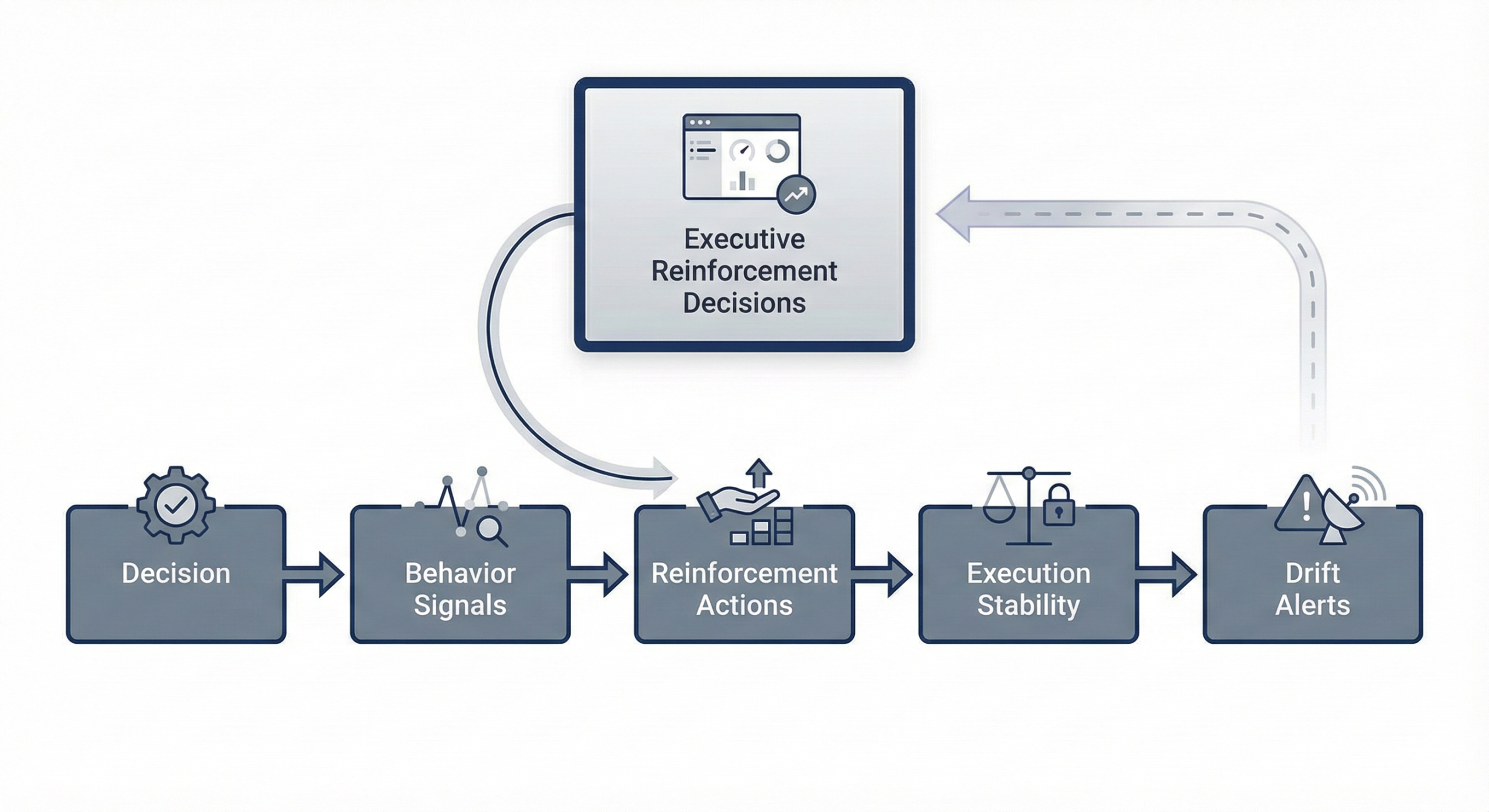
Decision → Behavior Signals → Reinforcement → Execution Data → Leadership Adjustment
This is not a behavior change model.
It is a governance loop.
- Decisions establish intent
- Behavior signals reveal what is actually happening
- Reinforcement stabilizes execution
- Execution data shows drift early
- Leadership adjusts before outcomes decline
In platforms like GWork, this loop is made visible so leaders can govern execution rather than react to failure.
Measurement Enables Reinforcement – It Does Not Lead It
Measurement is critical, but it is never the hero.
In Behavior Analytics for Execution:
- Measurement exists to support leadership judgment
- Data highlights drift, not behavior performance
- Visibility enables earlier intervention
Measurement without reinforcement decisions creates dashboards – not stability.
For COOs, this means data should answer:
“Where should we intervene now?”
For CHROs, it means visibility into leadership signals – not employee monitoring.
Reinforcement Decisions vs. Nudge-Tech
Nudge-tech is often misunderstood in execution systems.
Nudge-Tech in Isolation
Used alone, nudges:
- Create short-term behavior spikes
- Fail under leadership signal conflict
- Decay when attention shifts
This leads to disappointment, not stability.
Nudge-Tech Inside Reinforcement Systems
When subordinated correctly, nudges:
- Reduce friction
- Support leadership intent
- Amplify reinforcement decisions
The difference is governance.
Nudges never replace reinforcement decisions.
They support them.
Common Reinforcement Mistakes Executives Make
- Reinforcing urgency instead of completion
- Confusing communication with reinforcement
- Allowing conflicting leadership signals
- Measuring activity instead of stability
Each mistake weakens follow-through – even when intent is strong.
People Also Ask
How do executives reinforce behavior in organizations?
Executives reinforce behavior through attention, escalation, review cadence, and intervention – not through policies or training alone.
Why don’t decisions translate into consistent execution?
Because reinforcement decisions are inconsistent, implicit, or misaligned after decisions are announced.
What causes execution drift after leadership decisions?
Drift emerges when reinforcement weakens, attention shifts, or leadership signals conflict before outcomes change.
What This Means for Senior Leaders
For CHROs
Reinforcement decisions explain why culture and capability initiatives lose impact without leadership signal alignment.
For COOs
They explain where execution reliability breaks – even when processes and systems appear sound.
For CEOs
They determine whether decisions endure beyond the announcement phase.
Key Takeaways
- Reinforcement decisions govern execution outcomes
- Leaders reinforce behavior whether they intend to or not
- Measurement supports judgment – it does not replace it
- Habits are execution outputs, not anchors
- Execution reliability matters more than performance rhetoric
Closing: Reinforcement Decisions Are the Real Leadership Lever
Most leaders focus on making better decisions.
Fewer focus on what happens after.
Reinforcement decisions determine whether execution holds under real conditions – when attention shifts, priorities compete, and pressure increases.
In the framework of Behavior Analytics for Execution, reinforcement are not optional. They are the mechanism through which leadership intent becomes execution reality.
This is the gap GWork was built to address – not by managing people, but by making execution governance visible, intentional, and durable.
Ready to close the strategy-execution gap?

