
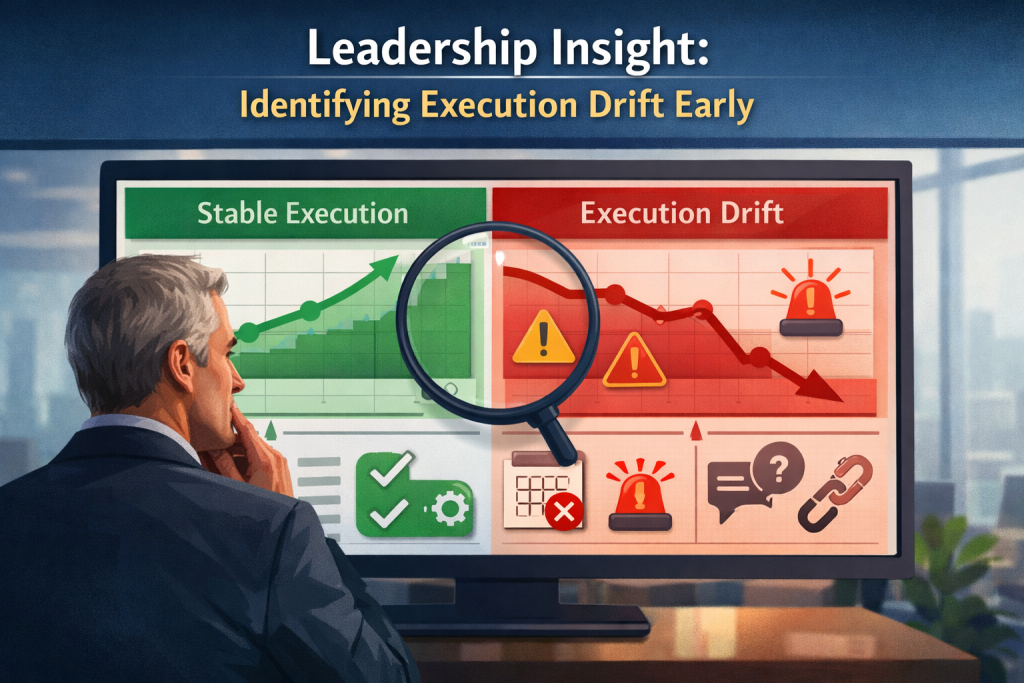

Executive Summary
Most strategies don’t fail at the decision stage.
They fail quietly afterward, as execution conditions weaken.
Leadership insight is not about monitoring people or enforcing compliance. It is about seeing where execution begins to drift before outcomes decline. When leaders identify drift early, they can reinforce what matters, intervene precisely, and avoid costly late-stage corrections.
This is the overlooked work of execution governance.
What Execution Drift Actually Looks Like
Execution drift is rarely dramatic.
A decision is made.
Teams align.
The plan is clear.
For a few weeks, execution looks strong.
Then real work returns. Inboxes fill. Priorities compete. Managers stop reinforcing the change. Teams adapt locally. The few behaviors the strategy depended on slowly become optional.
Nothing breaks loudly.
But something slips.
Follow-through becomes uneven. Standards soften. The strategy remains unchanged, but the organization is no longer doing the small number of actions the strategy relied on.
A concrete operational example:
A safety escalation process requires a 24-hour response. Initially, compliance is tight. Over time, responses slip to 36 hours, then 48.
Not because teams resist the rule, but because handoffs change, reminders fade, and no one is watching the behavior itself. KPIs remain stable – until an incident forces attention back.
That is execution drift.
Not failure.
Degradation.
By the time results decline, execution has already been drifting for weeks or months.
Why Leaders Miss Drift Until It’s Too Late
Senior leadership teams spend significant time aligning on strategy. Priorities are debated, decisions refined, and initiatives launched with clarity. Yet months later, leaders often ask the same question:
“We agreed on this – why isn’t it holding?”
The issue is not commitment.
It is durability.
Most organizations rely on dashboards, reports, and KPIs to assess progress. These tools are valuable, but they are lagging indicators. They answer one question well:
“What already happened?”
They do not answer the more important one:
“Is execution still holding the way we intended?”
Execution weakens after attention moves on because reinforcement fades, context changes, and interpretation begins to vary. None of this feels urgent in the moment. That is precisely why leaders miss it.
Leadership insight is the ability to see weakening follow-through while leaders still have room to act, not after results force reaction.
This is not people oversight.
It is decision stewardship.
For CHROs, this protects enterprise-wide consistency.
For COOs, it protects operational reliability.
For executive teams, it protects strategic intent.
Leadership Insight Is About Visibility, Not Control
In many organizations, “insight” is still equated with more data, more reports, or more measurement. But insight in an execution context is not about volume of information. It is about relevance.
Leadership insight means:
- Visibility into whether agreed actions are still happening
- Awareness of where follow-through is weakening
- Understanding which execution conditions are no longer holding
This shifts the leadership question from “Are people doing what we asked?” to:
“Is execution holding under real operating pressure?”
That distinction changes how leaders act. Instead of re-announcing strategy or increasing supervision, leaders focus on reinforcing the few behaviors that actually carry decisions into results.
Behavior Analytics for Execution: Seeing Drift Early
Leadership insight does not come from intuition alone. It comes from Behavior Analytics for Execution – systems designed to make post-decision execution visible.
Behavior Analytics for Execution focuses on:
- Follow-through patterns, not outcomes
- Execution stability over time
- Reinforcement strength after launch
These are leading signals. They show where execution is holding, where it is starting to weaken, and where early reinforcement will have the highest impact.
This allows leaders to intervene early, while correction is still inexpensive. Instead of firefighting after KPIs move, leaders govern execution proactively.
Triggers as Execution Stabilisation Mechanisms
Triggers are often misunderstood as behavior tools. In an execution system, they serve a different purpose.
Triggers exist to stabilize execution conditions after attention fades. They embed agreed actions into workflows, reduce reliance on memory or motivation, and maintain reliability over time.
Their value is not in prompting individuals, but in supporting leadership decisions about reinforcement. Without insight, triggers become noise. With insight, they become governance instruments.
Used correctly, triggers help leaders answer practical questions:
- Which behaviors require protection?
- Where is reinforcement no longer sufficient?
- Where is interpretation starting to vary?
This keeps leadership action early and targeted.
Closing Insight
Execution does not fail because strategies are wrong.
It fails because no one is watching what happens after the decision.
Leadership begins where strategy ends.
Ready to close the strategy-execution gap?