

... skip to Main Content
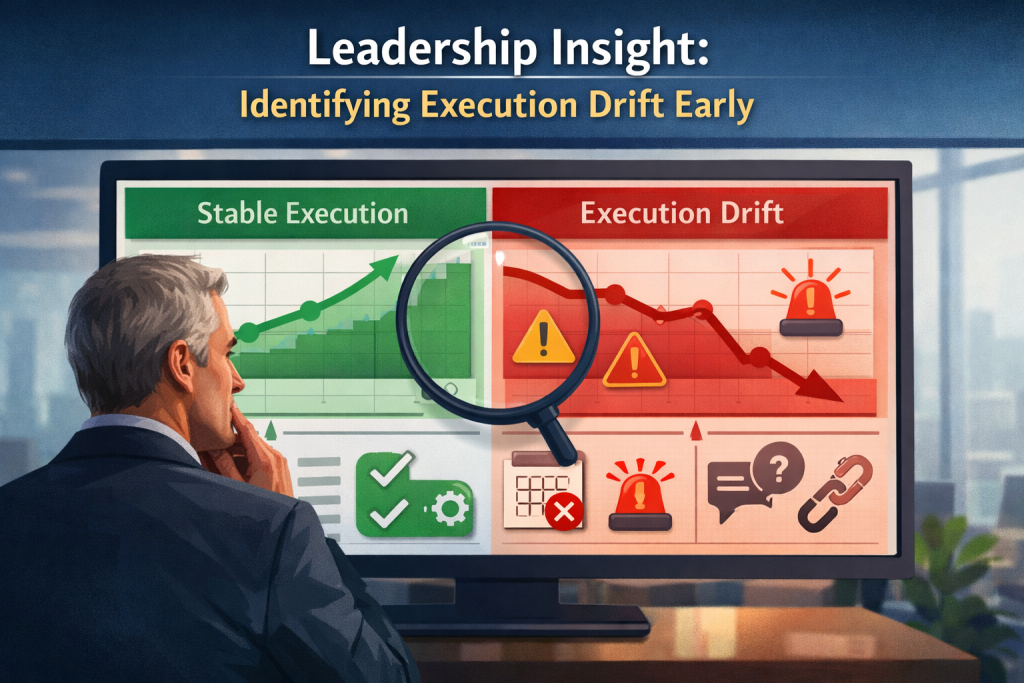
Execution governance showing how leadership decisions translate into stable execution after strategy

Execution Governance: Bridging Strategy and Post-Decision Follow-Through

January 14, 2026

6min read

Introduction: Why Strategy Often Breaks After the Decision

Most organizations don’t fail at strategy.

They fail after the strategy has already been decided.

The executive team agrees on a direction. Priorities are announced. Leaders leave the room aligned. For a brief moment, execution feels inevitable.

Then something subtle happens.

Momentum fades. Focus shifts. Follow-through becomes uneven. The initiative still exists on slides, but it no longer shapes daily decisions. By the time results start to disappoint, leaders are already late to respond.

This is not a motivation problem. It is not an engagement issue. And it is rarely a capability gap.

It is a governance gap.

What’s missing is a way for leaders to govern execution after decisions are made – to see whether follow-through is holding, where it is drifting, and what should be reinforced before outcomes change.

This is where Execution Governance comes in.

Execution Governance bridges the space between strategy and sustained follow-through. It gives leaders a way to stabilize execution under real conditions, not ideal ones. And it sits at the center of a broader system known as Behavior Analytics for Execution.

What Is Execution Governance?

Execution Governance is the leadership discipline of controlling how decisions translate into consistent action over time.

It is not execution management.
It is not performance tracking.
And it is not about managing people.

Execution Governance focuses on one core question:

After a decision is made, how do leaders ensure execution remains stable, coherent, and reinforced as conditions change?

In practical terms, Execution Governance allows leaders to:

  • See whether strategic decisions are still shaping behavior 
  • Detect execution drift before results decline 
  • Decide what to reinforce, where to intervene, and what to ignore 
  • Reduce variance in follow-through across teams and time

Execution Governance exists after strategy and before outcomes. That is the zone most leadership systems fail to cover.

This is why it is best understood as a governing layer inside Behavior Analytics for Execution, not as a standalone management practice.

The Hidden Gap Between Strategy and Results

Most executive dashboards are built for outcomes.

Revenue. Cost. Delivery timelines. Customer metrics.

These are important – but they are late.

By the time outcomes move, execution has already drifted. Decisions are no longer being reinforced. Trade-offs are being made quietly. Attention has shifted.

Leaders sense this intuitively.

They feel something is off before they can see it. Execution feels slower. Alignment feels thinner. Meetings require more explanation. Follow-ups increase.

Yet most systems offer no visibility into this phase.

As a result, leaders default to one of two ineffective responses:

  1. They over-intervene, creating noise and disruption 
  2. They wait, hoping results stabilize on their own

Neither approach governs execution.

Execution Governance exists to close this visibility gap – by making post-decision execution observable while leaders still have time to act.

👉 Without a system for making execution visible after decisions, leaders are forced to rely on lagging results instead of early signals of execution drift.

Execution Governance Is a Leadership Control Layer

One of the most important distinctions to make is this:

Execution Governance is not about managing people. It is about governing systems of execution.

That difference matters.

Managing people focuses on behavior change at the individual level. Execution Governance focuses on reinforcement signals at the system level.

Leaders practicing Execution Governance ask different questions:

  • What behaviors are being reinforced by our current signals? 
  • Where is execution stable, and where is it degrading? 
  • Which decisions still have force, and which have decayed? 
  • Where should leadership attention be applied now?

These are governance questions, not coaching questions.

They imply senior leadership judgment, not frontline management.

When Execution Governance is absent, leaders are forced to rely on anecdotes, escalations, or lagging results. When it is present, leaders can govern execution with precision.

👉 This is why execution governance for senior leaders focuses on governing reinforcement and execution stability, rather than managing people or tracking individual performance.

Behavior Analytics for Execution: Enabling Governance, Not Measurement Theater

Execution Governance does not function without visibility.

That visibility comes from Behavior Analytics for Execution – a system designed specifically to support leadership decisions after strategy is set.

This is not people analytics.
It is not HR measurement.
And it is not engagement tracking.

Behavior Analytics for Execution exists for one reason:
to show leaders how execution is unfolding after decisions are made.

It surfaces system-level signals such as:

  • Strength of follow-through 
  • Reinforcement consistency 
  • Early indicators of execution drift 
  • Stability versus volatility across time

Crucially, measurement here is never the end goal.

Measurement enables governance.
Data informs intervention.
Signals guide reinforcement.

At organizations like Gwork, Behavior Analytics for Execution is positioned explicitly as a leadership support system – not a reporting layer. The value lies in what leaders can now see and decide, not what is being measured.

Reinforcement Systems: The Missing Link Most Leaders Overlook

If execution feels unpredictable, reinforcement is usually the reason.

Every organization reinforces something – whether intentionally or not.

Reinforcement systems include:

  • What leadership attention signals as important 
  • Which trade-offs are tolerated 
  • Where speed is rewarded over quality (or vice versa) 
  • What persists when priorities conflict

Most leaders underestimate how powerful these signals are.

They assume execution fails because people forgot the strategy. In reality, execution decays because reinforcement shifted.

Execution Governance brings reinforcement into focus.

It allows leaders to see:

  • Which decisions are still being reinforced 
  • Where reinforcement is inconsistent 
  • How unintended signals are shaping execution 

Reinforcement systems are not motivational tools. They are execution control mechanisms.

And they sit squarely inside Behavior Analytics for Execution – not beside it.

Managing Execution Drift Before It Becomes Failure

Execution drift rarely looks dramatic at first.

It shows up as small deviations:

  • Slightly longer timelines 
  • More exceptions 
  • Quiet reprioritization 
  • Reduced clarity in meetings

Because these changes feel reasonable in isolation, they often go unchallenged.

Execution Governance changes that dynamic.

By focusing on patterns, not incidents, leaders can see when drift is forming – even if outcomes remain stable.

This allows for:

  • Early course correction 
  • Targeted intervention 
  • Reinforcement adjustments instead of broad resets

Drift management is not about control. It is about maintaining reliability under pressure.

Organizations that govern execution well do not prevent change – they prevent chaos.

Why High-Performance Framing Misses the Point

Many execution conversations fall into a familiar trap: high performance.

Optimize more. Move faster. Push harder.

But execution failure rarely comes from lack of effort.

It comes from instability.

When priorities conflict, when reinforcement weakens, when leadership attention shifts, execution becomes unreliable – even among highly capable teams.

Execution Governance is not about peak performance. It is about sustained follow-through under real conditions.

This is why the language matters.

We are not trying to get people to perform better.
We are trying to make execution more reliable.

That distinction changes how leaders act.

From Decision to Action: Governing the Full Loop

A well-governed execution system closes the loop between insight and decision.

It allows leaders to:

  • See what is happening now 
  • Decide what to reinforce 
  • Intervene where necessary 
  • Deprioritize noise 
  • Monitor stability over time

This is not a one-time process.

Execution Governance is continuous, because execution itself is continuous.

The goal is not perfect alignment. The goal is controlled variance – knowing when execution is stable and when it is not.

Platforms like Gwork support this by keeping leadership attention focused on execution signals, not operational detail. The system exists to support judgment, not replace it.

Why Existing Tools Don’t Solve This Problem

Many organizations assume they already have what they need.

They have dashboards. They have KPIs. They have performance reviews.

Yet execution still drifts.

That’s because most tools are designed to answer different questions:

  • Are we hitting targets? 
  • Are people productive? 
  • Are teams engaged?

Execution Governance asks something else entirely:

  • Are our decisions still shaping behavior? 
  • Is follow-through holding under pressure? 
  • What should leadership reinforce now?

This is why Behavior Analytics for Execution is a distinct category.

It fills a gap no existing system covers well – and explains why execution problems persist despite heavy investment in tools.

Execution Governance as a Leadership Imperative

At its core, Execution Governance is about decision integrity.

If decisions do not shape behavior, they are symbolic.
If follow-through cannot be seen, it cannot be governed.
If drift is detected too late, leaders are forced into reactive mode.

Organizations that govern execution well do not rely on hope or heroics.

They rely on visibility, reinforcement, and leadership judgment.

That is what Execution Governance enables.

And that is why Behavior Analytics for Execution is not an optional layer – it is foundational for any organization that wants strategy to survive contact with reality.

Final Thought: Making Execution Governable Again

Execution has always been hard.

What’s changed is that complexity, speed, and competing priorities make drift inevitable unless it is actively governed.

Execution Governance does not promise perfection. It promises control – the ability for leaders to see what is happening, decide how to respond, and stabilize execution over time.

That clarity is what ultimately bridges strategy and post-decision follow-through.

And it is the clarity modern leadership systems can no longer afford to operate without.

Stay Ahead with Productivity Insights

Table of Contents

Back To Top Seraphinite AcceleratorOptimized by Seraphinite Accelerator
Turns on site high speed to be attractive for people and search engines.