 Skip to content
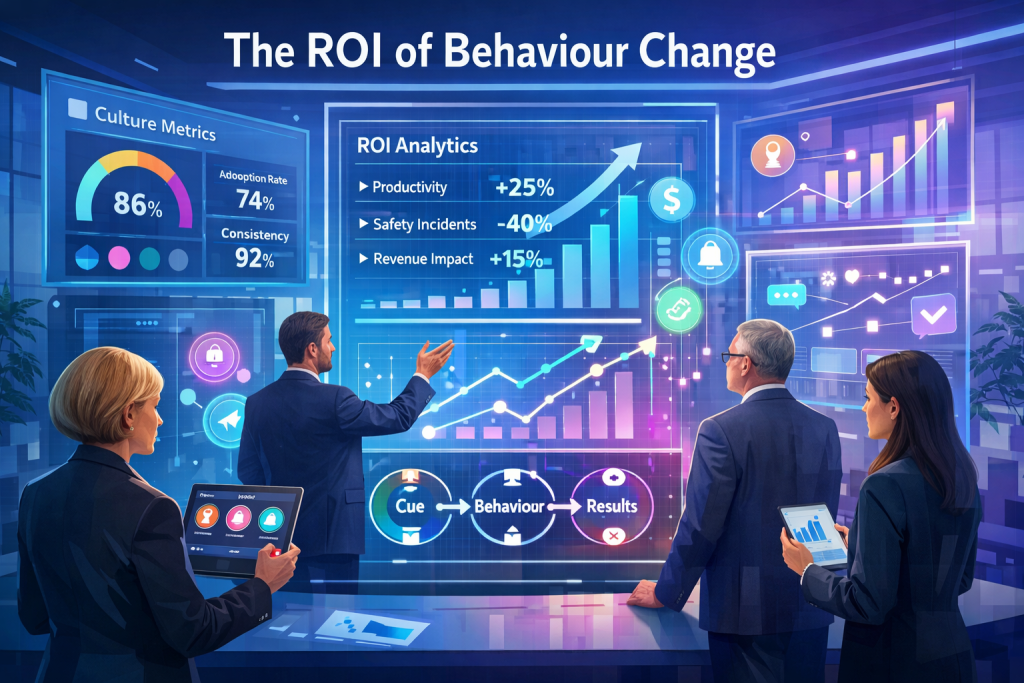

Executive Summary
- Behavior change ROI has become a board-level concern as leaders demand proof that culture investments drive real performance outcomes.
- Traditional training, engagement surveys, and culture narratives fail to show a measurable business impact of behavior change.
- Behavior analytics makes it possible to link behavior directly to performance metrics, operational outcomes, and financial results.
- Organizations using platforms like GWork are moving from culture as an abstract concept to culture as a measurable, optimizable system.
Why Behavior Change ROI Matters Now
Over the years culture and behavior initiatives have been considered as important and difficult to measure. That supposition is no longer true.
The environment that is being operated in today requires speed, consistency, and accountability. COOs have been under stress to implement change programs without interruption. CFOs require well presenting justification of all investments. CHROs will be supposed to demonstrate that culture and capability programs will offer something beyond engagement scores.
And this is where the behavior change ROI comes into the picture.
Behavior change ROI is a quantifiable business value that is created when employees demonstrate specific and observable behaviors that result in performance. It takes culture off the paper. It substitutes assumptions with facts.
Organizations that cannot measure the ROI of behavior change system face three growing risks:
- Transformation initiatives stall because behavior does not shift at scale.
- Training investments fail to translate into on-the-job performance.
- Culture programs lose credibility with executive leadership.
👉 Discover how GWork enables sustained behavior adoption beyond training, using behavior data to prove impact at scale.
What Is the ROI of Behavior Change?
Defining Behavior Change ROI in Business Terms
The ROI of behavior change is the measurable return an organization gains when targeted behaviors shift and remain consistent over time, resulting in improved performance outcomes.
In practical terms, behavior change ROI answers questions such as:
- Did leaders adopt the decision-making behaviors required to reduce cycle time?
- Did frontline teams consistently follow safety behaviors that reduced incidents?
- Did managers reinforce coaching behaviors that improved productivity or retention?
Unlike traditional ROI models that focus on activity, behavior change ROI focuses on adoption, consistency, and impact.
This distinction matters. Training completion does not equal behavior adoption. Engagement does not equal execution. Behavior change ROI only exists when new behaviors show up reliably in daily work and influence performance metrics.
Why Traditional ROI Models Fail for Culture
Most organizations still rely on lagging or indirect indicators to assess culture and behavior initiatives. These include:
- Engagement surveys
- Post-training satisfaction scores
- Anecdotal leadership feedback
Although they come in handy, these are not measurement tools of behavior. They assess perception or involvement.
This causes a gap in credibility as a CFO. Lack of behavior data does not enable leaders to have confidence in the relationship between culture investment and financial or operational outcomes.
The gap manifests itself as uneven execution as a COO. Leaders feel change has taken place but day-to-day behavior tells otherwise.
ROI Behavior change ROI needs a separate measurement method. One that measures observable behavior results with time and links it directly to the results of performance.
How Behavior Affects Performance Metrics
Linking Behavior to Performance Outcomes
Every performance metric is the result of human behavior.
Productivity depends on how people prioritize work, collaborate, and make decisions. Safety outcomes depend on whether employees follow procedures under pressure. Customer experience depends on how frontline teams respond in critical moments.
Linking behavior to performance means identifying the specific actions that drive results and measuring whether those actions are occurring consistently.
Examples include:
- Leaders conducting regular performance check-ins that improve execution alignment.
- Teams following standardized handoff behaviors that reduce errors and rework.
- Managers reinforcing feedback behaviors that accelerate skill development.
When these behaviors shift, performance metrics follow.
The Business Impact of Behavior Change
The business impact of behavior change becomes visible when organizations move beyond one-time interventions and focus on sustained adoption.
Small behavior shifts, when applied consistently across teams, compound over time. A slight improvement in decision quality, safety compliance, or leadership consistency can generate significant gains at scale.
Organizations that measure behavior change ROI often see impact in areas such as:
- Reduced operational risk
- Faster execution cycles
- Improved quality and reliability
- Higher productivity without additional headcount
This is why behavior change has become central to transformation discussions. Without it, strategy remains theoretical.
Measuring ROI of Behavior Change With Behavior Analytics
How to Calculate ROI of Behavior Change
Calculating the ROI of behavior change requires a structured approach that aligns behavior data with business outcomes.
The process typically includes five steps:
1. Define the target behaviors
Identify the specific behaviors that directly influence a business objective. These must be observable and repeatable.
2. Establish a baseline
Measure how often these behaviors occur today. This creates a clear starting point.
3. Track behavior adoption over time
Use behavior analytics to monitor consistency, frequency, and spread across teams.
4. Link behaviors to performance metrics
Correlate behavior data with operational or financial outcomes such as productivity, safety incidents, or cycle time.
5. Quantify the impact
Translate performance improvements into financial or operational value to calculate behavior change ROI.
This approach allows leaders to move from assumptions to evidence. It answers the long-standing question of how to calculate ROI of behavior change in a way that stands up to executive scrutiny.
Behavior Data for Decision Making
Behavior data for decision making provides leaders with real-time insight into how change is actually unfolding.
Unlike surveys or annual reviews, behavior analytics reveal:
- Where adoption is strong or weak
- Which teams are reinforcing behaviors consistently
- When interventions are needed to prevent regression
Behavior data transforms culture from a retrospective conversation into a management system.
👉 See how GWork helps improve execution reliability by measuring and reinforcing the behaviors that drive operational performance.
Can Culture Change Be Quantified?
Culture ROI Metrics That Actually Matter
Culture can be quantified, but only if it is measured through behavior rather than beliefs or attitudes.
Effective culture ROI metrics focus on:
- Adoption rates of critical behaviors
- Consistency of behaviors across leaders and teams
- Speed at which new behaviors take hold
- Durability of behavior change over time
These metrics provide a far clearer picture of culture than engagement scores alone.
Quantifying Culture Change at Scale
Quantifying culture change requires scale and consistency. Manual observation or anecdotal feedback cannot provide this.
Behavior analytics platforms enable organizations to capture behavior signals across large populations and over extended periods. This makes it possible to quantify culture change in a way that is reliable and repeatable.
Behavior Change ROI for Organizations in Transformation
Large-scale transformation efforts often fail for one reason. Behavior does not change at the same pace as strategy.
Organizations invest heavily in new operating models, systems, and processes. But without behavior reinforcement, employees revert to familiar habits under pressure.
Behavior change ROI for organizations becomes especially critical during transformation because the cost of failure is high. Missed milestones, stalled initiatives, and employee fatigue all erode value.
Behavior analytics help de-risk transformation by:
- Identifying where behavior adoption is lagging
- Enabling targeted reinforcement instead of broad retraining
- Providing early indicators of execution risk
How GWork Helps Prove Culture ROI With Data
From Behavior Signals to Business Impact
GWork enables organizations to move from behavior assumptions to measurable outcomes.
By capturing behavior data tied to specific performance objectives, GWork provides visibility into how work actually happens. Leaders can see which behaviors are being adopted, where reinforcement is needed, and how behavior shifts correlate with performance metrics.
This allows organizations to prove culture ROI with data rather than narratives.
👉 Learn how GWork quantifies culture ROI and links behavior change directly to financial and risk outcomes.
How Behavior Data Supports Business Decisions at Scale
Behavior data supports business decisions by making the invisible visible.
With GWork, leaders can:
- Monitor behavior adoption across functions and regions
- Identify high-performing behavior patterns
- Adjust reinforcement strategies based on real-time insight
People Also Ask
What Is the ROI of Behavior Change?
The ROI of behavior change is the measurable value created when targeted behaviors shift and remain consistent, resulting in improved business performance. It is calculated by linking behavior adoption to operational or financial outcomes.
How Does Behavior Affect Performance?
Behavior affects performance by shaping how decisions are made, how work is executed, and how consistently standards are followed. Performance metrics are the outcome of repeated human behaviors.
Can Culture Change Be Quantified?
Yes. Culture can be quantified by measuring observable behaviors over time and linking them to performance metrics. Behavior analytics make it possible to track culture change at scale.
Key Takeaways for Executives
- Behavior change ROI connects culture directly to performance outcomes.
- Measuring behavior adoption provides clearer insight than surveys or training metrics.
- Behavior analytics enable data-driven decisions during transformation.
- Culture becomes measurable when defined through observable behaviors.
- Alignment between COO, CFO, and CHRO priorities is essential.
Frequently Asked Questions
1. What is the ROI of behavior change?
ROI of behavior change can be defined as the quantifiable value of the business when employees develop consistent performance-critical behaviors. Behavior change ROI is concerned with what people actually do in the job as compared to training ROI which is usually concerned with participation or satisfaction. When organizations monitor behavior adoption and correlate it with such outcomes, as productivity, safety, quality, or cycle time, they can readily illustrate the pay off on their culture and people investments.
2. How does behavior affect performance?
Behavior influences performance since all business outcomes are created by the repetition of human conduct. The quality of decisions, the speed of execution, customer experience, and operational reliability are all related to the behavior of individuals in the daily work. With consistent reinforcement of the right behaviors, there is an improvement in the performance measures. Even the most effective strategies and processes are not able to bring results when the behaviors are the same. The quantification of behavior allows one to determine the reason behind the performance gap and how performance gaps can be bridged.
3. Can culture change be quantified?
Yes, the culture change may be measured by quantifying observable behaviors over time. Culture does not lie in the values statements or responding to the survey, but in the way people behave in the actual circumstances. Through monitoring behavior pick up, reliability among teams and sustainability of changes, the organizations can measure culture in a practical, data-driven manner. Behavior analytics enables the leaders to find out whether culture initiatives are making a difference in how work is done.
4. Why doesn’t training alone lead to behavior change?
Awareness and knowledge are developed through training, which does not often transform behavior. Unless reinforced, individuals tend to go back to the old ways when the demands get higher. The process of behavior change must be accompanied by continuous cues, feedbacks and reinforcements in day to day working. Organizations that solely use training tend to experience low returns since the behavior acquisition is short lived.
5. How does behavior data support business decisions?
Behavior data offers a timely indication on whether the change initiatives are effective or not. Leaders are able to know where adoption is high, reinforcement is required as well as correlation between behaviors and performance outcomes. This will enable more informed and faster decision making and minimize chances of unsuccessful transformation processes.
Ready to close the strategy-execution gap?

