
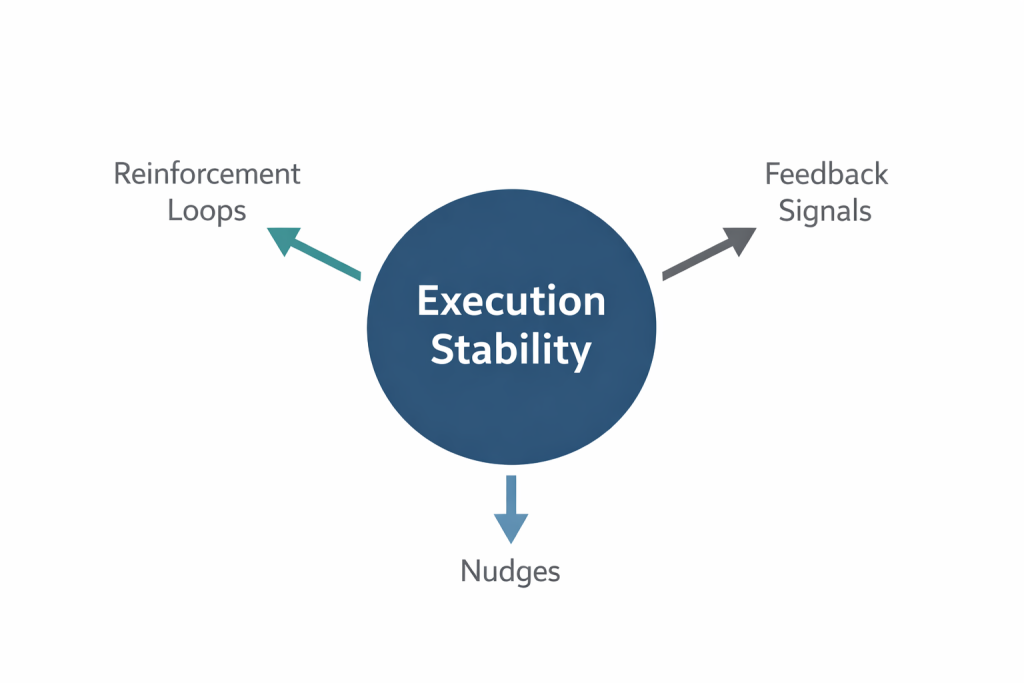

Executive Summary
Most organizations don’t fail because leaders make bad decisions.
They fail because execution drifts after the decision.
Behavioral triggers are not about motivation, employee control, or productivity hacks.
They are the governance signals that stabilize follow-through under real-world conditions.
In this article, we look at:
- Why execution drifts even when strategy is clear
- What behavioral triggers actually are (and what they are not)
- How reinforcement systems create stability where training alone fails
- How leaders use triggers to reduce drift before results collapse
For organizations building serious execution capability, platforms like GWork are reframing behavior not as an HR topic – but as a critical layer of execution governance.
Let’s start with the real problem.
Strategy Rarely Fails. Execution Drifts After Decisions.
Most leaders recognize this pattern.
A strategy is defined.
Teams align.
Kickoff meetings happen.
Dashboards light up.
And then – slowly – things begin to drift.
Critical steps slip.
Exceptions appear.
Important behaviors get skipped “just this once.”
Projects stall, not because people don’t want to execute – but because execution conditions don’t reinforce the right behavior at the right moment.
What most organizations reach for at this point is predictable:
- more reminders
- more communication
- more dashboards
- more training
But dashboards show results after behavior has already drifted.
Training builds knowledge – not execution reliability.
This is why Behavior Analytics for Execution matters.
It gives leaders visibility not only into outcomes, but into the behavior layer that drives those outcomes – and the signals that stabilize it.
And inside that system, behavioral triggers play a specific, disciplined role.
They are not the hero.
They are not “motivation tricks.”
They are execution controls that reduce drift.
What Are Behavioral Triggers – Really?
Let’s define them clearly.
A behavioral trigger is:
A system-level cue that activates the right behavior at the exact moment it matters – and connects it to reinforcement.
Not a reminder.
Not a nudge.
Not a motivational message.
A trigger is part of an intentional governance loop:
Cue → Behavior → Reinforcement → Data → Adjustment
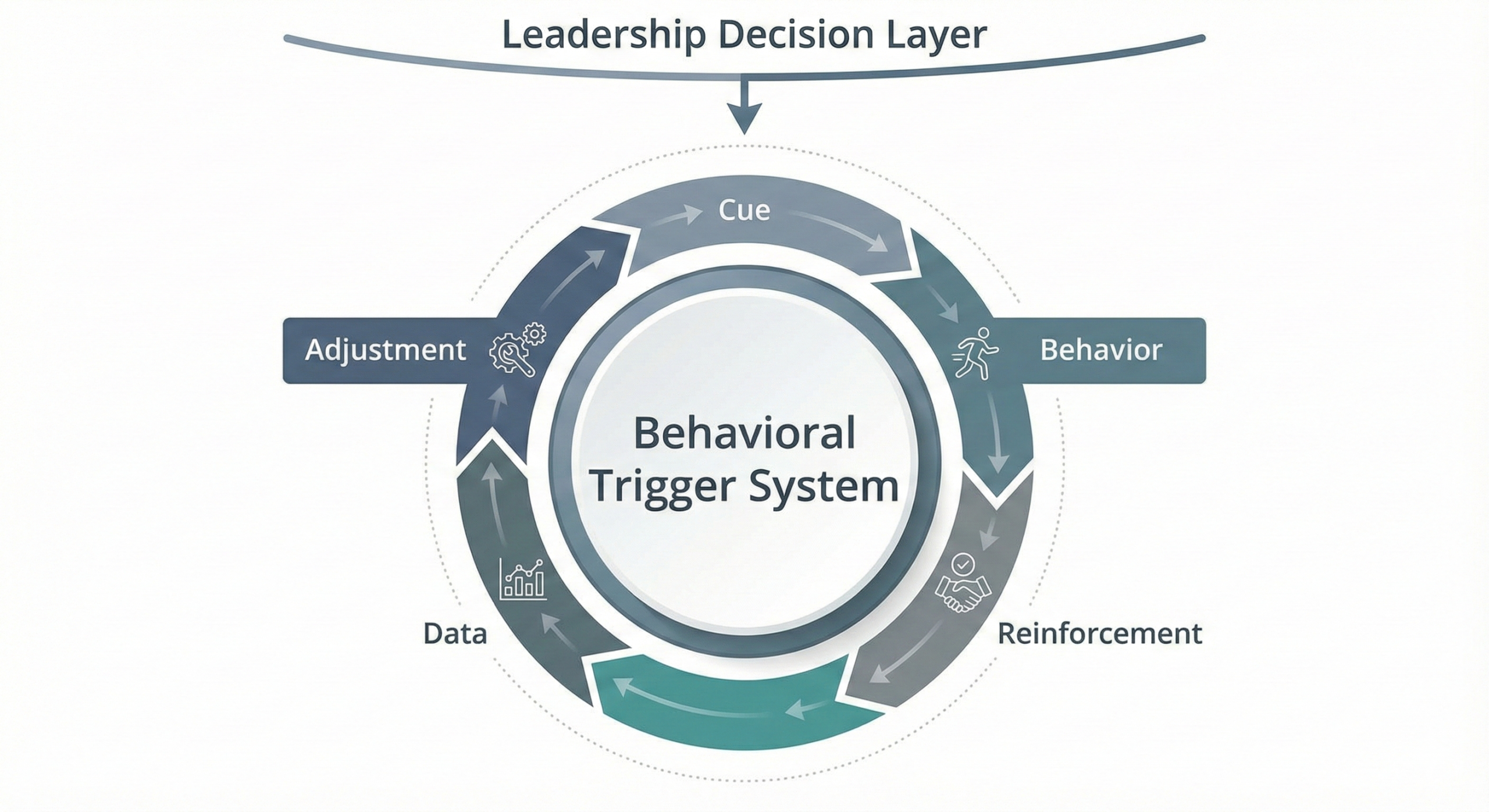
Here’s how that loop works in practice:
- A cue appears at a mission-critical moment
- The expected behavior becomes explicit and easy
- Reinforcement clarifies why it matters
- The action generates behavior data
- Leaders adjust governance rules based on patterns of drift
Triggers are not about “getting people to behave.”
They are about designing execution environments that stabilize critical workflows.
And this is where leadership enters the picture.
The Leadership Lens: Triggers Support Execution Governance
Behavioral triggers only make sense when viewed through governance – not management.
Senior leaders are responsible for:
- deciding what behaviors matter most
- defining where drift is most dangerous
- setting reinforcement rules
- intervening when execution stability weakens
Behavioral triggers serve that leadership function.
They answer questions such as:
- Where in the workflow do we consistently lose execution?
- What should be reinforced at this stage?
- What signal should appear before results deteriorate?
- Where do leaders need visibility earlier?
This is not about controlling employees.
It is about reducing execution volatility.
For different leadership roles, the emphasis shifts slightly:
For CHROs:
Behavior becomes a governance layer tied to strategy – not an HR engagement program.
For COOs:
Triggers create predictability across processes, handoffs, and operations.
For L&D leaders:
Reinforcement bridges the gap between training and real-world application.
When leaders understand triggers as part of execution governance, the conversation shifts from motivation and performance – to stability, drift reduction, and reliable follow-through.
The Five Core Types of Behavioral Triggers
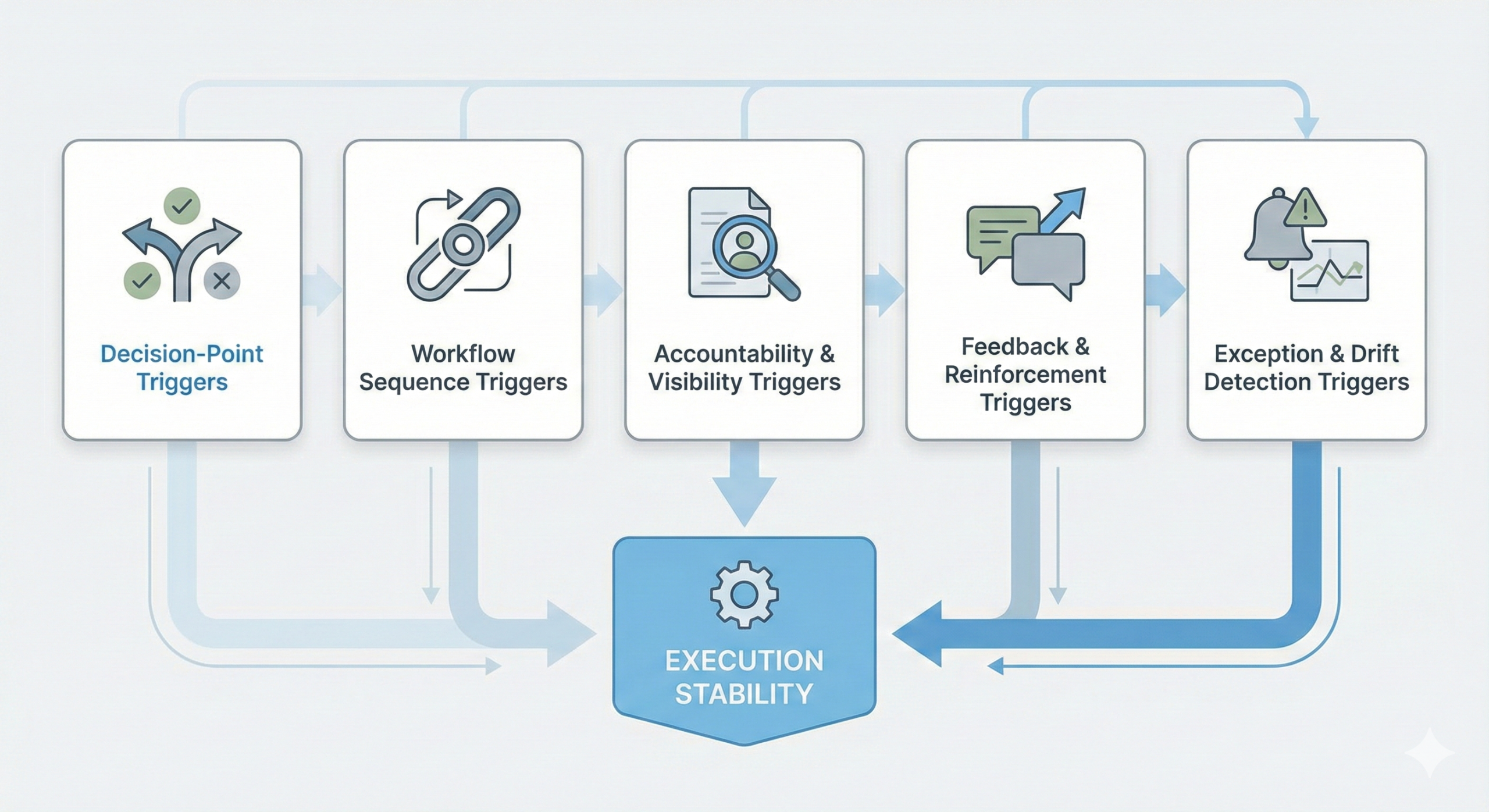
Not all triggers are equal.
And not all should exist everywhere.
Let’s look at the main types that consistently improve execution stability.
1. Decision-Point Triggers
These are cues placed exactly where a decision can create drift.
Approvals.
Risk assessments.
Compliance checkpoints.
Handoffs between teams.
Example:
Before a sales proposal is approved, a trigger requires confirmation that certain risk criteria were evaluated. It does not say:
“Please remember to review risks.”
Instead, it structures the decision so risk review is impossible to skip.
Decision-point triggers are powerful because they protect moments where a single oversight can cascade downstream.
2. Workflow Sequence Triggers
Execution often collapses when steps happen out of order.
These triggers:
- enforce correct sequence
- make skipped steps visible
- reinforce why order matters
They don’t ask people to be more disciplined.
They stabilize the workflow so discipline is no longer the weak point.
3. Accountability and Visibility Triggers
These triggers create shared transparency without micromanagement.
They make:
- commitments visible
- handoffs explicit
- ownership clear
And they give leaders early visibility when follow-through is weakening.
This is where GWork becomes relevant again – because execution visibility is not about monitoring people.
It’s about helping leaders see drift before it becomes failure.
4. Feedback and Reinforcement Triggers
These connect behavior to consequence and learning.
A behavior occurs.
Feedback happens quickly.
The system clarifies:
“This is the right behavior – here’s why it matters.”
Over time, these reinforcement loops build reliability.
They don’t rely on inspiration.
They rely on structure.
5. Exception and Drift Detection Triggers
Finally, some triggers exist purely to detect drift early.
They create alerts like:
- “This step is being skipped 30% more often.”
- “This approval is consistently delayed.”
- “This behavior is weakening in one region.”
This is governance, not surveillance.
Leaders get earlier signals so interventions become smaller, faster, and less disruptive.
Nudge-Tech Alone vs Triggers Inside Reinforcement Systems
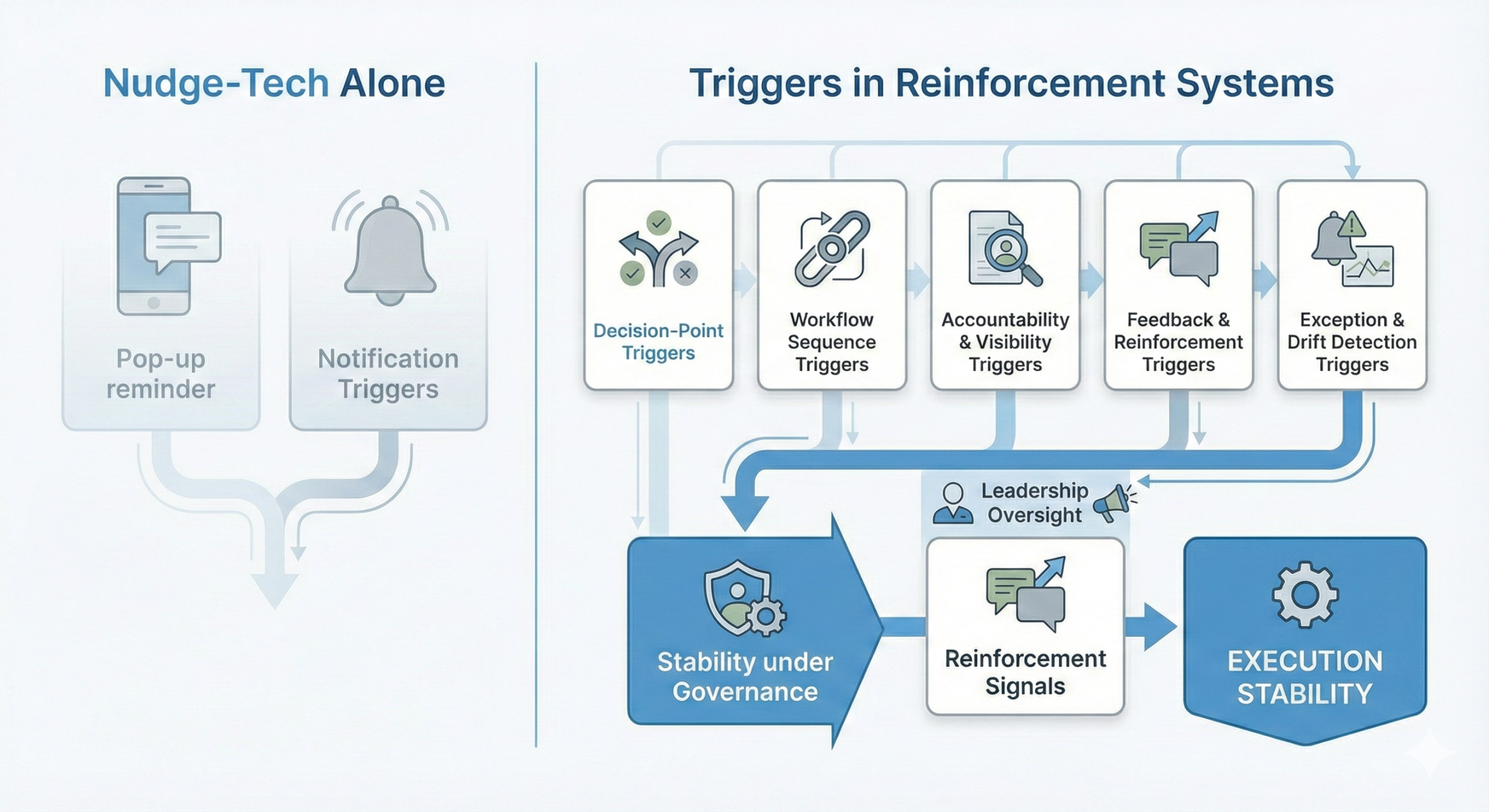
This distinction is critical.
Many organizations buy “nudge tools” believing reminders change behavior.
But nudges alone rarely create stable execution.
Nudges say:
“Don’t forget.”
Reinforcement systems say:
“This is part of how execution works here – and the system depends on it.”
Nudges without reinforcement:
- fade over time
- train people to ignore notifications
- don’t connect behavior to governance
Triggers inside reinforcement systems:
- create accountability
- connect behavior to outcomes
- structure follow-through
- reduce drift sustainably
Habits matter – but habits are execution units, not the conceptual anchor.
The system itself must reinforce them.
Reinforcement vs Training: Where Triggers Actually Fit
Training is essential.
But it answers a different question:
“Do people understand what to do?”
Reinforcement answers:
“Will they reliably do it under real-world pressure?”
Behavioral triggers live squarely inside reinforcement.
They don’t replace training.
They operationalize it.
This is the point where many leaders have the “aha” moment.
The issue was never knowledge.
It was execution stability.
👉 If you’re exploring how reinforcement systems actually stabilize execution workflows, platforms like GWork are designed specifically around Behavior Analytics for Execution – not HR engagement.
Measurement Enables Leadership – It Is Not the Center
Another trap appears when organizations become measurement-led.
Dashboards expand.
Metrics multiply.
Everything is reported.
But measurement without governance becomes noise.
In Behavior Analytics for Execution, measurement exists to serve leadership decisions.
Leaders should be able to use behavior data to answer:
- Where are we drifting?
- What requires reinforcement?
- What rules should change?
- What no longer matters?
Measurement is the flashlight – not the steering wheel.
A Practical Framework for Designing Behavioral Triggers
Let’s translate all of this into something leaders can immediately use.
Step 1: Identify Mission-Critical Moments
Where does drift create real risk?
- customer commitments
- regulatory exposure
- safety
- quality gates
- financial approvals
Start there.
Step 2: Define the Expected Behavior Clearly
What exactly should happen?
Avoid vague language.
Make it observable and concrete.
Step 3: Decide What Gets Reinforced and Why
What signal will tell people:
“This matters for execution – not for compliance.”
Step 4: Capture Execution Signals
Track only what helps leaders decide:
- where to intervene
- when drift begins
- what patterns repeat
Step 5: Adjust Governance Based on Real Behavior
This is the heart of Behavior Analytics for Execution:
Cue → Behavior → Reinforcement → Data → Adjustment
The loop stays alive.
👉 To design reinforcement systems that actually reduce drift, leaders can follow the principles outlined in our Behavior Blueprint.
People Also Ask
How do behavioral triggers improve execution stability?
They reduce dependence on memory, motivation, and willpower – and replace them with structured cues tied to reinforcement. Instead of telling people to “try harder,” triggers reshape the system so the right behavior becomes the easiest default.
Why doesn’t training lead to behavior change?
Training teaches concepts.
Execution requires reinforcement under pressure.
Without reinforcement and triggers at real decision points, knowledge decays and behavior returns to previous patterns.
What’s the difference between nudges and reinforcement?
Nudges remind.
Reinforcement governs.
Nudges work when nothing is at stake.
Reinforcement creates predictable behavior where execution risk is high.
Key Takeaways
- Execution usually fails in the post-decision stage – not during planning.
- Behavior Analytics for Execution focuses on visibility, drift detection, and governance.
- Behavioral triggers are governance tools, not motivational tactics.
- Reinforcement systems stabilize follow-through where training alone fails.
- Leaders use behavior signals to reinforce, intervene, and adjust – not to control employees.
As organizations mature, many discover the same truth:
Execution reliability isn’t a people problem.
It’s a systems problem.
And systems can be redesigned.
Platforms such as GWork are emerging specifically because leaders now recognize behavior as the execution layer – not an HR category.
Final Thought
If leaders want strategies to hold under real conditions, they must treat behavior not as something to “improve,” but as something to govern intentionally.
Behavioral triggers – when designed inside reinforcement systems – help organizations do exactly that.
Not by pushing harder.
But by engineering environments where the right behavior stays stable, even when pressure increases.
Frequently Asked Questions About Behavioral Triggers
What are the 3 types of behavioral triggers?
The three types of behavioral triggers in organizational execution are: antecedent triggers (environmental cues that prompt behavior before it happens, like a pre-meeting checklist), consequence triggers (reinforcement signals after behavior occurs, like recognition or feedback loops), and social triggers (peer and team dynamics that shape individual behavior, like visible commitments in team standups). Each type addresses a different point in the behavior cycle.
How do behavioral triggers differ from motivation?
Motivation is internal and unreliable. It fluctuates with energy, mood, and competing priorities. Behavioral triggers are external and systematic. They create conditions where the right behavior happens regardless of whether someone feels motivated. Organizations that rely on motivation see inconsistent execution. Organizations that design behavioral triggers see stable follow-through even under pressure.
Can behavioral triggers improve strategy execution?
Yes. Behavioral triggers directly address the gap between strategic decisions and daily actions. Most strategies fail not because the plan is wrong, but because daily behavior drifts away from strategic priorities over time. Well-designed triggers keep teams aligned by making strategic behaviors the path of least resistance. Research shows organizations using systematic behavioral triggers see 30-40% less execution drift compared to those relying on training and communication alone.
What is the difference between behavioral triggers and nudges?
Nudges are a subset of behavioral triggers. All nudges are triggers, but not all triggers are nudges. Nudges specifically work by making a desired choice easier or more salient without restricting options. Behavioral triggers is the broader category that includes direct prompts, environmental design, reinforcement systems, and social accountability structures. In execution governance, triggers encompass the full system of cues that sustain follow-through.
How Behavioral Triggers Build Employee Consistency
Behavioral triggers do more than stabilize execution — they build lasting employee consistency. When the right trigger fires at the right moment, it removes the need for willpower, memory, or managerial oversight. Over time, triggered behaviors become automatic habits. Teams that operate on shared triggers develop predictable rhythms: follow-ups happen, handoffs complete, and quality checks run without supervision.
This is why behavioral triggers matter for consistency at scale. Individual motivation fluctuates. Organizational triggers do not. They create the structural reliability that turns strategy into daily action — across departments, time zones, and reporting lines.
FAQs About Behavioral Triggers
What are behavioral triggers?
A behavioral trigger is a system-level cue that activates the right behavior at the moment it matters — and connects that behavior to reinforcement. Unlike simple reminders, triggers are part of an intentional governance loop: Cue → Behavior → Reinforcement → Data → Adjustment. In the workplace, they reduce execution drift by making critical behaviors automatic rather than dependent on memory or motivation.
What are the 3 types of behavioral triggers?
The three types of behavioral triggers are: (1) Cue-based triggers — external signals like notifications, calendar alerts, or dashboard prompts that grab attention at the right moment. (2) Context-based triggers — triggers tied to workflow events, such as a prompt to log action items immediately after a client call, or a reflection prompt at end-of-day. (3) Internal triggers — self-driven cues based on personal values, goals, or internalized habits that sustain behavior even without external prompts.
How do behavioral triggers improve execution stability?
Behavioral triggers reduce execution drift by creating structural reinforcement at critical workflow moments. Instead of relying on managers to catch slippage after the fact, triggers intervene before drift compounds. They stabilize follow-through across teams by making the right behavior the default behavior — regardless of workload pressure, remote work conditions, or management attention.
What is the difference between behavioral triggers and nudges?
Nudges are a subset of behavioral triggers. All nudges are triggers, but not all triggers are nudges. Nudges work by making a desired choice easier or more salient without restricting options. Behavioral triggers encompass the full system: direct prompts, environmental design, reinforcement loops, and social accountability structures that sustain follow-through at organizational scale.
Can behavioral triggers work in remote or hybrid teams?
Yes — behavioral triggers are especially valuable for distributed teams where managers cannot observe behavior directly. Digital triggers (workflow prompts, automated check-ins, context-based nudges) maintain execution rhythms across time zones. Platforms like GWork embed these triggers into tools teams already use, ensuring consistency without adding meetings or surveillance.
Ready to close the strategy-execution gap?