
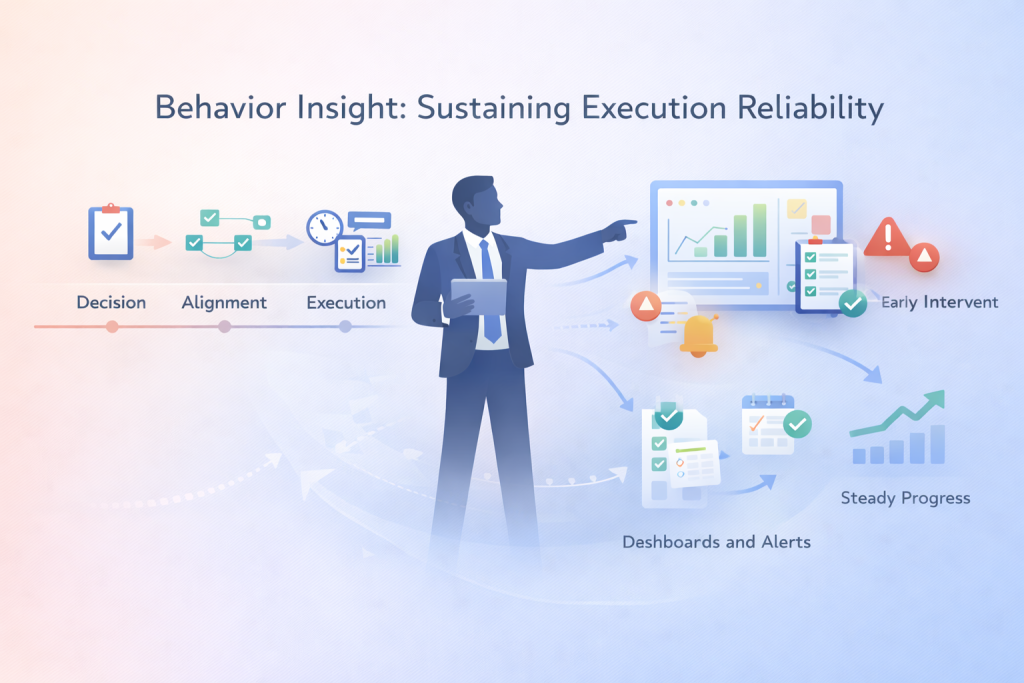

Behavior Insight shows that most strategies don’t fail because they are wrong.
They fail quietly, during ordinary work.
A decision is made. Leaders align. Teams commit. For a short time, execution looks coordinated. Everyone pays attention because the change is new.
Then attention moves on.
The inbox fills. Priorities compete. Managers focus on today’s emergencies. Behaviors that once felt critical start feeling optional.
A step gets skipped.
A check stops happening.
A review is postponed.
Nothing dramatic breaks. Follow-through weakens.
Weeks later, leaders notice missed targets and ask what happened. They search for a strategic flaw or a capability gap. Often, neither exists. Execution didn’t collapse – it drifted quietly.
This is execution drift: gradual, ordinary, and easy to miss. Most initiatives fail not through resistance or incompetence, but through small, repeated omissions that compound over time. By the time results reflect the problem, the damage is already done.
A Real Operational Example
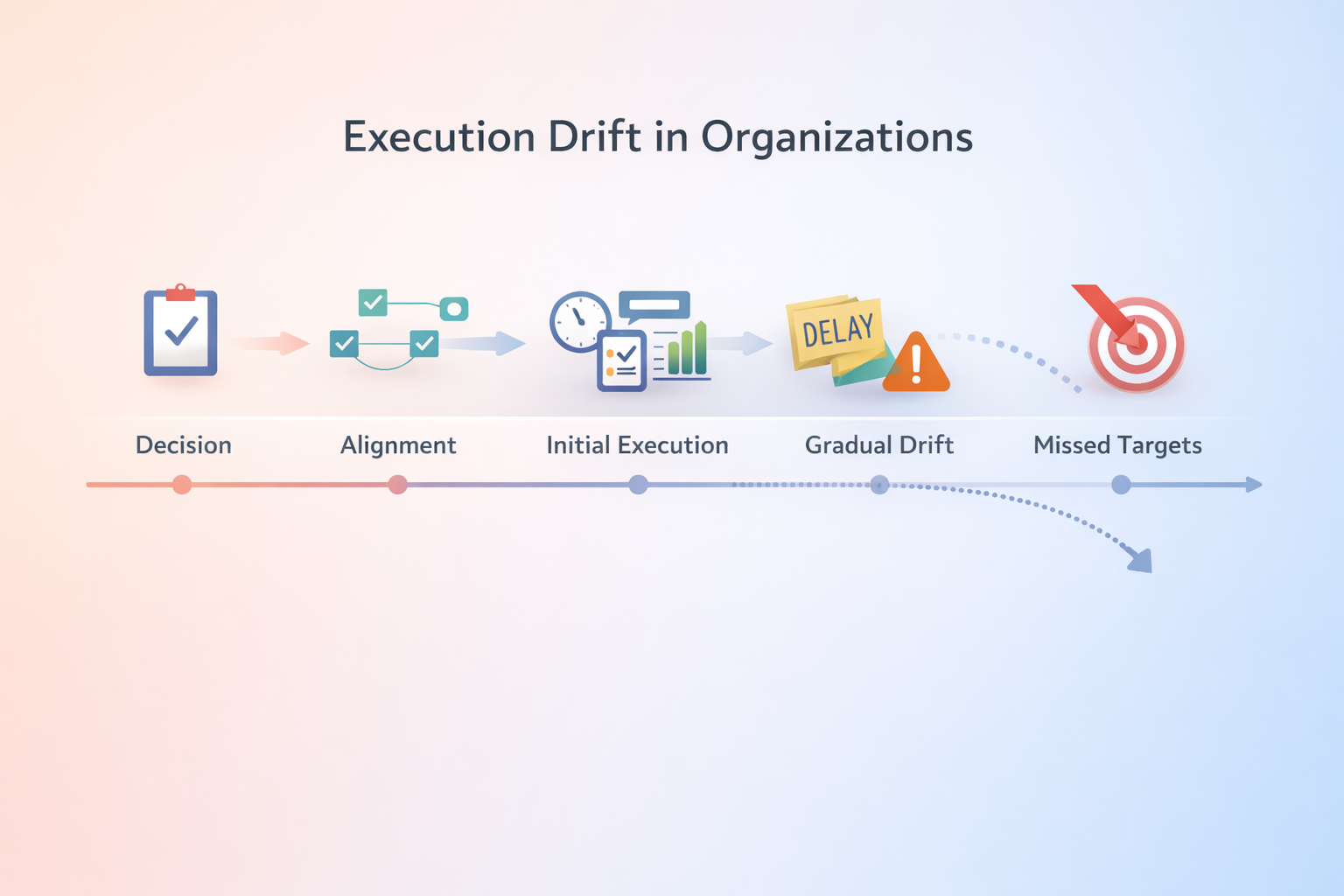
Consider a company introducing a new customer escalation process:
- Every issue must be logged
- Responses must happen within four hours
- A weekly review tracks patterns
The first two weeks look perfect. Compliance is high. Dashboards are green.
Then reality returns. Logs are entered late. Responses stretch from four hours to nine, then eighteen. Reviews get rescheduled.
Nothing triggers immediate alarm. Each delay feels minor, yet customers notice before leaders do. By the time KPIs turn red, the behaviors have already eroded.
Execution drift in its natural form is slow, ordinary, and invisible. It is not dramatic, but it erodes results steadily and silently.
Leaders see the outcome, but they often miss the drift until it is well advanced.
Leadership’s Role: Governance, Not Motivation
When execution weakens, many organizations respond the wrong way:
- Communicating more
- Sending reminders
- Pushing for accountability
- Trying to motivate harder
Pressure rarely stabilizes execution. Structure does.
Leaders cannot directly control results. They control the environment in which work happens. They decide:
- What gets attention
- What gets checked
- What gets reinforced
- What becomes routine
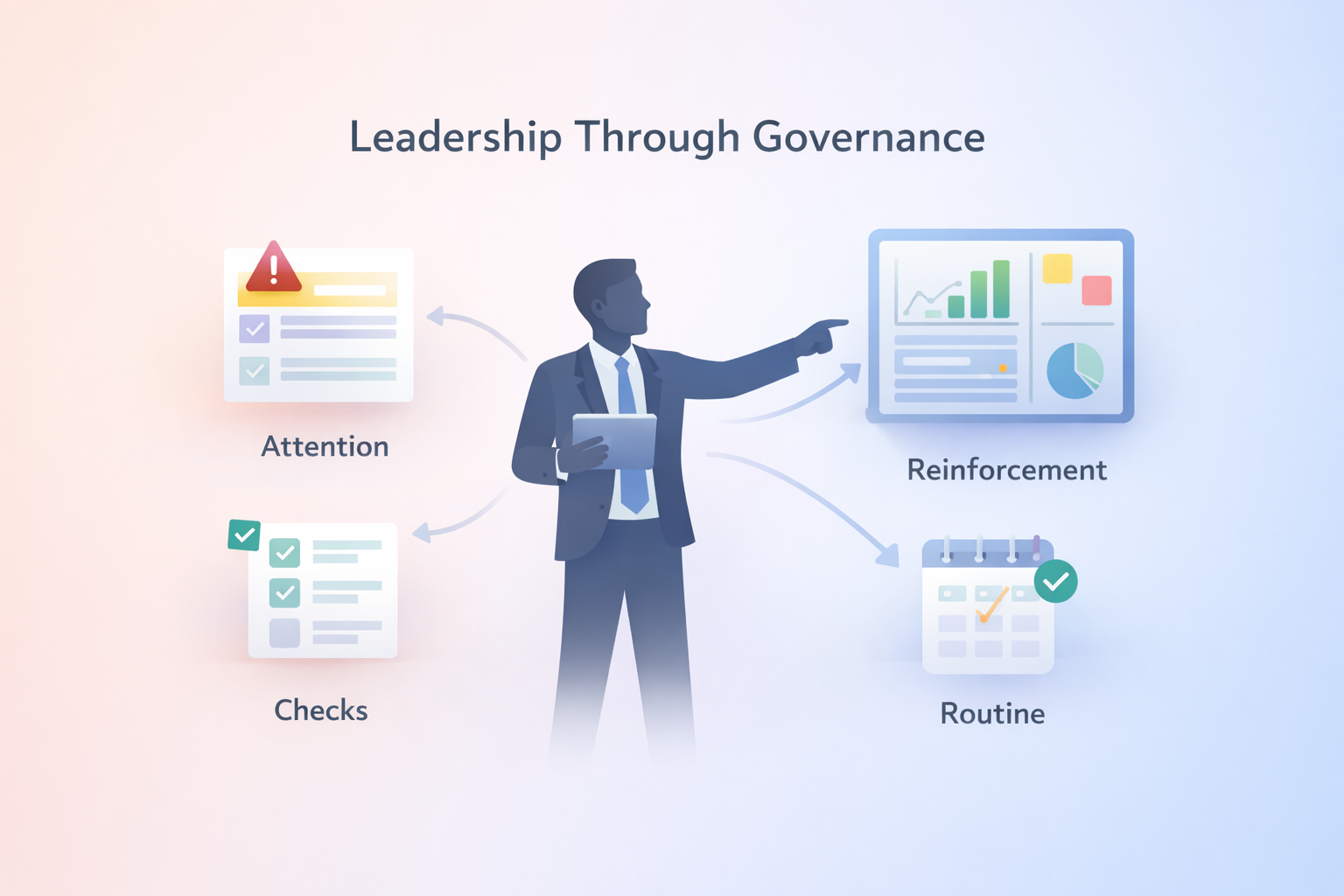
These choices determine whether critical behaviors stick or fade. Execution reliability is not a motivation problem – it is a reinforcement problem.
- If a weekly review stops, performance drifts.
- If handoffs aren’t checked, errors rise.
- If ownership isn’t clear, tasks stall.
No speech fixes it. Only operational discipline does.
Leaders should ask:
“Which few follow-through actions are slipping, and what do we need to restore this week?”
This leads to concrete action: restore the review, clarify ownership, simplify processes. Small structural adjustments, not more pressure, stabilize execution.
By making follow-through explicit, leaders prevent small lapses from becoming large failures. Execution reliability becomes a function of system design, not effort or persuasion.
Visibility: The Missing Layer Between Strategy and Results
Most dashboards focus on outcomes: revenue, cost, output. These metrics are useful, but they come late. By the time a number drops, underlying behaviors have been weakening for weeks.
Leaders need execution visibility. Are agreed actions happening consistently, under real conditions?
Behavior Insight provides that visibility:
- Are safety checks happening daily?
- Are escalation calls on time?
- Are handoffs completed within the agreed window?
- Are weekly reviews still taking place?
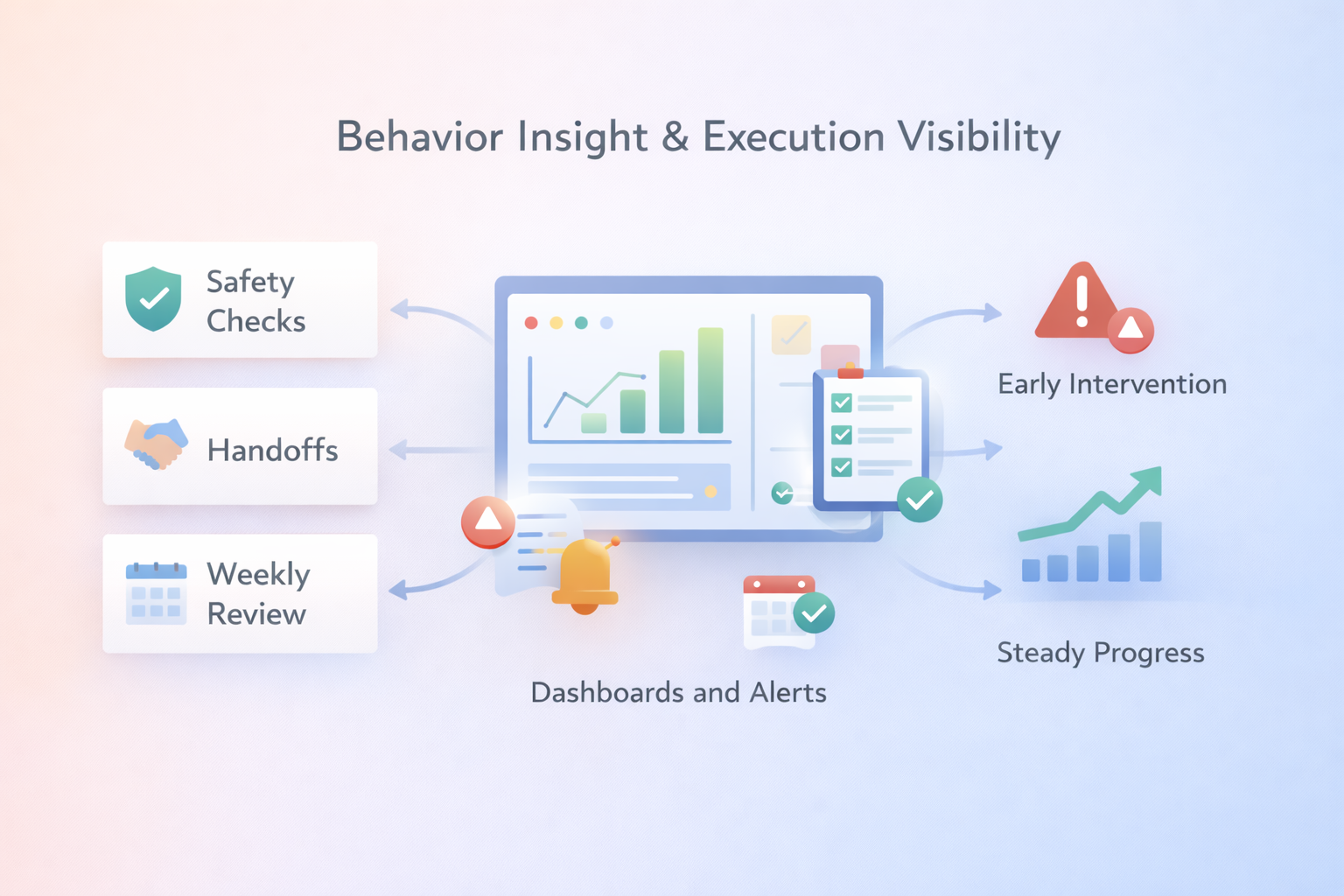
When signals weaken, leaders intervene early. When they are stable, leaders step back. No guessing. No debates. No waiting for KPIs to fail.
This approach reduces surprises, emergency fixes, and post-mortems. Execution improves because the system improves.
Daily operations are monitored and reinforced, making leadership calmer and more focused on strategy rather than firefighting.
Conclusion
Strategy sets direction. Results show outcomes. Between them lies daily execution – where most plans quietly fade.
Behavior Insight makes that middle layer visible. Leaders don’t push harder. They protect the few actions that matter.
Leadership is not announcing strategy. It is ensuring critical behaviors continue.
Strategy rarely fails loudly. It disappears quietly. And leadership is what keeps it aliv
Ready to close the strategy-execution gap?