
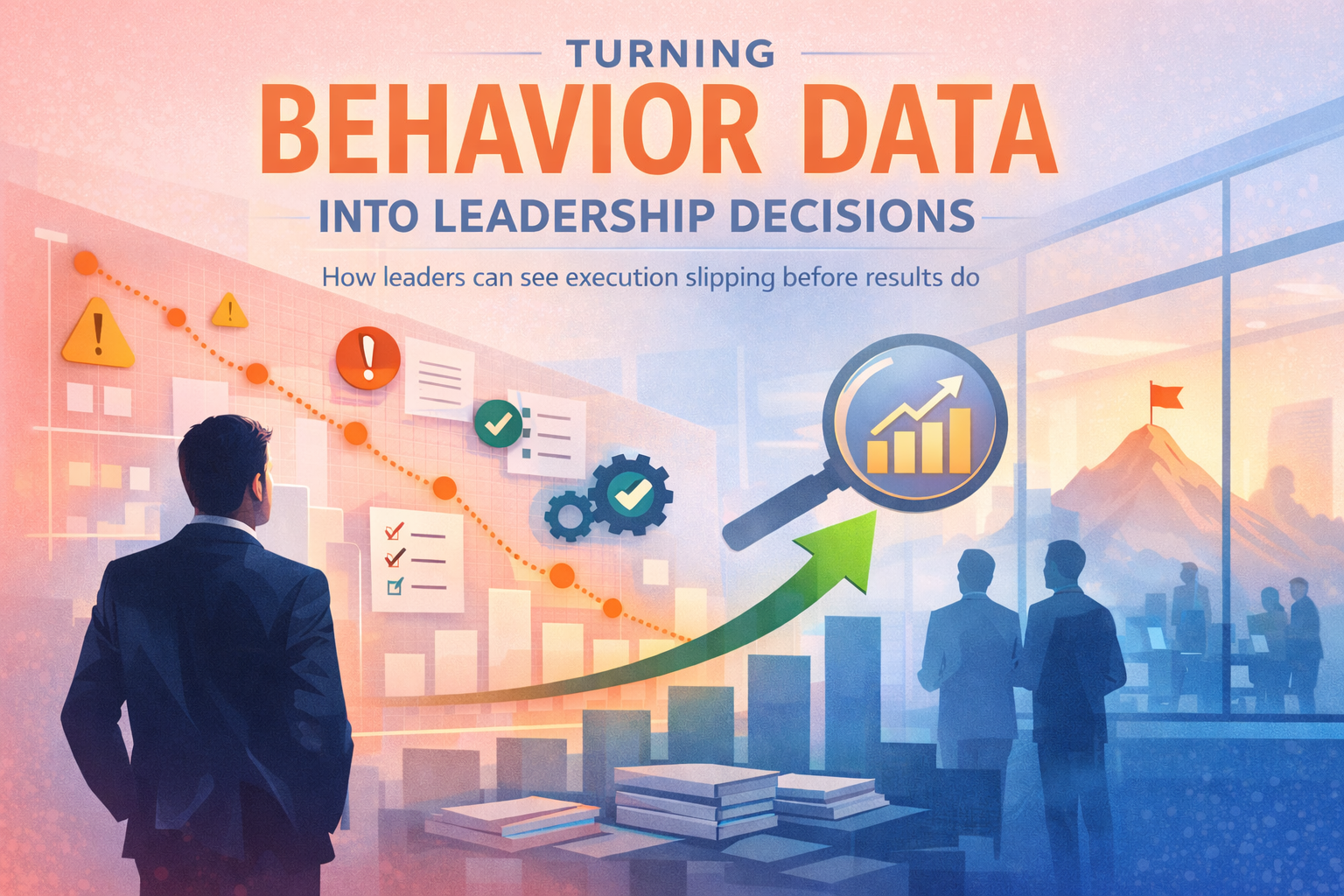

How leaders can see execution slipping before results do
Most strategies don’t fail because they are wrong.
Last updated: April 2026
They fail because execution weakens quietly.
A handoff takes longer than it used to. A standing review gets postponed “just this week.” An escalation arrives a day late. Nothing appears broken – yet follow-through is slowly loosening. By the time revenue, delivery, or customer outcomes move, the damage is already visible.
This is not primarily a motivation, engagement, or talent problem. It is a visibility problem. Leaders rarely see execution deteriorate early enough to act.
That is the role of behavior data: not to analyze people, but to make execution visible so leaders can decide sooner.
Execution Drift Happens Before Results Change
Execution almost never collapses overnight. It drifts.
Small deviations accumulate:
- A checklist step gets skipped
- A review meeting stops happening
- A handoff gets delayed
- Ownership becomes vague
Each change feels minor. Together, they compound.
A simple operational example
Consider a customer onboarding process.
Originally:
- Sales hands off to Operations the same day
- Setup is completed within 24 hours
- The customer is contacted within 48 hours
Three months later:
- Handoffs happen “when possible.”
- Setup stretches to three or four days
- First contact slips to a week
No one decided to lower standards. The system simply loosened.
By the time churn rises, leaders are reacting to outcomes rather than causes. That is execution drift.
Traditional dashboards rarely surface this. Financial metrics show results. Surveys capture opinions. Performance reviews reflect perceptions. None of them reliably answer the core question:
Are agreed actions still happening consistently?
Behavior data answers it by looking at observable signals:
- Are handoffs on time?
- Are reviews occurring as scheduled?
- Are critical steps being skipped?
- Is follow-through consistent?
Not effort. Not attitude. Not activity counts. Just whether the system is holding or loosening.
Leadership’s Job Is to Stabilize Execution
When execution becomes visible, leadership’s role sharpens.
It is not about pushing people harder or sending more reminders. It is about reinforcing the system so follow-through becomes reliable.
Leaders shift from asking, “How do we get people to try harder?” to asking, “Where is follow-through weakening, and what should we strengthen?”
Data only matters if it changes decisions. Every signal should lead to a clear action, such as:
- reinforcing a ritual
- simplifying a workflow
- clarifying ownership
- removing a bottleneck
- increasing cadence
- deprioritizing lower-value work
If leaders cannot say, “This is what we will adjust this week,” the data has little value.
Reinforcement works better than announcements. Kickoffs and emails create awareness; they do not sustain execution. What sustains execution are daily supports such as:
- standing reviews that are never skipped
- checkpoints before work moves forward
- simple prompts at key decision moments
- visible ownership at every step
These are not behavior tricks. They are structural supports that keep the system steady.
Behavior data helps leaders see where these supports are weakening so they can strengthen them in time.
This is not HR analytics or employee monitoring. It is an operational tool for leaders who care about reliable execution.
A Simple Visibility and Reinforcement System
Behavior data is most effective inside a simple loop:
Leaders notice early signals, make clear decisions, reinforce the system, and keep execution steady.
The objective is clear:
- See early
- Decide fast
- Stabilize quickly
A practical weekly leadership review might track just a few measures:
- % of handoffs completed the same day
- % of scheduled reviews held
- time to escalate issues
- critical steps skipped in key workflows
Each metric leads to one question: Do we reinforce this – or leave it alone?
No complex dashboards. No endless analysis. Just clarity and action.
Without signals, leadership conversations sound vague:
- “It feels like alignment is slipping.”
- “This team seems slower.”
- “Maybe morale is the issue.”
With behavior data, conversations become concrete:
- Same-day handoffs dropped from 92% to 70%
- Reviews shifted from weekly to biweekly
- The escalation time doubled
When the facts are clear, politics fade and action accelerates.
How to Detect Execution Drift Before It Becomes a Crisis
Execution drift is the gradual weakening of follow-through after a strategic decision. It does not announce itself. There is no single moment where execution “breaks.” Instead, small slippages compound until KPIs finally reflect what has been happening for weeks.
Here is what execution drift looks like in practice:
- Week 1-2: Decision made, energy high, actions happen fast
- Week 3-4: Competing priorities emerge, some actions delayed “just this once”
- Week 5-8: The delays become normal. Nobody mentions the original commitment anymore
- Week 9-12: KPIs start moving. Leadership asks “what happened?” The answer: drift happened 8 weeks ago
The organizations that catch execution drift early share three habits:
- They track behavior frequency, not just outcomes. If the weekly strategy review gets rescheduled twice in a row, that is a signal. If cross-functional check-ins drop from weekly to “when needed,” drift is already underway.
- They watch for silence. When teams stop raising blockers, it rarely means everything is fine. It usually means they have stopped trying to solve the problem.
- They act on the first sign, not the third. One skipped commitment is a data point. Two is a pattern. Waiting for three is too late.
Behavior data makes execution drift visible in real time. Instead of discovering problems in quarterly reviews, leaders see follow-through weakening as it happens and intervene while corrections are still small.
Where Gwork fits
Gwork surfaces early execution signals inside everyday workflows, giving leaders clear visibility into where follow-through is weakening and where reinforcement is needed-before outcomes deteriorate.
The payoff
When leaders consistently use behavior data, organizations experience:
- fewer surprises
- fewer last-minute escalations
- fewer recovery projects
- more predictable delivery
Not because people work harder, but because the system holds steadier.
The real shift
Behavior has always existed inside organizations. What has changed is visibility.
When leaders can see execution slipping early, they can stabilize it early. If leaders cannot see execution slipping early, they are condemned to manage damage later.
Ready to close the strategy-execution gap?




![6 Best 15Five Alternatives for Teams That Want More Than Check-Ins [2026] - engagement, surveys, behavior, leadership, teams](https://gwork.io/wp-content/uploads/2026/04/15five-alternatives-featured.jpg)
![The Complete Guide to Behavioral Change Platforms [2026] - engagement, surveys, behavior, leadership, teams](https://gwork.io/wp-content/uploads/2026/04/behavioral-change-platforms-guide-featured.jpg)
![GWork vs Humu: Behavioral Change Platforms Compared [2026] - engagement, surveys, behavior, leadership, teams](https://gwork.io/wp-content/uploads/2026/04/gwork-vs-humu-featured-3.jpg)
![GWork vs BetterUp: Behavioral Change Platform vs. Coaching Platform [2026] - engagement, surveys, behavior, leadership, teams](https://gwork.io/wp-content/uploads/2026/04/gwork-vs-betterup-featured.jpg)
![6 Best BetterUp Alternatives for Scalable Employee Development [2026] - engagement, surveys, behavior, leadership, teams](https://gwork.io/wp-content/uploads/2026/04/betterup-alternatives-featured.jpg)
![7 Best Lattice Alternatives for Performance That Actually Changes [2026] - engagement, surveys, behavior, leadership, teams](https://gwork.io/wp-content/uploads/2026/04/lattice-alternatives-featured.jpg)